AMD Ryzen 9 9950X3D2 Dual Edition
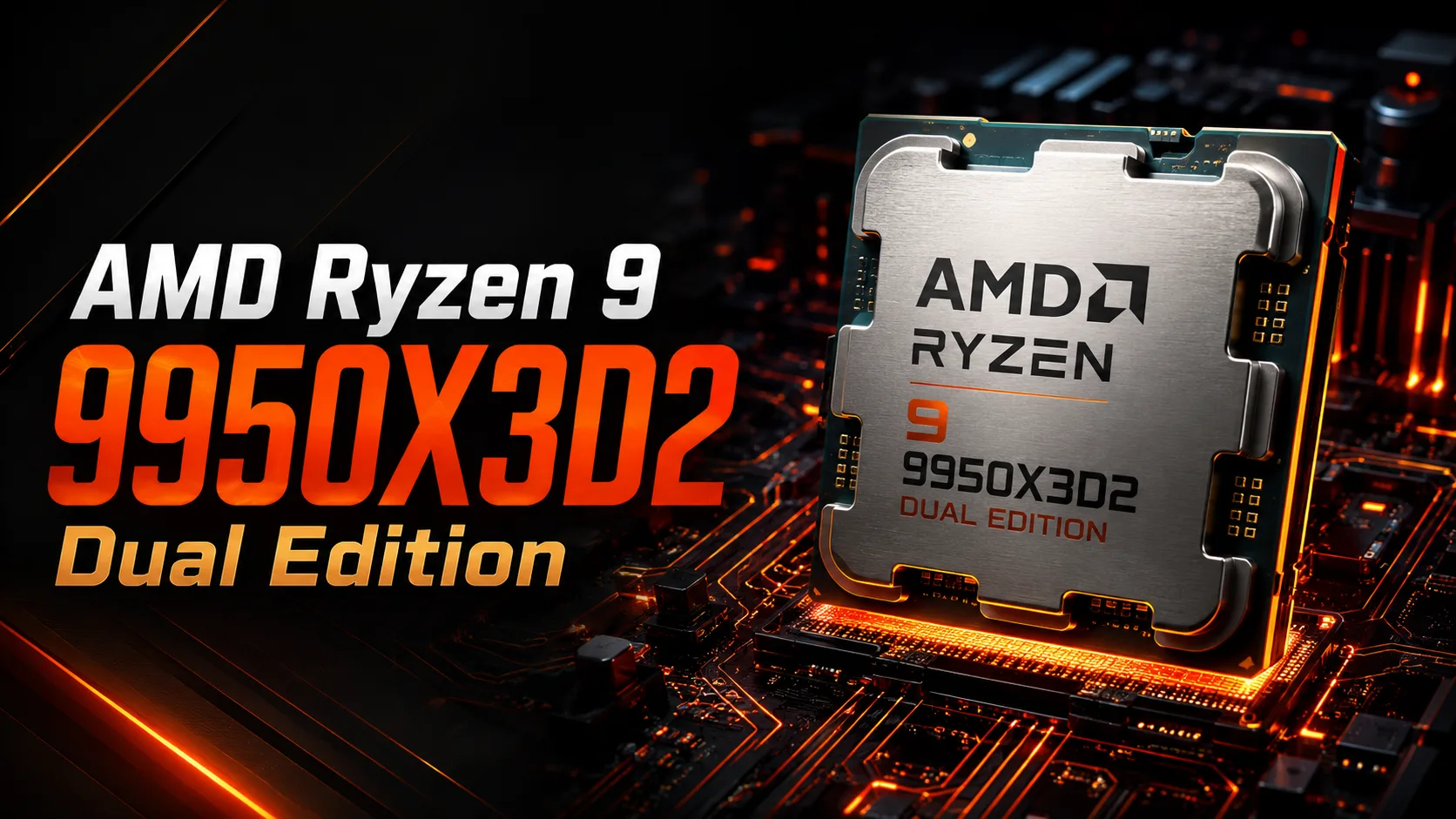
AMD Ryzen 9 9950X3D2 Dual Edition: Flagship AM5 with Dual 3D V-Cache
The AMD Ryzen 9 9950X3D2 Dual Edition is an unusual flagship processor for desktop PCs on the AM5 platform. Its main idea is simple: to combine 16 Zen 5 cores, high frequencies, and a very large cache size to create a powerful CPU not only for gaming but also for heavy workloads.
The processor features 16 cores and 32 threads, a base clock of 4.3 GHz, and a boost up to 5.6 GHz. However, the key feature of this model is the dual 3D V-Cache. Unlike many X3D processors where the additional stacked cache is placed only on one chiplet, the Ryzen 9 9950X3D2 utilizes the expanded 3D V-Cache on both CPU chiplets. As a result, the processor boasts 192 MB of L3 cache and 208 MB of total cache.
What Makes Ryzen 9 9950X3D2 Special
| Feature | Why It Matters |
|---|---|
| Dual 3D V-Cache | Expanded 3D V-Cache is placed on both CPU chiplets, making the processor more balanced |
| 192 MB L3 Cache | The processor accesses slower RAM less frequently in suitable scenarios |
| 16 Cores and 32 Threads | A good reserve for gaming, rendering, compiling, streaming, and multitasking |
| Zen 5 Architecture | Modern AMD architecture with high performance per core |
| AM5 Platform | Compatibility with current AMD motherboards after BIOS support |
| 200 W TDP | Requires quality cooling and a well-ventilated case |
| Integrated Radeon Graphics | Useful for display output and diagnostics but not a replacement for a gaming graphics card |
Why Dual 3D V-Cache Is Important
A large cache is not just a pretty number in specifications. It can directly influence performance in tasks where the processor frequently deals with repetitive data sets. The more useful information placed closer to the cores, the less the CPU has to access the RAM. This reduces latency and can improve system responsiveness.
In gaming, this is particularly noticeable in projects where the CPU actively participates in world simulation, physics calculations, NPC behavior, asset loading, and frame preparation for a powerful graphics card. The Ryzen 9 9950X3D2 is interesting not just for average FPS but also for potentially smoother frame delivery in heavy scenes.
For work tasks, a large cache can also be beneficial. Compiling large projects, engineering calculations, simulations, data processing, and some professional applications can benefit from a combination of 16 cores and a very large L3 cache. Thus, the Ryzen 9 9950X3D2 appears not just as a gaming processor but as a universal flagship for a powerful home or work PC.
How It Differs from Ryzen 9 9950X3D
The main difference between the Ryzen 9 9950X3D2 Dual Edition and the standard Ryzen 9 9950X3D is the dual 3D V-Cache. In the standard X3D model, the increased cache is not utilized equally across the entire 16-core configuration, while in the Dual Edition version, the additional 3D V-Cache is placed on both CPU chiplets.
In practice, this makes the Ryzen 9 9950X3D2 more appealing for mixed workloads. It retains a strong gaming focus but appears more balanced for tasks that actively utilize all 16 cores: compiling, heavy multitasking, data processing, streaming, and professional applications.
This does not mean that the difference will be equally noticeable in every program or game. In some scenarios, a huge cache may provide a significant advantage, while in others, frequencies, the graphics card, memory, or optimization of a particular application may be more important. However, the very idea of the Dual Edition makes the Ryzen 9 9950X3D2 a more unusual and technically interesting processor than standard X3D models.
A Flagship for Gaming and Work
The Ryzen 9 9950X3D2 Dual Edition is aimed at users who do not want to choose between a gaming processor and a powerful CPU for work. With 16 cores and 32 threads, it is suitable for video editing, 3D rendering, code compilation, streaming, heavy multitasking, and other resource-intensive tasks.
At the same time, the enormous L3 cache makes it particularly interesting for gaming systems. Such a processor logically fits into a PC with a powerful discrete graphics card, fast DDR5 memory, and a quality motherboard. It is well-suited for builds where high FPS, stability of frames, and performance reserves for several years are important.
However, the Ryzen 9 9950X3D2 should not be perceived as a universal choice for everyone. If the computer is only needed for gaming, the more affordable Ryzen 7 X3D may prove more beneficial. If the system is primarily used for rendering or encoding, where pure multi-threaded performance is more critical, the advantage of a large cache will depend on the specific program.
Where Ryzen 9 9950X3D2 Excels the Most
| Scenario | Is Ryzen 9 9950X3D2 Suitable? | Comments |
|---|---|---|
| Games with a powerful GPU | Yes | Large L3 cache can help in CPU-dependent games and heavy scenes |
| Gaming + Streaming | Yes | 16 cores and 32 threads provide good reserve for simultaneous gaming and streaming |
| Video Editing | Yes | High multi-threaded performance is useful in heavy projects |
| 3D Rendering | Yes, but depends on the program | CPU is powerful, but some tasks depend more on GPU or core count |
| Software Development | Yes | Compilation and multitasking work well with large cache and 16 cores |
| Home Workstation | Yes | A good option for a single PC for both gaming and heavy work tasks |
| Budget Gaming PC | No | The processor is too expensive and demanding for such a build |
| Compact Quiet PC | Not the best choice | 200 W TDP requires serious cooling |
| Office Computer | No | For simple tasks, such a CPU is clearly excessive |
Power Consumption, Cooling, and Platform
One of the important features of the Ryzen 9 9950X3D2 is its high thermal design power (TDP). This model has a TDP of 200 W, so it cannot be considered an economical gaming processor. To keep the CPU consistently performing well under prolonged loads, it needs serious cooling.
For such a model, it is advisable to use a quality liquid cooling system. A powerful air cooler is also possible but only in a well-ventilated case and without expecting maximum silence under prolonged loads. Adequate fresh air intake, proper fan configurations, and solid power delivery on the motherboard are also crucial.
The AM5 platform remains a significant advantage. The Ryzen 9 9950X3D2 is compatible with supported AM5 motherboards, although a BIOS update may be required for operation. The processor supports DDR5, PCIe 5.0, Precision Boost Overdrive, AMD EXPO for memory, and manual tuning via Ryzen Master.
For such a model, it is better to choose a higher-quality AM5 board with a strong power subsystem. It makes sense to look towards X870E, X870, X670E, B850, or B650E if the specific board has the needed BIOS support and sufficiently robust power delivery.
Integrated AMD Radeon Graphics is present as well, but its role is supplemental. It is useful for display output, diagnostics, or temporary operation without a discrete graphics card. For gaming and heavy graphics, this processor still anticipates the use of a dedicated graphics card.
Who Should Choose the Ryzen 9 9950X3D2 Dual Edition
The Ryzen 9 9950X3D2 Dual Edition is best suited for those building an expensive and powerful PC without a clear focus solely on one task. It is a great option for users who game, work with code, edit videos, run heavy applications, and want a single universal processor with significant headroom.
This CPU is particularly appealing to those who previously considered X3D models for gaming but did not want to sacrifice the capabilities of a 16-core flagship. The dual 3D V-Cache makes the Ryzen 9 9950X3D2 more balanced: the increased stacked cache is not only on one chiplet but on both CPU chiplets.
It is not advisable to choose this model for a simple home computer, office system, or budget gaming build. There, its capabilities would be excessive, and the demands for cooling, power, and the motherboard would only increase the overall platform cost.
Conclusion
The AMD Ryzen 9 9950X3D2 Dual Edition is one of the most unusual and powerful desktop processors for the AM5 platform. Its main focus is not just on the number of cores or frequencies but on the dual 3D V-Cache, which provides 192 MB of L3 cache and 208 MB of total cache.
This processor excels in high-end systems where both gaming and work performance are important. It is suitable for powerful graphics cards, high FPS, streaming, editing, compiling, and heavy multitasking. However, it requires quality cooling, a good motherboard, and careful assembly.
The Ryzen 9 9950X3D2 Dual Edition is not the most rational choice for every user. However, for enthusiasts seeking the maximum capabilities on AM5 and interested in the combination of 16 Zen 5 cores and a massive cache, it is one of the most intriguing flagship processors in the Ryzen 9000 lineup.
CPU Comparison
Compare Ryzen 9 9950X3D2 Dual Edition with other CPUs
Basic
CPU Specifications
Memory Specifications
GPU Specifications
Miscellaneous
Benchmarks
Compared to Other CPU
Related CPU Comparisons




Share in social media
Or Link To Us
<a href="https://cputronic.com/index.php/cpu/amd-ryzen-9-9950x3d2-dual-edition" target="_blank">AMD Ryzen 9 9950X3D2 Dual Edition</a>