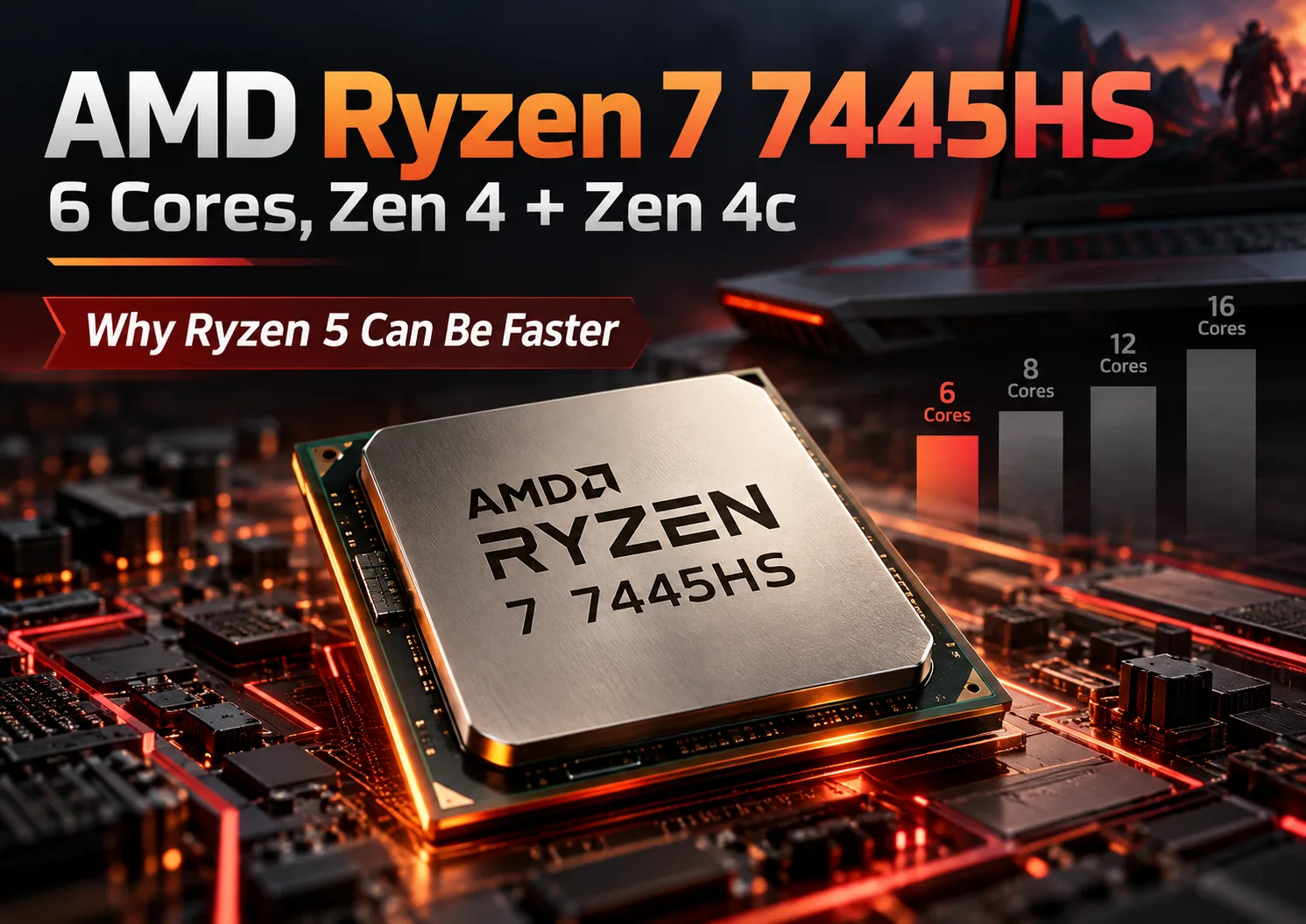
AMD Ryzen 7 7445HS

AMD Ryzen 7 7445HS

AMD Ryzen 7 7445HS: Hybrid Architecture for Balanced Mobile Systems

In the world of mobile processors, the battle for efficiency and performance is ongoing. The AMD Ryzen 7 7445HS represents a balanced solution, combining the hybrid Zen 4 architecture with a modern fabrication process. This chip is aimed at high-performance laptops, where balance between speed and battery life is crucial. Let’s take a detailed look at its features based on technical specifications.

Architecture and Fabrication Process: A Hybrid Approach

The core of the processor consists of a hybrid architecture that brings together two types of compute cores:

  • 2 Zen 4 cores: These are high-performance cores with an increased cache size per core. They are designed for tasks requiring maximum responsiveness: application launches, single-threaded operations.
  • 4 Zen 4c cores: These are compact, efficiency-optimized cores. Built on the same Zen 4 architecture, they have a smaller die size and are intended for background and multi-threaded tasks, which minimizes power consumption.

The result is a configuration of 6 physical cores and 12 threads thanks to Simultaneous Multithreading (SMT) technology. The base clock frequency is 3.55 GHz, and in automatic boost mode (Max Turbo Frequency), the processor can reach 4.7 GHz.

The chip is manufactured using the TSMC 4nm FinFET process, one of the most advanced solutions available on the market. This directly impacts energy efficiency and thermal output.

The integrated graphics AMD Radeon 740M is based on the RDNA 3 architecture. It includes 4 compute units (CUs) with a frequency of up to 2700 MHz. This solution provides performance for handling 4K interfaces, hardware acceleration for multimedia tasks, and comfortable gaming in less demanding projects.

Cache sizes include:

  • L2 cache: 6 MB
  • L3 cache: 16 MB

The memory subsystem supports modern standards: dual-channel DDR5-5600 for socketed modules (FP7r2) and energy-efficient LPDDR5x-7500 for soldered memory (FP7/FP8). The maximum supported RAM capacity is up to 256 GB. The processor provides 20 PCIe 4.0 lanes for connecting storage devices and discrete graphics. ECC memory support is absent.

Power Consumption and Thermal Design Power (TDP)

The Ryzen 7 7445HS falls into the HS category, indicating a balance between performance and thermal output. Its nominal TDP is 35 W. In practice, this means that the laptop's cooling system must be designed to maintain such thermal load over extended periods.

Laptop manufacturers can configure cTDP (configurable TDP) within a certain range, adapting the processor for different types of devices—from compact models to those with enhanced cooling. The maximum operating temperature is 100°C, which is a standard value for modern chips.

Performance in Real-World Tasks

Performance evaluation is based on synthetic tests and typical use scenarios.

Synthetic Benchmarks:

  • Geekbench 6: Single-core score - 2078, multi-core - 7052.
  • PassMark CPU Mark: Single-core score - 3566, multi-core - 19095.

These figures indicate that:

  • Single-threaded performance is high, providing a responsive system and smooth interface.
  • Multi-threaded performance allows for comfortable operation with multiple demanding applications simultaneously, rendering video, or processing data.

Real-World Scenarios:

  • Office Work and Everyday Tasks: For browsing, office suites, video calls, and content consumption, the processor's power is more than sufficient. The hybrid architecture effectively distributes the load, conserving battery charge for background operations.
  • Multimedia and Creative Work: The processor handles photo editing and video editing at 1080p/4K in software that uses hardware acceleration. For serious 3D rendering or high-resolution effects work, a laptop with a high-end discrete GPU is recommended.
  • Gaming: The integrated Radeon 740M graphics solution is suitable for casual gaming. It can manage esports titles at medium settings in Full HD resolution, as well as older or indie games. The processor's key role in gaming laptops is its synergy with a discrete graphics card (for example, GeForce RTX 4050/4060). Its performance is sufficient not to create bottlenecks in most modern games.
  • Max Turbo Frequency: Boosting to 4.7 GHz is activated when thermal headroom is available and under high load on one or more cores. During prolonged multi-threaded workloads, the frequency may fluctuate depending on the cooling efficiency of the specific laptop.

Use Cases: Who Needs the Ryzen 7 7445HS?

This processor is a versatile solution for a wide range of users:

  1. Students and Professionals: Ideal for those who need one laptop for study and work (documents, presentations, programming) and leisure (movies, music, casual gaming).
  2. Mobile Gamers: A good choice for entry to mid-level gaming laptops paired with a discrete graphics card.
  3. Content Creators (beginner to intermediate): Suitable for video editing, blogging, and photo processing. For professional work on heavy projects, chips with more high-performance cores should be considered.
  4. Users valuing battery life and portability: Thanks to the hybrid architecture and 4 nm process, such laptops can offer good battery life when performing light tasks.

Battery Life and Energy Efficiency

The hybrid Zen 4/Zen 4c architecture is a key tool for energy saving. Background tasks can be performed on the energy-efficient Zen 4c cores, while the high-performance Zen 4 cores are either powered down or running at lower frequencies.

Battery life is influenced by many factors: battery capacity, screen brightness, and wireless module activity. However, the processor itself provides capabilities for optimizing power consumption.

Comparison with Competitors and Predecessors

  • Within the AMD Lineup: The Ryzen 7 7445HS occupies a niche between the U series (focus on battery life) and the HX series (focus on maximum performance). It offers greater multi-threaded performance than previous generation chips on Zen 3+, primarily due to IPC improvements in the Zen 4 architecture and higher frequencies.
  • Against Intel Core: A direct competitor includes the Intel Core i5/i7 13th and 14th generation H series processors. The Ryzen 7 7445HS generally demonstrates comparable or better multi-threaded performance at similar TDP. AMD's integrated graphics often has an advantage over Intel's solutions.
  • Against Apple Silicon: Comparing with Apple M2 or M3 chips isn't appropriate due to differing architectures (ARM vs x86) and ecosystems. The Ryzen 7 7445HS offers full compatibility with classic software and the gaming library for Windows.

Pros and Cons

Strengths:

  • Modern hybrid architecture Zen 4/Zen 4c: Optimal balance of performance and energy consumption.
  • Advanced 4 nm fabrication process: High efficiency and reduced heat output.
  • Powerful integrated graphics Radeon 740M.
  • Support for high-speed LPDDR5x-7500 memory.
  • Good performance headroom in both single-threaded and multi-threaded tasks.

Possible Drawbacks:

  • Only 2 high-performance Zen 4 cores: May lag behind processors with a larger number of full-fledged Zen 4 cores in purely multi-threaded scenarios.
  • Lack of PCIe 5.0 support.
  • No ECC memory support: Excludes use in mobile workstations for critical computations.

Laptop Selection Recommendations

The Ryzen 7 7445HS can be found in various types of devices:

  1. Thin and Light Laptops: Often featuring soldered LPDDR5x memory, compact chassis, and a focus on battery life.
  2. Entry to Mid-Level Gaming Laptops: Pairing with a discrete graphics card. Here, the cooling system quality is crucial.
  3. Universal Multimedia and Work Laptops: Devices with 15-16 inch displays, often with additional storage compartments and socketed DDR5 RAM.

What to Consider When Buying:

  • Cooling: Check reviews for specific models. Good cooling will unlock the CPU’s potential.
  • RAM: Minimum - 16 GB of dual-channel memory. For gaming and creative tasks, 32 GB is preferable.
  • Discrete Graphics Card: Determines gaming and creative capabilities.
  • Display: For color work, color space coverage is important. For gaming - a high refresh rate.
  • Battery: A capacity of 70-80 Wh will aid in prolonged battery life.

Conclusion

The AMD Ryzen 7 7445HS is a modern, balanced mobile processor that is perfect for users seeking a "golden mean." It offers high single-threaded performance, sufficient multi-threaded power for most tasks, and impressive energy efficiency thanks to its hybrid architecture and 4 nm fabrication process.

Key Benefits: Compatibility with the entire Windows ecosystem, excellent performance per watt, strong integrated graphics, and readiness to work with fast memory.

This processor is ideal for those who do not wish to compromise on speed or battery life and consider a laptop as a versatile tool for work, study, and entertainment. When choosing a specific laptop model, focus should be placed on build quality, cooling system, and component configuration.

Basic

Label Name
AMD
Platform
Laptop
Launch Date
May 2023
Model Name
?
The Intel processor number is just one of several factors - along with processor brand, system configurations, and system-level benchmarks - to be considered when choosing the right processor for your computing needs.
Ryzen 7 7445HS
Code Name
Phoenix
Generation
2x Zen 4, 4x Zen 4c

CPU Specifications

Total Cores
?
Cores is a hardware term that describes the number of independent central processing units in a single computing component (die or chip).
6
Total Threads
?
Where applicable, Intel® Hyper-Threading Technology is only available on Performance-cores.
12
Basic Frequency
3.55 GHz
Max Turbo Frequency
?
Max Turbo Frequency is the maximum single-core frequency at which the processor is capable of operating using Intel® Turbo Boost Technology and, if present, Intel® Turbo Boost Max Technology 3.0 and Intel® Thermal Velocity Boost. Frequency is typically measured in gigahertz (GHz), or billion cycles per second.
4.7 GHz
L2 Cache
6 MB
L3 Cache
16 MB
CPU Socket
?
The socket is the component that provides the mechanical and electrical connections between the processor and motherboard.
FP7, FP7r2
Technology
?
Lithography refers to the semiconductor technology used to manufacture an integrated circuit, and is reported in nanometer (nm), indicative of the size of features built on the semiconductor.
TSMC 4nm FinFET
TDP
35
Max. Operating Temperature
?
Junction Temperature is the maximum temperature allowed at the processor die.
100
PCI Express Version
?
PCI Express Revision is the supported version of the PCI Express standard. Peripheral Component Interconnect Express (or PCIe) is a high-speed serial computer expansion bus standard for attaching hardware devices to a computer. The different PCI Express versions support different data rates.
PCIe® 4.0
Instruction Set
?
The instruction set is a hard program stored inside the CPU that guides and optimizes CPU operations. With these instruction sets, the CPU can run more efficiently. There are many manufacturers that design CPUs, which results in different instruction sets, such as the 8086 instruction set for the Intel camp and the RISC instruction set for the ARM camp. x86, ARM v8, and MIPS are all codes for instruction sets. Instruction sets can be extended; for example, x86 added 64-bit support to create x86-64. Manufacturers developing CPUs that are compatible with a certain instruction set need authorization from the instruction set patent holder. A typical example is Intel authorizing AMD, enabling the latter to develop CPUs compatible with the x86 instruction set.
x86-64

Memory Specifications

Memory Type
?
Intel® processors come in four different types: Single Channel, Dual Channel, Triple Channel, and Flex Mode. Maximum supported memory speed may be lower when populating multiple DIMMs per channel on products that support multiple memory channels.
DDR5 (FP7r2), LPDDR5X (FP7-FP8)
Max Memory Size
?
Max memory size refers to the maximum memory capacity supported by the processor.
256
Memory Channels
?
The number of memory channels refers to the bandwidth operation for real world application.
2
Maximum Memory Speed
4x2R DDR5-5600, LPDDR5x-7500
ECC Memory Support
No

GPU Specifications

Integrated Graphics Model
?
An integrated GPU refers to the graphics core that is integrated into the CPU processor. Leveraging the processor's powerful computational capabilities and intelligent power efficiency management, it delivers outstanding graphics performance and a smooth application experience at a lower power consumption.
AMD Radeon™ 740M
Graphics Frequency
?
Graphics max dynamic frequency refers to the maximum opportunistic graphics render clock frequency (in MHz) that can be supported using Intel® HD Graphics with Dynamic Frequency feature.
2700
Graphics Core Count
4

Miscellaneous

Official Website
OS Support
RHEL x86 64-BitUbuntu x86 64-BitWindows 11 - 64-Bit EditionWindows 10 - 64-Bit Edition

Benchmarks

Geekbench 6
Single Core Score
2078
Geekbench 6
Multi Core Score
7052
Passmark CPU
Single Core Score
3566
Passmark CPU
Multi Core Score
19095

Compared to Other CPU

Geekbench 6 Single Core
2220 +6.8%
2162 +4%
2012 -3.2%
1925 -7.4%
Geekbench 6 Multi Core
7882 +11.8%
7476 +6%
6669 -5.4%
6324 -10.3%
Passmark CPU Single Core
3726 +4.5%
3658 +2.6%
3501 -1.8%
3441 -3.5%
Passmark CPU Multi Core
20471 +7.2%
19613 +2.7%
18478 -3.2%
17880 -6.4%