AMD Ryzen 5 5625U

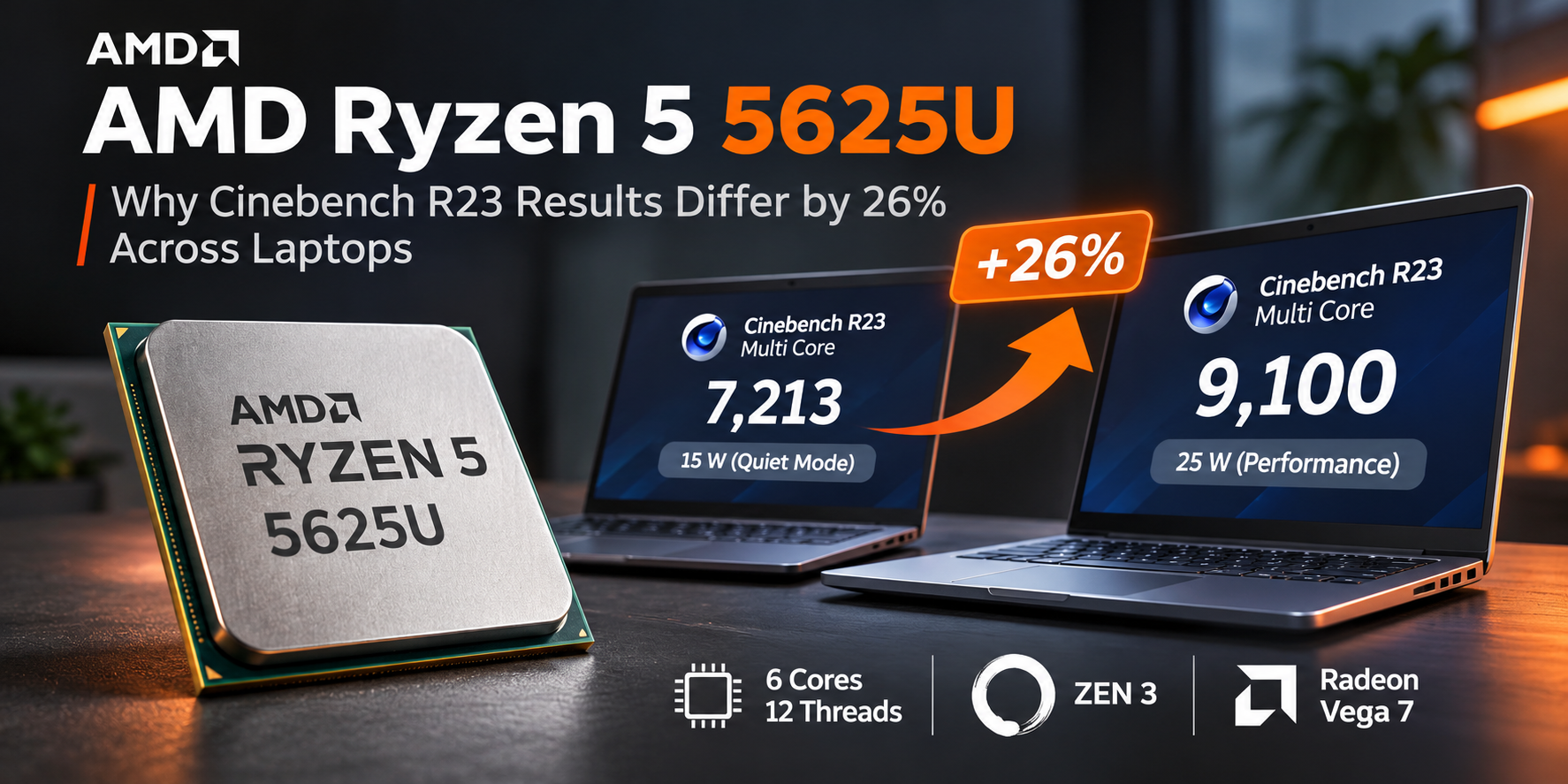
AMD Ryzen 5 5625U: Why Cinebench R23 Laptop Results Differ by 26%
The AMD Ryzen 5 5625U is a six-core mobile processor from 2022 that is still suitable for office work, programming, and multitasking. However, its performance depends noticeably on the specific laptop. In Cinebench R23 Multi Core, results range from 7,213 to 9,100 points-a difference of up to 26%. Power limits, cooling, and the selected operating mode all affect the result.
Zen 3 Instead of Zen 2: What Changed
The Ryzen 5 5625U belongs to the Barcelo family and is manufactured using TSMC’s 7 nm process. It features 6 Zen 3 cores, 12 threads, a base clock of 2.3 GHz, and boost speeds of up to 4.3 GHz. Its L3 cache totals 16 MB, while its nominal TDP is 15 W.
The Ryzen 5 5625U uses Zen 3 instead of the Ryzen 5 5500U’s Zen 2, has twice as much L3 cache, and operates at higher frequencies. At the same time, its integrated Radeon Vega 7 has barely changed.
| Specification | Ryzen 5 5500U | Ryzen 5 5625U | Ryzen 5 7530U |
|---|---|---|---|
| Architecture | Zen 2 | Zen 3 | Zen 3 |
| Base clock | 2.1 GHz | 2.3 GHz | 2.0 GHz |
| Maximum clock | 4.0 GHz | 4.3 GHz | 4.5 GHz |
| L3 cache | 8 MB | 16 MB | 16 MB |
| GPU clock | 1800 MHz | 1800 MHz | 2000 MHz |
The Ryzen 5 7530U belongs to the Ryzen 7000 series but uses the same Zen 3 architecture. Its advantages over the 5625U are mainly its higher maximum CPU and GPU frequencies. Both processors support DDR4-3200, LPDDR4X-4267, and PCIe 3.0.
Cinebench R23: How Important Is the Laptop Model?
The Ryzen 5 5625U results from specific laptops show how strongly sustained multi-threaded performance depends on power settings and cooling.
| Laptop | Single Core | Multi Core |
|---|---|---|
| Dell Inspiron 14 5425, quiet mode | 1,379 | 7,213 |
| Lenovo ThinkBook 14 G4, 16 GB | 1,345 | 7,677 |
| Dell Inspiron 14 5425, 16 GB | 1,391 | 8,290 |
| Lenovo IdeaPad 3 15ABA7, 16 GB | 1,399 | 8,561 |
| Lenovo ThinkBook 15 G4, 16 GB | 1,372 | 9,100 |
The ThinkBook 15 G4 scores 26% higher in the multi-threaded test than the Dell Inspiron 14 5425 in quiet mode. However, this compares different laptops and power modes; it does not indicate a constant difference in speed.
The ThinkBook 14 G4 has a sustained power limit of about 15 W, while the ThinkBook 15 G4 is set to 25 W. A higher limit allows the processor to maintain elevated clock speeds for longer under sustained load.
Single-threaded results are much closer, ranging from 1,345 to 1,399 points. As a result, the difference between configurations is smaller during everyday browser and document use than when compiling a large project or rendering.
Comparison with the Ryzen 5 5500U and 7530U
The move from Zen 2 to Zen 3 improves single-threaded performance. However, results from finished laptops show that the newer processor’s advantage does not always persist in multi-threaded workloads.
Cinebench R23-Different Processors in Specific Laptops
| Processor and device | Single Core | Multi Core |
|---|---|---|
| Ryzen 5 5500U - Lenovo IdeaPad 5 15ALC05 | 1,149 | 7,221 |
| Ryzen 5 5625U - Lenovo ThinkBook 14 G4 | 1,345 | 7,677 |
| Ryzen 5 5625U - Lenovo ThinkBook 15 G4 | 1,372 | 9,100 |
| Ryzen 5 7530U - Dell Inspiron 16 7635 2-in-1 | 1,439 | 8,361 |
| Ryzen 5 7530U - Lenovo ThinkBook 16 G6 | 1,463 | 9,347 |
In the single-threaded test, the ThinkBook 14 G4 with the Ryzen 5 5625U outperforms the IdeaPad 5 with the Ryzen 5 5500U by about 17%. This demonstrates Zen 3’s advantage, although some of the difference may depend on the laptop configurations.
In the multi-threaded test, the Ryzen 5 7530U’s advantage depends on the specific device. The ThinkBook 15 G4 with the Ryzen 5 5625U scores 9,100 points, surpassing the Dell Inspiron 16 with the Ryzen 5 7530U, which scores 8,361 points. At the same time, the ThinkBook 16 G6 with the same 7530U reaches 9,347 points.
These results cannot be used to isolate the processors’ performance at identical power consumption levels: the laptops have different power limits and cooling systems.
The Ryzen 5 7530U is slightly faster under comparable conditions, but in a finished laptop, cooling quality may matter more than the difference between the two processors.
Radeon Vega 7: Integrated Graphics Limitations
The Ryzen 5 5625U is equipped with a Radeon Vega 7 featuring seven compute units, 448 shader ALUs, and a clock speed of up to 1800 MHz.
In 3DMark Time Spy Graphics, the Lenovo IdeaPad 3 15ABA7 scores 1,088 points, while the ThinkBook 15 G4 scores 1,096. The results are close despite differences in the laptops’ designs.
Gaming at 1920 × 1080
Results for the Lenovo IdeaPad 3 15ABA7 with the Ryzen 5 5625U:
| Game | Settings | Average FPS |
|---|---|---|
| Dota 2 Reborn | High | 49.1 |
| F1 22 | Low | 33.7 |
| Need for Speed Unbound | Low | 21.0 |
Dota 2 averages 49 FPS even at high settings. F1 22 runs at approximately 34 FPS on the low preset; a lower resolution will be needed for smoother gameplay. In Need for Speed Unbound, performance is insufficient for 30 FPS at 1920 × 1080.
The Vega 7 is still suitable for less demanding games, but its capabilities are limited in modern titles. Laptops with Radeon 680M or more powerful graphics are considerably better suited to gaming without a discrete GPU.
Memory, Interfaces, and Power Consumption
The Ryzen 5 5625U supports dual-channel DDR4-3200 and LPDDR4X-4267. The stated maximum memory capacity is 64 GB, although the actual upgrade options depend on the laptop’s design.
Dual-channel operation is particularly important for the Vega 7. The graphics processor uses system RAM, so operating in single-channel mode reduces the available memory bandwidth, which can noticeably lower FPS.
The processor supports PCIe 3.0 but not PCIe 4.0. Even if a newer SSD is installed, its speed will be limited by the capabilities of the third-generation interface.
A nominal 15 W does not mean that the processor constantly consumes exactly 15 W. The laptop manufacturer can configure higher short-term and sustained power limits, affecting clock speeds, heat, and fan noise.
What to Look for When Choosing a Laptop
When choosing a model with the Ryzen 5 5625U, it is worth considering the specifications of the entire device:
- RAM: 16 GB in dual-channel mode is preferable. Virtual machines and several development environments may require 32 GB, so upgrade options should be checked in advance.
- Display: An IPS panel with a resolution of at least 1920 × 1080 is preferable. Budget models may use TN displays with narrow viewing angles.
- Cooling: A higher sustained power limit is useful for compilation and other prolonged workloads.
- SSD and interfaces: Check the storage capacity, port selection, and whether the components can be replaced.
Is the Ryzen 5 5625U Worth Buying in 2026?
As of November 2026, laptops with the Ryzen 5 5625U are still available for sale, but they are not always cheaper than models with more powerful processors.
Listings from US retailers have included the Lenovo V15 G4 with the Ryzen 5 5625U for approximately $749, an HP model with the Ryzen 5 7530U for around $760, and the Lenovo V15 G4 with the eight-core Ryzen 7 5825U for about $720. These are prices from individual listings, not a comparison of fully identical configurations.
Even within the Lenovo V15 G4 lineup, significant differences are possible. For example, some configurations come with a TN display rated at 250 nit, while others use a 300-nit IPS panel. Memory capacity, the operating system, and warranty terms may also differ. Therefore, prices should be compared using the device’s full part number.
The Ryzen 5 5625U makes sense as a choice when available at a significant discount or in a laptop with a higher-quality display, keyboard, or cooling system. With comparable equipment, paying extra for a model with this processor instead of the Ryzen 5 7530U or Ryzen 7 5825U is not worthwhile.
Six Zen 3 cores are still sufficient for office work and development. The platform’s main limitations are its aging Radeon Vega 7, PCIe 3.0 interface, and sustained-performance dependence on the settings of the specific laptop.
CPU Comparison
Compare Ryzen 5 5625U with other CPUs
Basic
CPU Specifications
Memory Specifications
GPU Specifications
Benchmarks
Compared to Other CPU
Related CPU Comparisons


Share in social media
Or Link To Us
<a href="https://cputronic.com/index.php/cpu/amd-ryzen-5-5625u" target="_blank">AMD Ryzen 5 5625U</a>