NVIDIA GeForce RTX 5060
vs
NVIDIA GeForce RTX 5070
GPU Comparison Result
GeForce RTX 5060 vs RTX 5070: Which Graphics Card to Choose for Full HD and 1440p
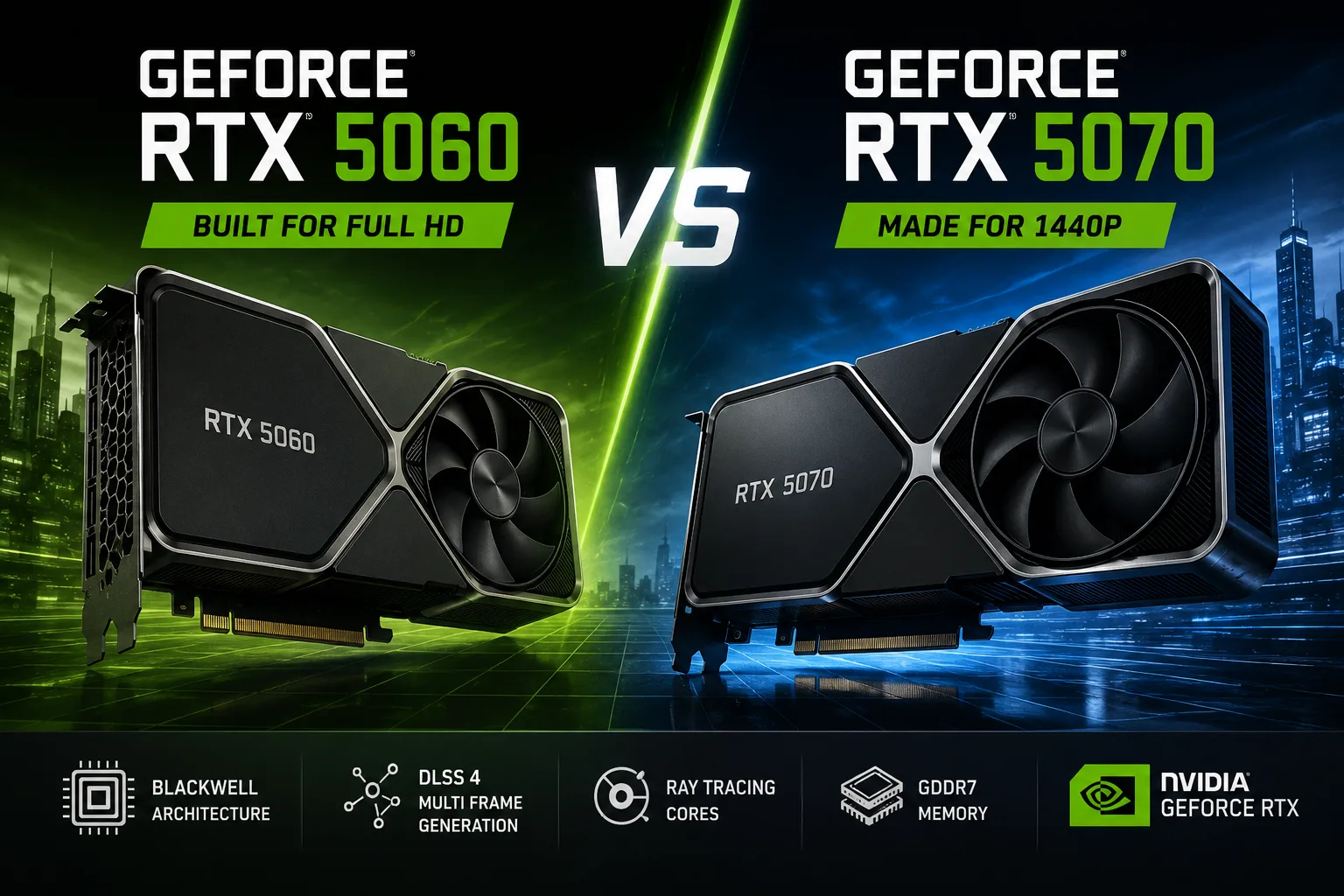
The GeForce RTX 5060 and RTX 5070 belong to the Blackwell generation but are designed for different gaming scenarios. The RTX 5060 is the entry-level card for Full HD without much memory headroom. The RTX 5070 is significantly more expensive and has higher power requirements, but it is better suited for 1440p, high textures, and ray tracing.
The frequency difference is minimal: 2.50 GHz for the RTX 5060 and 2.51 GHz for the RTX 5070. However, frequency is not the main metric in this comparison. The RTX 5070 has more CUDA cores, a wider memory bus, a larger amount of VRAM, and higher bandwidth. Therefore, it performs more stably in games where the lower card is limited by memory and the 128-bit bus.
| Specification | GeForce RTX 5060 | GeForce RTX 5070 |
|---|---|---|
| Architecture | Blackwell | Blackwell |
| CUDA Cores | 3840 | 6144 |
| Video Memory | 8 GB GDDR7 | 12 GB GDDR7 |
| Memory Bus | 128-bit | 192-bit |
| Memory Bandwidth | around 448 GB/s | around 672 GB/s |
| AI Performance | 614 AI TOPS | 988 AI TOPS |
| RT Performance | 58 TFLOPS | 94 TFLOPS |
| Boost Clock | 2.50 GHz | 2.51 GHz |
| Power Consumption | 145 W | 250 W |
| Recommended PSU | 550 W | 650 W |
| Starting Price | $299 | $549 |
Gaming Performance
The RTX 5060 is best suited for Full HD. It is appropriate for online games, esports titles, and less demanding AAA games, especially with DLSS. However, it lacks headroom for maximum settings in new heavy titles. By 2026, 8 GB of video memory will be the minimum for a modern gaming card.
The RTX 5070 is significantly stronger in configuration. It has 60% more CUDA cores, a 50% wider memory bus, and 4 GB more VRAM. While it is still not a universal solution for 4K, it performs better at 2560×1440. At this resolution, the RTX 5070 allows for less frequent texture downscaling, less dependency on DLSS Performance modes, and more confidence in enabling ray tracing.
Both models support DLSS 4 and Multi Frame Generation, but these do not replace native performance. Frame generation is useful when the base FPS is already sufficiently high. If the graphics card barely manages the scene, the technology can boost the frame count, but it does not always improve smoothness and responsiveness.
Memory and Bus
GDDR7 gives the RTX 5060 high bandwidth, but the amount of memory remains its main limitation. At Full HD, this is still tolerable if textures and ray tracing are not maxed out. However, at 1440p and in new games with large open worlds, the memory quickly runs out.
The RTX 5070 also does not provide a large supply for the years ahead: 12 GB is not the level of higher-end cards. However, the difference from the RTX 5060 is significant. The additional 4 GB and 192-bit bus are better suited for 1440p, high textures, mods, and heavy graphical modes.
Ray Tracing and DLSS
Both graphics cards support DLSS 4, Ray Reconstruction, Multi Frame Generation, and Reflex 2. However, in terms of ray tracing, the RTX 5070 is significantly stronger: 94 TFLOPS compared to 58 TFLOPS for the RTX 5060.
The RTX 5060 is better considered as a card for regular rendering with occasional ray tracing. You can enable RT, but you will often have to lower settings or use DLSS in a more performance-oriented mode. The RTX 5070 is better suited for games where ray tracing is used as a permanent setting.
Price and Practicality of Upgrade
The RTX 5070 is almost twice the price of the RTX 5060 at launch, but don't expect a twofold increase in FPS in all games. The premium is justified not by itself but only for a specific scenario: a 1440p monitor, high textures, ray tracing, or the desire to lessen the need to lower settings in new projects.
For Full HD, the difference between the cards will be noticeable, but it is not always price-rational. If the game does not hit memory limits and does not require heavy RT, the RTX 5060 may prove to be a more economical purchase. The RTX 5070 excels where the lower card is already forced to lower graphics quality.
Power Consumption and PC Requirements
The RTX 5060 consumes 145 W and requires a power supply of at least 550 W. This is a plus for budget builds, compact cases, and upgrading older computers without a complete platform replacement. The card is easier to cool and fits better in quieter systems.
The RTX 5070 consumes 250 W and requires a power supply of at least 650 W. It needs a case with adequate airflow. The difference in power consumption is significant, so the RTX 5070 is a model with other requirements for power and cooling, not just a slightly accelerated version of the RTX 5060.
Who Should Choose the RTX 5060
The RTX 5060 is recommended for Full HD, online games, popular single-player titles, and builds where price, low power consumption, and simple power supply are important. It is a rational option if there is no need for maximum settings in the heaviest games.
As a long-term option for ultra settings, the card is debatable. The main limiting factor is 8 GB of video memory.
Who Should Choose the RTX 5070
The RTX 5070 is more logically selected for 1440p, high textures, and ray tracing. It is more expensive and consumes more power, but it offers significantly better headroom in GPU, memory, and RT block.
The premium for the RTX 5070 is justified only when transitioning to a heavier scenario: a 1440p monitor, RT, new AAA games, or the desire to delay replacing the graphics card.
Conclusion
The GeForce RTX 5060 is the entry-level card of the Blackwell generation for Full HD. Its strengths are price, DLSS 4, low power consumption, and simple system requirements. Its weak point is the amount of video memory.
The GeForce RTX 5070 is a more serious option for 1440p. It is faster, better suited for ray tracing, has 12 GB of memory, and a wider bus. However, it costs nearly twice as much and requires a more powerful power supply.
If a rational upgrade for Full HD is needed, the RTX 5060 is justified. If the goal is 1440p, high settings, and headroom for new games, the RTX 5070 would be the more appropriate choice.
Advantages
- Higher Bandwidth: 448 GB/s (448 GB/s vs 120.0GB/s)
- Newer Launch Date: May 2025 (May 2025 vs January 2025)
- Higher Boost Clock: 2520 MHz (2497 MHz vs 2520 MHz)
- Larger Memory Size: 12GB (8GB vs 12GB)
- More Shading Units: 6400 (3840 vs 6400)
Basic
Memory Specifications
Display and Media
3x DisplayPort 2.1b
3x DisplayPort 1.4a
Theoretical Performance
Miscellaneous
Benchmarks
Related GPU Comparisons


Share in social media
Or Link To Us
<a href="https://cputronic.com/gpu/compare/nvidia-geforce-rtx-5060-vs-nvidia-geforce-rtx-5070" target="_blank">NVIDIA GeForce RTX 5060 vs NVIDIA GeForce RTX 5070</a>