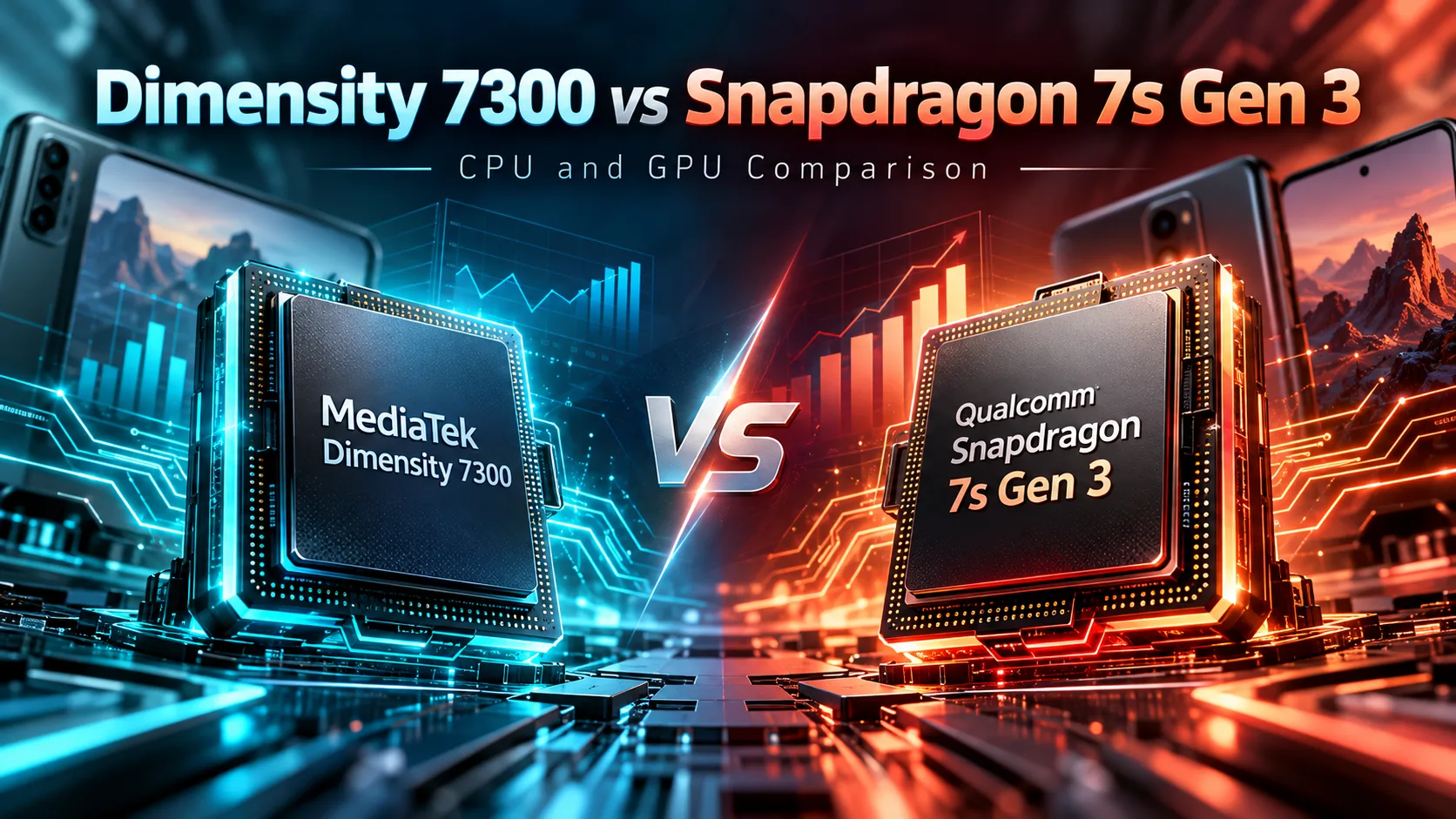
MediaTek Dimensity 7300
vs
Qualcomm Snapdragon 7s Gen 3

SoC Comparison Result
MediaTek Dimensity 7300 vs Snapdragon 7s Gen 3: Which Processor is Better for Mid-Range Smartphones
MediaTek Dimensity 7300 and Qualcomm Snapdragon 7s Gen 3 are two closely matched processors for modern smartphones. Both are manufactured using a 4nm process, support 5G, LPDDR5, UFS 3.1, cameras up to 200 MP, and high-refresh-rate displays. However, they represent different platforms internally: Snapdragon focuses on newer CPU core generations and strong graphics, while Dimensity offers balanced performance and good energy efficiency.
When looking solely at performance, Snapdragon 7s Gen 3 appears to be the better option. Yet, during real-world purchases, it’s not just the processor that matters but the entire smartphone: screen, camera, battery, cooling, interface, and price. Therefore, it’s better to compare these chips not only on benchmarks but also on usage scenarios.
CPU Architecture: New Generation vs Proven Design
Snapdragon 7s Gen 3 features an 8-core configuration of 1+3+4:
| CPU Block | Cores | Frequency |
|---|---|---|
| Prime | 1 Kryo core, close to Cortex-A720 | up to 2.5 GHz |
| Performance | 3 Kryo cores, close to Cortex-A720 | up to 2.4 GHz |
| Efficiency | 4 Kryo cores, close to Cortex-A520 | up to 1.8 GHz |
The main advantage of Snapdragon is its newer CPU core generation. This helps in heavy applications, multitasking, web browsing, photo processing, app installation and updates, as well as in scenarios where high single-core performance is crucial.
Dimensity 7300 follows a 4+4 scheme:
| CPU Block | Cores | Frequency |
|---|---|---|
| Performance | 4 x Cortex-A78 | up to 2.5 GHz |
| Efficiency | 4 x Cortex-A55 | up to 2.0 GHz |
Cortex-A78 and Cortex-A55 are not the newest cores but are well-studied and still suitable for mid-range smartphones. In everyday tasks, Dimensity 7300 does not appear weak: the interface, messengers, web browser, videos, navigation, banking apps, and social media run comfortably.
The conclusion on CPU performance is simple: Snapdragon 7s Gen 3 is faster and more promising, especially in heavy tasks. Dimensity 7300 is behind in performance headroom but remains a solid choice for a regular daily smartphone.
Benchmark Performance
Test results depend on the specific smartphone, cooling, memory speed, firmware, and benchmark version. Therefore, the table below doesn't show a precise ranking of all devices on these chips but rather a general reference between platforms.
| Test | Snapdragon 7s Gen 3 | Dimensity 7300 | Approximate Difference |
|---|---|---|---|
| AnTuTu 10 | around 815,000 | around 642,000 | up to 25-30% |
| Geekbench 6 Single-Core | around 1190 | around 1020 | around 15-20% |
| Geekbench 6 Multi-Core | around 3150-3360 | around 2900-2950 | around 8-15% |
In AnTuTu 11, the difference may be less than in older comparisons using AnTuTu 10, so it's not wise to cling to one specific number. More important is the overall trend: Snapdragon 7s Gen 3 is usually faster in CPU tasks and noticeably stronger in graphics. Dimensity 7300 is closer in routine tasks but lags behind in heavy gaming and prolonged high loads.
Graphics and Gaming
Snapdragon 7s Gen 3 is equipped with Adreno 810 graphics. Dimensity 7300 uses Mali-G615 MP2. In graphics benchmarks, Snapdragon is typically significantly faster, making GPU one of the main distinctions between these processors.
In light and medium games, both chips perform well. PUBG Mobile, Call of Duty Mobile, Mobile Legends, Asphalt, and similar games usually run smoothly with reasonable graphics settings.
In heavy games like Genshin Impact, Honkai: Star Rail, or Wuthering Waves, the advantages of Snapdragon become more apparent. It often allows for higher settings or achieves more stable frame rates. Dimensity 7300 is also capable for gaming, but in demanding projects, you will often have to lower the graphics to avoid drops and overheating.
| Scenario | Better Suited |
|---|---|
| Casual Games | Both Processors |
| Online Shooters and MOBA | Both, with Snapdragon advantage |
| Heavy 3D Games | Snapdragon 7s Gen 3 |
| Games Focused on Stability and Battery Life | Depends on the specific smartphone |
Cooling is an important factor to consider. A smartphone with Dimensity 7300 and a good heat dissipation system may remain more stable than a thin model using Snapdragon 7s Gen 3 with strict temperature limits. So, it's better to look at reviews of specific devices for gaming, rather than just the processor name.
AI and Neural Network Features
Snapdragon 7s Gen 3 features a Hexagon NPU. Qualcomm emphasizes local AI scenarios: image processing, voice functions, photo enhancement, and some on-device generative capabilities.
Dimensity 7300 uses MediaTek NPU 655. It is also designed for AI tasks: scene recognition, noise reduction, background blur, photo enhancement, and acceleration of certain camera and interface functions.
For most users, the difference between the NPUs of these chips is hardly noticeable. In mid-range smartphones, AI functions depend not only on the processor but also on the interface, applications, cloud services, and manufacturer optimization.
In short: Snapdragon is more interesting as a platform with greater headroom for future AI capabilities, but today this is not the main argument in choosing a smartphone.
Camera and Photo Processing
Both processors support cameras up to 200 MP and 4K video recording. MediaTek employs the Imagiq 950 ISP, while Qualcomm uses the Spectra ISP. On paper, their capabilities are similar, but the quality of photos and videos on a real smartphone depends not solely on the processor.
The final result is influenced more by:
- Camera sensor;
- Optics;
- Stabilization;
- Processing algorithms;
- Firmware quality;
- Specific manufacturer settings.
Therefore, a smartphone with Snapdragon 7s Gen 3 is not necessarily guaranteed to take better photos than a model with Dimensity 7300. In one device, a manufacturer may use a good sensor and finely tune the processing, while in another, they might economize on the camera, even if the processor is formally more powerful.
Display, Memory, and Connectivity
Both processors support modern high-refresh-rate displays. Dimensity 7300 claims support for WFHD+ 120 Hz and Full HD+ 144 Hz. Snapdragon 7s Gen 3 also supports Full HD+ 144 Hz. Therefore, 144 Hz cannot be considered an exclusive advantage of MediaTek.
The memory situation is similar. Both chips can work with LPDDR4X and LPDDR5, as well as support UFS 3.1 storage. For mid-range smartphones, this is a good level, especially if the device has 8-12 GB of RAM and a fast storage option.
In terms of connectivity, there is an important difference. Dimensity 7300 is geared for 5G sub-6. Snapdragon 7s Gen 3 technically supports both sub-6 and mmWave, but the presence of mmWave depends on the specific smartphone and region. In most countries and mid-range models, this advantage may not have practical significance.
| Parameter | Dimensity 7300 | Snapdragon 7s Gen 3 |
|---|---|---|
| Memory | LPDDR4X / LPDDR5 | LPDDR4X / LPDDR5 |
| Storage | UFS 3.1 | UFS 3.1 |
| Wi-Fi | Wi-Fi 6E | Wi-Fi 6E |
| Bluetooth | Bluetooth 5.4 | Bluetooth 5.4 |
| 5G | sub-6 | sub-6 + mmWave, if implemented in the device |
| Display | up to FHD+ 144 Hz | up to FHD+ 144 Hz |
Energy Efficiency and Heating
Both processors are manufactured using a modern 4nm process, so they are quite energy-efficient in everyday tasks. In browsing, messaging apps, videos, social media, and navigation, the difference in battery life will often depend not on the SoC, but on the battery, display, modem, interface, and smartphone optimization.
Under heavy loads, the situation is more complex. Snapdragon 7s Gen 3 is usually faster but may consume more energy during active gaming or long demanding tasks. Dimensity 7300 may remain cooler, but its graphical performance is lower.
Therefore, comparing battery life solely by processor name is inaccurate. One smartphone on Snapdragon may last longer than another on Dimensity if it has a larger battery and better optimization-and vice versa.
Which to Choose: Snapdragon 7s Gen 3 or Dimensity 7300
Choose Snapdragon 7s Gen 3 if you value:
- Higher CPU performance;
- Stronger graphics;
- Gaming at medium to high settings;
- Greater headroom for 2-3 years;
- A more modern platform;
- Potentially more developed AI capabilities from Qualcomm.
Choose Dimensity 7300 if you value:
- Stable performance in everyday tasks;
- Good energy efficiency;
- Normal performance without overpaying;
- A good device for the price;
- A good screen, camera, or battery is more important than maximum test results.
Conclusion
Snapdragon 7s Gen 3 is a more powerful and promising processor. It is faster in CPU tasks, significantly stronger in graphics, and better suited for those who game, actively use demanding applications, and want to ensure future performance headroom.
MediaTek Dimensity 7300 is a calmer and more balanced option. It may not be a record-breaker in power, but it handles everyday tasks well, supports modern cameras, fast displays, Wi-Fi 6E, UFS 3.1, and LPDDR5. For the average user, its capabilities are sufficient.
If choosing solely based on the processor, the winner is Snapdragon 7s Gen 3. However, if a smartphone on Dimensity 7300 is cheaper and has a better camera, screen, battery, or interface, it could be a more advantageous purchase. In the mid-range, it’s not just the chip that matters, but the balance of the entire device.
Advantages
- Newer Launch Date: August 2024 (June 2024 vs August 2024)
Basic
3x 2.4 GHz – Kryo Gold
4x 1.8 GHz – Kryo Silver
GPU Specifications
Connectivity
Memory Specifications
Miscellaneous
Benchmarks
Comparison of Devices
Related SoC Comparisons




Share in social media
Or Link To Us
<a href="https://cputronic.com/en/soc/compare/mediatek-dimensity-7300-vs-qualcomm-snapdragon-7s-gen-3" target="_blank">MediaTek Dimensity 7300 vs Qualcomm Snapdragon 7s Gen 3</a>