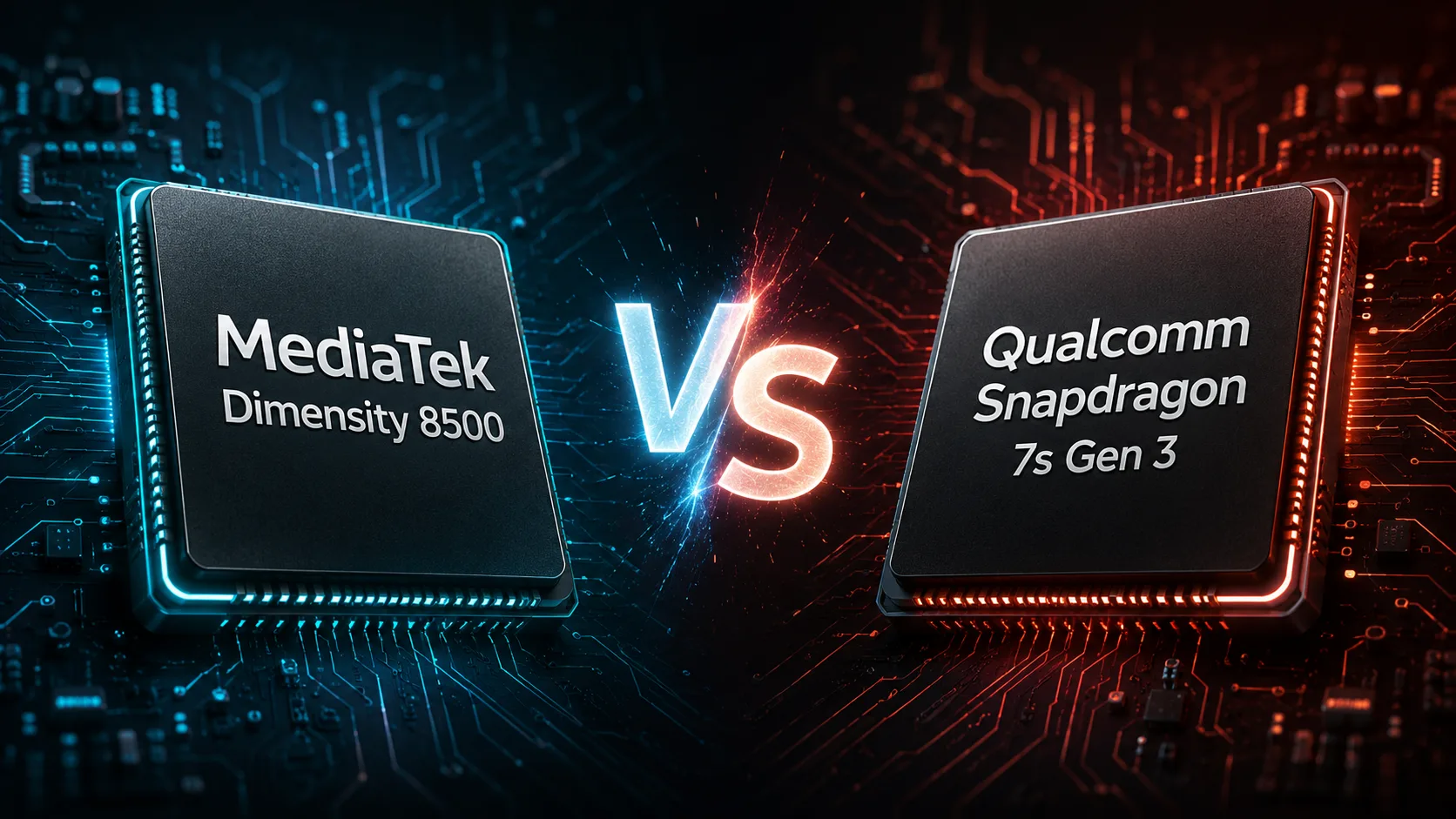
MediaTek Dimensity 8500
vs
Qualcomm Snapdragon 7s Gen 3

SoC Comparison Result
MediaTek Dimensity 8500 vs Snapdragon 7s Gen 3: A Difference in Class, Not Just a Few Percent
The MediaTek Dimensity 8500 is significantly more powerful than the Qualcomm Snapdragon 7s Gen 3. In smartphones, the difference is about 50% in single-threaded performance and exceeds 100% in multi-threaded performance. In gaming, MediaTek's advantage is even more pronounced: the graphical component of the Dimensity 8500 is designed for high settings, whereas the Snapdragon 7s Gen 3 often has to settle for medium.
This does not mean that Snapdragon-powered smartphones are slow. For browsing, social media, video, navigation, and everyday photography, their performance is sufficient. However, at a similar price point, a model with the Dimensity 8500 offers a much larger headroom for heavy applications and gaming.
Key Differences
| Parameter | MediaTek Dimensity 8500 | Qualcomm Snapdragon 7s Gen 3 |
|---|---|---|
| Process Technology | 4 nm | 4 nm |
| CPU Configuration | 1 × Cortex-A725 3.4 GHz + 3 × Cortex-A725 3.2 GHz + 4 × Cortex-A725 2.2 GHz | 1 × Cortex-A720 2.5 GHz + 3 × Cortex-A720 2.4 GHz + 4 × Cortex-A520 1.8 GHz |
| Max Clock Speed | 3.4 GHz | 2.5 GHz |
| Graphics | Mali-G720 MC8 | Qualcomm Adreno |
| RAM | LPDDR5X up to 9600 Mbps | LPDDR5 |
| Storage | UFS 4 with MCQ | UFS 2.2 or UFS 3.1 |
| Max Camera Resolution | 320 MP | 200 MP |
| Video Recording | Up to 4K at 60 fps | Up to 4K HDR |
| Max 5G Speed | 5.17 Gbps | 2.9 Gbps |
| Wireless Networks | Wi-Fi 6E, Bluetooth 5.4 | Wi-Fi 6E, Bluetooth 5.4 |
Both platforms are produced using a 4nm process, but they employ different approaches to CPU core configuration. The Dimensity 8500 features eight Cortex-A725 cores. In contrast, the Snapdragon 7s Gen 3 has four Cortex-A720 cores complemented by four compact Cortex-A520 cores, primarily intended for background and moderate loads.
MediaTek also supports faster LPDDR5X memory and UFS 4 storage. This impacts not only AnTuTu scores but also application installation, game data loading, photo processing, and working with large files.
Qualcomm does not officially specify the number of the graphical core in the Snapdragon 7s Gen 3, using the designation Adreno. Therefore, the name Adreno 810 found in third-party databases cannot be considered a confirmed characteristic of the platform.
Benchmarks of Specific Smartphones
Processor performance depends on cooling, memory, firmware, and manufacturer settings. Therefore, it is more useful to compare ranges that show several finished devices rather than isolated records.
| Smartphone | Processor | Geekbench 6 Single | Geekbench 6 Multi | AnTuTu 11 |
|---|---|---|---|---|
| POCO X8 Pro | Dimensity 8500-Ultra | around 1710 | around 6540 | around 2.22 million |
| Xiaomi 17T | Dimensity 8500-Ultra | around 1700 | around 6690 | around 2.41 million |
| Motorola Edge 70 Pro | Dimensity 8500 | around 1740 | around 6860 | around 2.19 million |
| Nothing Phone (3a) | Snapdragon 7s Gen 3 | around 1180 | around 3210 | around 1.04 million |
| Realme 14 Pro+ | Snapdragon 7s Gen 3 | around 1110 | around 2990 | around 1.11 million |
| Redmi Note 14 Pro+ 5G | Snapdragon 7s Gen 3 | around 1170 | around 3160 | around 1.01 million |
Typical results can be summarized in the following ranges:
| Test | Dimensity 8500 | Snapdragon 7s Gen 3 |
|---|---|---|
| Geekbench 6 Single-Core | 1700-1750 | 1100-1200 |
| Geekbench 6 Multi-Core | 6500-6900 | 3000-3300 |
| AnTuTu 11 | 2.2-2.4 million | 1.0-1.1 million |
This presentation is more accurate than calculating an average across results. Even two smartphones with the same processor can differ by several percent due to thermal constraints and power settings.
CPU Performance
In single-threaded Geekbench 6, the Dimensity 8500 has an advantage of about 45-50%. This advantage becomes evident when running heavy applications, processing web pages, extracting files, and performing operations that do not distribute well across multiple cores.
In multi-threaded mode, the gap exceeds double. The reason is the CPU configuration. The Dimensity 8500 uses eight Cortex-A725 cores, while the Snapdragon 7s Gen 3 has only four high-performance Cortex-A720 cores. The other four Cortex-A520 cores consume less power but are noticeably weaker under sustained computational loads.
In messengers and social media, users will not notice a doubling in speed. The difference becomes apparent in heavier scenarios such as:
- video editing;
- batch processing photos;
- emulating gaming systems;
- installing and extracting large games;
- simultaneous operation of multiple demanding applications.
The Dimensity 8500 will also retain acceptable speeds for a longer time as the demands of mobile software increase.
Graphics and Gaming
The main limitation of the Snapdragon 7s Gen 3 remains its graphics. It handles most mobile games, but in demanding projects, it often requires lowering texture quality, shadows, and rendering resolution.
The Mali-G720 MC8 in the Dimensity 8500 belongs to a higher class. This allows for increased frame rates and higher graphics settings, especially in smartphones with effective cooling systems.
The practical differences appear as follows:
- The Snapdragon 7s Gen 3 is primarily oriented towards medium settings;
- The Dimensity 8500 more often allows for high settings;
- During prolonged gaming sessions, performance depends on cooling;
- The graphical headroom of MediaTek is significantly higher.
MediaTek claims support for hardware ray tracing and its proprietary gaming technologies, HyperEngine. However, in smartphones of this class, stable frame rates are more important than additional lighting effects. Even a powerful GPU does not guarantee smooth operation of ray tracing in all supported games.
AnTuTu results confirm the overall picture: smartphones with the Dimensity 8500 score around 2.2-2.4 million points, while those with the Snapdragon 7s Gen 3 score about 1.0-1.1 million.
Some individual devices achieve higher results, but record runs should not be seen as the norm for the entire platform. The final performance is affected by the smartphone's temperature, performance mode, and firmware version.
Heating and Battery Life
The same manufacturing process does not imply the same power consumption. The Dimensity 8500 is capable of doing much more work, but its eight performance cores and large GPU require more cooling.
In a thin chassis or with a weak heat dissipation system, the processor may reduce its clock speeds faster. Therefore, when choosing a gaming smartphone, it is important to consider not only the chip but also the assembled device: the area of the vapor chamber, the thickness of the body, and performance under sustained loads.
The Snapdragon 7s Gen 3 is easier to cool. The four Cortex-A520 cores are suitable for background processes and light applications, so under moderate loads, the platform does not have to constantly engage the high-performance cores.
However, a smartphone powered by Snapdragon does not necessarily last longer. Battery life is more influenced by:
- battery capacity;
- screen brightness and type;
- mobile network settings;
- firmware optimization;
- background activity restrictions.
It is incorrect to compare battery life solely based on the processor name.
Cameras and Connectivity
The Dimensity 8500 supports sensors with resolutions up to 320 MP and can record video at 4K 60 fps. The Snapdragon 7s Gen 3 is designed for cameras up to 200 MP and also supports 4K HDR recording.
The maximum sensor resolution does not determine the quality of finished photographs. Sensor size, optics, stabilization, and processing algorithms have a greater impact on the result.
For example, a smartphone with Snapdragon 7s Gen 3 may feature a telephoto lens or a higher-quality primary camera, while the manufacturer of a Dimensity 8500 model may prioritize performance and battery life.
In terms of modem speed, MediaTek is ahead: up to 5.17 Gbps compared to 2.9 Gbps for Qualcomm. In practice, the difference depends on the operator, available frequencies, and coverage quality. Both platforms support Wi-Fi 6E and Bluetooth 5.4.
What to Choose
Choose Dimensity 8500 for:
- heavy mobile gaming;
- emulators;
- video editing;
- processing large numbers of photos;
- active multitasking;
- a smartphone with performance headroom.
Consider Snapdragon 7s Gen 3 when:
- the smartphone is significantly cheaper;
- gaming is not a priority;
- cameras, build quality, or software support are more important;
- the device is primarily used for browsing, video, and social media.
Conclusion
The MediaTek Dimensity 8500 clearly outperforms in terms of performance. It is approximately 45-50% faster in single-threaded Geekbench 6, more than twice as fast in multi-threaded mode, and roughly twice as fast in the overall AnTuTu 11 score.
The Snapdragon 7s Gen 3 remains an acceptable foundation for a mid-range smartphone, but it cannot be called a direct competitor to the Dimensity 8500 in terms of speed. Given similar specifications and prices, a model with the Dimensity 8500 is preferable. The Snapdragon should be chosen if a specific smartphone is significantly cheaper or offers better cameras, build quality, or longer software support.
Advantages
- Higher Frequency: 3400 MHz (3400 MHz vs 2500 MHz)
- Newer Launch Date: January 2026 (January 2026 vs August 2024)
Basic
3x 2.4 GHz – Kryo Gold
4x 1.8 GHz – Kryo Silver
GPU Specifications
Connectivity
Memory Specifications
Miscellaneous
Benchmarks
Comparison of Devices
Related SoC Comparisons


Share in social media
Or Link To Us
<a href="https://cputronic.com/en/soc/compare/mediatek-dimensity-8500-vs-qualcomm-snapdragon-7s-gen-3" target="_blank">MediaTek Dimensity 8500 vs Qualcomm Snapdragon 7s Gen 3</a>