Intel Core i7-14650HX
Intel Core i7-14650HX: Laptop Tests and Comparison with Other Processors
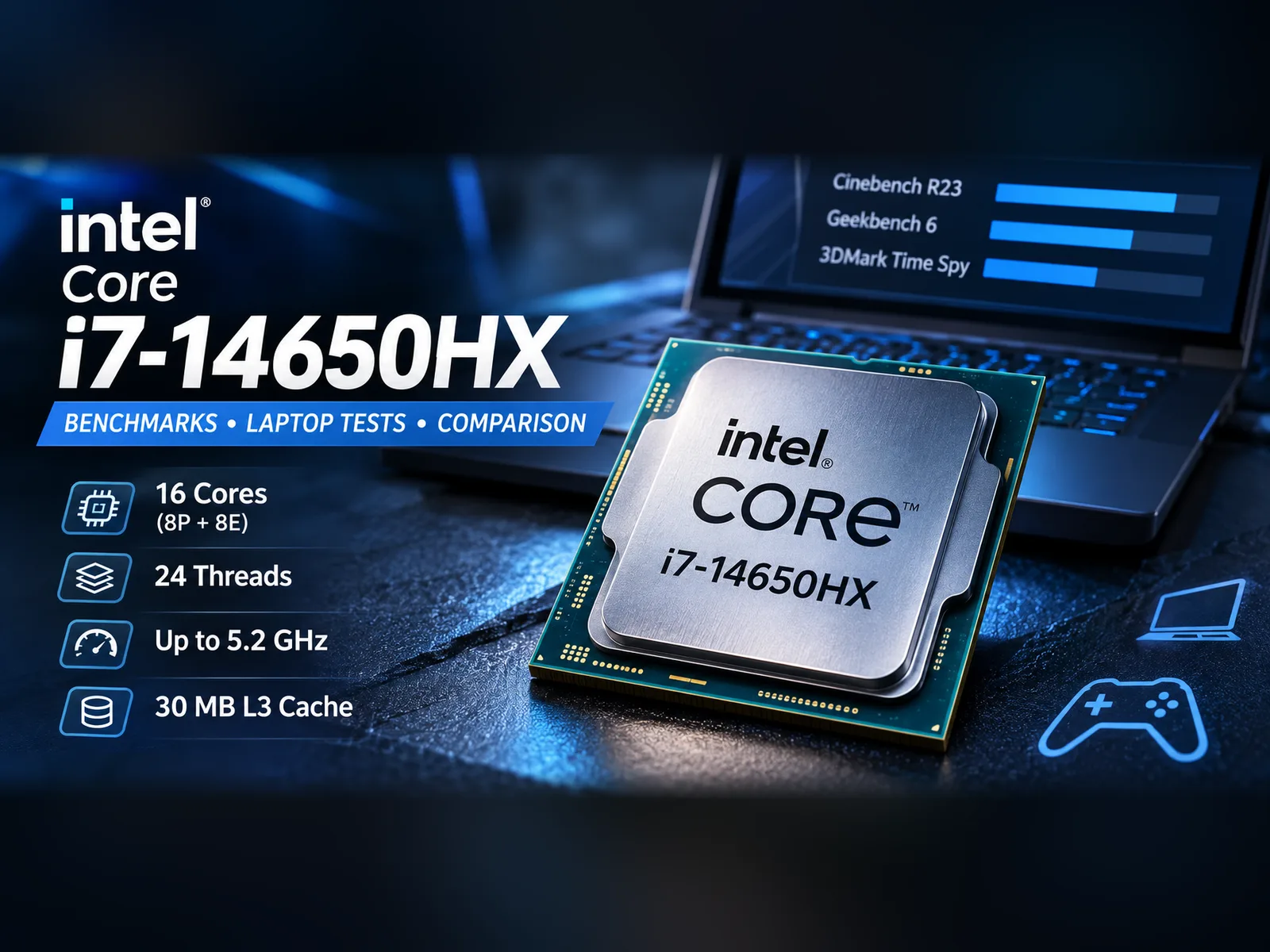
The Intel Core i7-14650HX is a processor for gaming laptops and mobile workstations, introduced in January 2024. It features 8 performance cores and 8 efficient cores, supports 24 threads, and reaches clock speeds of up to 5.2 GHz. Compared with the Core i7-13650HX, the number of P-cores increased from six to eight, while the L3 cache grew from 24 to 30 MB. In multithreaded tests, the new model is usually faster than its predecessor, although results depend on the specific laptop.
Specifications and Differences from Other Core i7 HX Processors
The Core i7-14650HX belongs to the Raptor Lake-HX Refresh family and is manufactured using the Intel 7 process. The processor is based on the Raptor Lake architecture used in the previous-generation Core HX lineup.
| Specification | Core i7-13650HX | Core i7-14650HX | Core i7-14700HX |
|---|---|---|---|
| Cores (P+E) | 6+8 | 8+8 | 8+12 |
| Threads | 20 | 24 | 28 |
| Max. P-core frequency | 4.9 GHz | 5.2 GHz | 5.5 GHz |
| Max. E-core frequency | 3.6 GHz | 3.7 GHz | 3.9 GHz |
| L3 cache | 24 MB | 30 MB | 33 MB |
| Maximum DDR5 speed | 4800 MT/s | 5600 MT/s | 5600 MT/s |
| GPU execution units | 16 EU | 16 EU | 32 EU |
For all three models, Intel specifies a base power of 55 W and a maximum turbo power of 157 W. The Core i7-14650HX supports dual-channel DDR5-5600 or DDR4-3200 memory and the PCI Express 5.0 interface.
The Core i7-13650HX has two fewer P-cores, while the Core i7-14700HX has four more E-cores. The performance difference can be assessed using results from specific laptops.
Geekbench 6 Performance
In the tests shown, the Core i7-14650HX scores 2688-2761 points in Single-Core and 12,892-16,010 points in Multi-Core.
| Device | Processor | Single-Core | Multi-Core |
|---|---|---|---|
| Lenovo Legion Pro 5 16IRX9 | Core i7-14700HX | 2884 | 17,562 |
| Lenovo Legion 5 16IRX9 | Core i7-14650HX | 2761 | 16,010 |
| MSI Crosshair 16 HX E14WFK | Core i7-14650HX | 2688 | 15,878 |
| MSI Sword 16 HX B14VGKG | Core i7-14700HX | 2837 | 15,107 |
| Dell G16 | Core i7-13650HX | 2562 | 13,711 |
| Lenovo Legion Pro 5 16ARX8 | Ryzen 7 7745HX | 2621 | 13,282 |
| MSI Katana 17 HX B14WGK | Core i7-14650HX | 2744 | 12,892 |
Geekbench 6 results for specific laptops. Different test versions and power settings were used, so the comparison is indicative.
The Lenovo Legion 5 with the Core i7-14650HX outperforms the Dell G16 with the Core i7-13650HX by approximately 17% in the multithreaded test. The difference is consistent with the increase in P-core count from six to eight, although laptop settings also affect the result.
The Core i7-14700HX in the Lenovo Legion Pro 5 achieves a score 10% higher than the Core i7-14650HX in the Lenovo Legion 5. However, in the MSI Sword 16 HX, the same Core i7-14700HX scores lower than the 14650HX in the Lenovo laptop. Thus, the higher-end processor is not always faster in a specific laptop.
The Ryzen 7 7745HX is close to the Core i7-14650HX in single-threaded performance, but in the multithreaded tests shown, it trails most of the Intel configurations. The difference between the Lenovo Legion Pro 5 with the Ryzen processor and the Legion 5 with the Core i7-14650HX is approximately 17% in favor of Intel.
Cinebench R23: Performance Under Sustained Load
Cinebench R23 measures processor performance during rendering. Under sustained load, the result depends on power limits and cooling efficiency.
| Laptop | Processor | Cinebench R23 Multi |
|---|---|---|
| MSI Crosshair 16 HX E14WFK | Core i7-14650HX | 25,366 |
| Lenovo Legion 5 16IRX9 | Core i7-14650HX | 24,455 |
| MSI Katana 17 HX B14WGK | Core i7-14650HX | 16,453 |
The difference between the MSI Crosshair and the Lenovo Legion 5 is approximately 4%. The MSI Katana 17 scores 35% lower than the Crosshair, despite using the same processor.
In the tested MSI Katana configuration, the long-term CPU power limit was 50 W, compared with 100 W in the Lenovo Legion 5.
Performance under sustained load is important for rendering, compiling large projects, and video processing. Therefore, when choosing a laptop for these tasks, it is worth checking not only the processor model but also sustained-test results.
3DMark Time Spy: CPU Test Results
3DMark Time Spy evaluates graphics and processor performance separately. The Time Spy CPU Score is used for CPU comparisons; the graphics card has significantly less impact on it than on the overall score.
| Device | Processor | Time Spy CPU Score |
|---|---|---|
| MSI Crosshair 16 HX E14WFK | Core i7-14650HX | 17,884 |
| HP Victus 16 (2024) | Core i7-14700HX | 16,109 |
| Lenovo Legion 5 16IRX9 | Core i7-14650HX | 15,311 |
| Dell G16 | Core i7-13650HX | 14,690 |
| MSI Katana 17 HX B14WGK | Core i7-14650HX | 12,741 |
| Lenovo Legion Pro 5 16ARX8 | Ryzen 7 7745HX | 11,477 |
The MSI Crosshair 16 HX scores 17% higher than the Lenovo Legion 5 with the same Core i7-14650HX, and approximately 40% higher than the MSI Katana 17.
In this comparison, the Core i7-14650HX in the MSI Crosshair was faster than the Core i7-14700HX installed in the HP Victus 16.
A difference in Time Spy CPU Score does not imply the same difference in gaming frame rates. Gaming performance also depends on the graphics card, resolution, graphics settings, and engine characteristics.
Gaming Tests at 1920 × 1080
The Lenovo Legion Pro 5i Gen 9 with a Core i7-14650HX and GeForce RTX 4060 achieved the following results:
| Game | Settings | Average FPS |
|---|---|---|
| Shadow of the Tomb Raider | Highest | 109 |
| Cyberpunk 2077 | Ray Tracing Ultra | 61 |
| Far Cry 6 | Ultra | 92 |
| Borderlands 3 | Badass | 90 |
| Red Dead Redemption 2 | Medium | 69 |
Results from one Lenovo Legion Pro 5i Gen 9 configuration with an RTX 4060 Laptop GPU and 16 GB of RAM. The figures apply to the laptop as a whole, not only to the processor.
In Shadow of the Tomb Raider, the laptop reaches 109 FPS, while in Far Cry 6 it achieves 92 FPS. In Cyberpunk 2077 with the Ray Tracing Ultra preset, the result is 61 FPS.
At a resolution of 2560 × 1600, the frame rate in Shadow of the Tomb Raider and Far Cry 6 drops to 64 FPS.
These results show the performance of the Core i7-14650HX and RTX 4060 combination, but they do not allow the processor’s individual contribution to the frame rate to be assessed. Such a comparison requires tests using the same graphics card, memory, and graphics settings but different CPUs.
Power Consumption and Cooling
The Core i7-14650HX has a base power of 55 W and a maximum turbo power of 157 W. Laptop manufacturers may set lower limits, especially under sustained load.
In the Acer Predator Helios Neo 16 with an RTX 4060, Time Spy results differ significantly between Turbo and Silent modes.
| Metric | Turbo | Silent mode |
|---|---|---|
| Time Spy, overall score | 11,793 | 7708 |
| Time Spy CPU Score | 15,765 | 5780 |
Comparison of the modes while running on AC power and using the same Windows performance profile.
In Silent mode, the overall score decreases by approximately 35%, while the CPU score drops by 63%. CPU and GPU power limits can reduce heat and noise, but they also lower performance.
When choosing a laptop for sustained computing workloads, it is worth checking:
- The processor’s long-term power limit.
- Clock stability under sustained load.
- Fan noise levels.
- Performance under simultaneous CPU and GPU load.
When running on battery power, the processor’s power is usually limited. Maximum benchmark results are generally achieved when the laptop is connected to the mains.
Integrated Graphics and RAM
The Core i7-14650HX features Intel UHD Graphics with 16 execution units and a frequency of up to 1.6 GHz. The integrated graphics are sufficient for the desktop, web browsing, and video playback. Demanding modern games require a discrete graphics card.
The integrated graphics support hardware video encoding and decoding through Intel Quick Sync.
The memory controller supports DDR5-5600 and DDR4-3200 in dual-channel mode. The maximum specified capacity is 192 GB, but the actual limit depends on the laptop’s motherboard and BIOS.
The processor uses an FCBGA1964 package and is soldered to the motherboard. It cannot be replaced without specialized equipment.
Comparison with the Core i7-13650HX, Core i7-14700HX, and Ryzen 7 7745HX
Core i7-13650HX. A laptop with this processor is worth considering if it is noticeably cheaper with the same graphics card and comparable cooling. With an RTX 4060, the difference between the two CPUs may be small in games. The Core i7-14650HX is preferable for sustained multithreaded workloads.
Core i7-14700HX. The higher-end model makes sense for regular rendering, video encoding, and other workloads capable of using all the cores. In games with the same graphics card, the advantage may be small, so paying extra for the processor is not always justified.
Ryzen 7 7745HX. The Ryzen is roughly on par with the Core i7-14650HX in single-threaded performance. In multithreaded tests, the advantage depends on the application and power limits. At a similar price, the choice between them is best made based on results from specific laptops, including heat and battery-life tests.
Conclusion
The Core i7-14650HX outperforms the Core i7-13650HX in the multithreaded tests shown, but results vary significantly between different laptops. In Cinebench R23, the MSI Katana 17 scores 35% lower than the MSI Crosshair 16 HX with the same processor.
For gaming with an RTX 4060, switching to the Core i7-14700HX is not always justified: with the same budget, the graphics card and cooling system specifications are more important. The higher-end model is more appealing for regular rendering and other multithreaded workloads. The Core i7-13650HX remains an alternative if the laptop with it is substantially cheaper while offering comparable hardware.
CPU Comparison
Compare Core i7-14650HX with other CPUs
Basic
CPU Specifications
Memory Specifications
GPU Specifications
Benchmarks
Compared to Other CPU
Related CPU Comparisons



Share in social media
Or Link To Us
<a href="https://cputronic.com/en/cpu/intel-core-i7-14650hx" target="_blank">Intel Core i7-14650HX</a>