AMD Ryzen AI 7 350

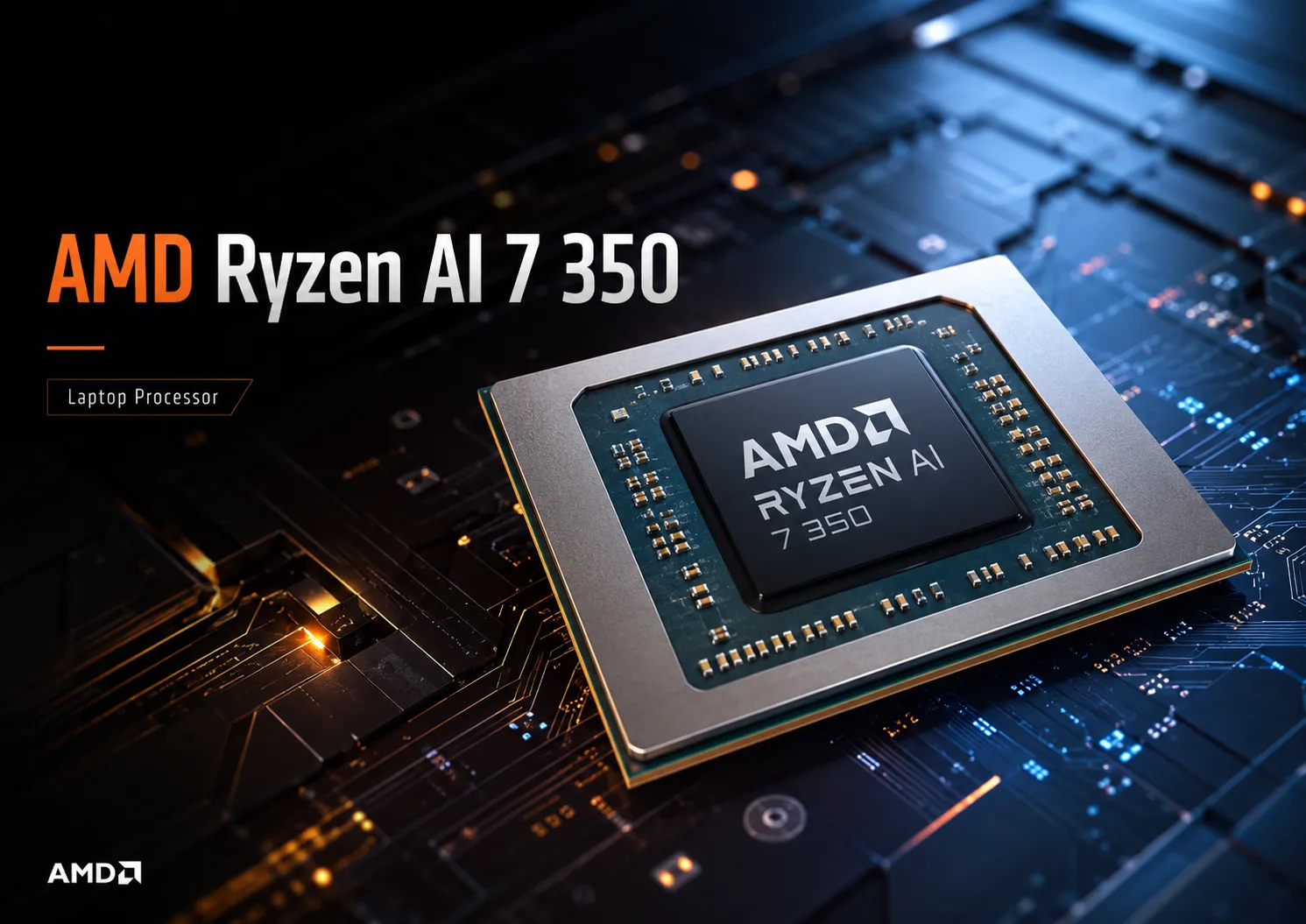
AMD Ryzen AI 7 350: a compact Zen 5 with a focus on versatility
Key specifications
-
Cores/threads: 8 / 16 (4× Zen 5 + 4× Zen 5c)
-
Process: 4 nm
-
Max clocks: up to 5.0 GHz on Zen 5 cores; ~3.5 GHz on Zen 5c
-
L3 cache: 16 MB
-
Graphics: Radeon 860M (RDNA 3.5), 8 compute units
-
Memory: DDR5-5600 or LPDDR5X-8000 (dual-channel)
-
I/O: PCIe 4.0, USB4 (up to 40 Gbps)
-
NPU: XDNA 2 up to 50 TOPS
-
Power envelope: baseline around 28 W; configurable 15-54 W (OEM-dependent)
Positioning
Ryzen AI 7 350 sits in the Krackan Point family-mobile Zen 5 APUs designed for thin-and-light laptops, mid-range study and work machines, and compact workstations with a discrete GPU. The core idea is a hybrid of performance Zen 5 and efficient Zen 5c cores, keeping the system snappy under load and frugal at idle.
CPU architecture: Zen 5 + Zen 5c
The 4× Zen 5 + 4× Zen 5c mix yields 16 threads and a wide operating “range”:
-
Zen 5 handles peaks-compiles, rendering, heavy encoding;
-
Zen 5c sustains background multitasking and extends battery life.
The IPC uplift over Zen 4 is most noticeable in snappy single- and lightly-threaded work and interactive workflows.
Integrated graphics: Radeon 860M
The RDNA 3.5-based Radeon 860M packs 8 CUs at high clocks. It’s ample for everyday graphics, 4K video, UI acceleration, and light 3D. For AAA gaming at ultra settings you’ll want a discrete GPU; with an eGPU over USB4/Thunderbolt and adequate cooling, interesting pairings are possible.
Memory and interfaces
The dual-channel controller supports DDR5-5600 and LPDDR5X-8000-memory choice directly affects iGPU bandwidth and overall responsiveness. For I/O you get PCIe 4.0 (for SSDs and dGPU in applicable designs) and USB4 up to 40 Gbps for fast peripherals and docks.
NPU: XDNA 2 up to 50 TOPS
A dedicated AI engine offloads CPU/GPU for on-device tasks-speech features, noise suppression, auto-framing, and some generative/summarization models. That trims power draw in “smart” workflows and keeps more inference local for privacy.
Power, thermals, and acoustics
Laptop makers set their own power limits: from 15-20 W in ultra-thin designs to 45-54 W in performance-oriented models.
-
Low profiles favor battery life and quiet operation but lower sustained clocks under long loads.
-
High profiles boost sustained frequency and throughput, at the cost of stronger cooling requirements.
Performance: grounded expectations
In typical configs, the Ryzen AI 7 350 feels confident in office suites, IDEs, and a browser with dozens of tabs, speeds up builds, photo exports, and video encoding (especially with a fast SSD and dual-channel LPDDR5X). Under extended stress, results hinge on the specific laptop’s power limits and cooling efficiency.
Who it’s for
-
Entry-to-mid content creators. Photo pipelines, social-video edits, proxy workflows, accelerated exports.
-
Mobile developers. Builds, containers, local LLM helpers and tools-without brutal battery hit.
-
Students and office users. Multitasking, video calls with AI filters, large browser workspaces.
-
Compact workstations. Paired with a discrete GPU, the chip shines in on-site CAD/render tasks.
What to look for in a laptop
-
Memory: 16 GB minimum, 32 GB preferred; LPDDR5X-8000 noticeably lifts iGPU and system snap.
-
SSD: NVMe PCIe 4.0 with strong write speeds-key for encoding and cache-heavy workloads.
-
Cooling: dual fans and substantial heatpipes in 35-54 W models improve frequency stability.
-
Ports: USB4 for docks, fast external SSDs, and (potentially) eGPU.
Bottom line
Ryzen AI 7 350 is a well-rounded new-gen “midranger”: a Zen 5/Zen 5c hybrid, capable integrated graphics, fast memory controller, and a powerful NPU. It scales from ultrabooks to compact workhorses and covers a wide range of tasks without awkward compromises. Real-world performance ultimately depends on the specific laptop-its cooling, memory type, and chosen power profile.
CPU Comparison
Compare Ryzen AI 7 350 with other CPUs
Basic
CPU Specifications
Memory Specifications
GPU Specifications
Miscellaneous
Benchmarks
Compared to Other CPU
Related CPU Comparisons






Share in social media
Or Link To Us
<a href="https://cputronic.com/en/cpu/amd-ryzen-ai-7-350" target="_blank">AMD Ryzen AI 7 350</a>