
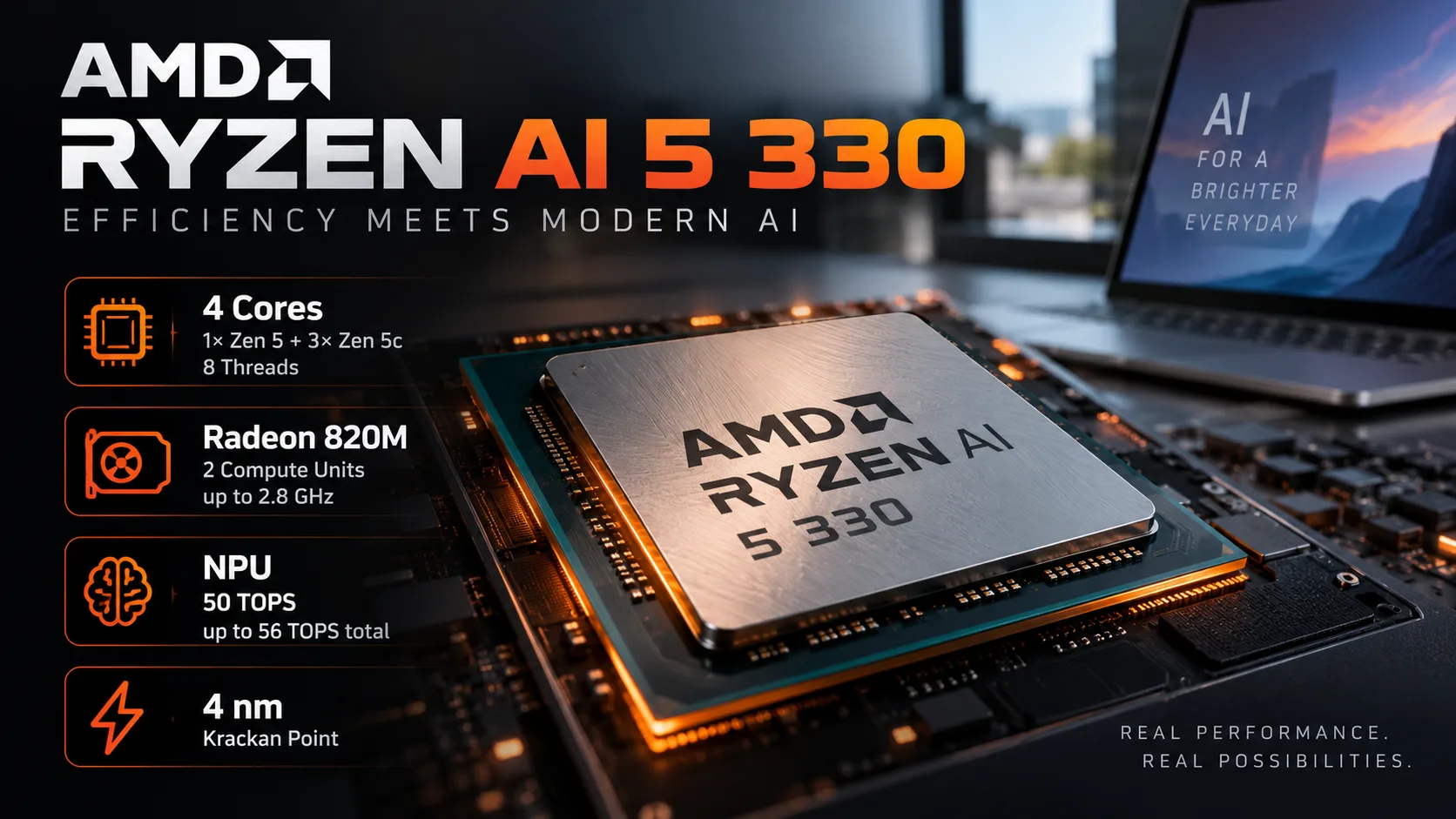
AMD Ryzen AI 5 330

AMD Ryzen AI 5 330
AMD Ryzen AI 5 330 processor review

AMD Ryzen AI 5 330: 4 Cores, Radeon 820M, and a 50 TOPS NPU

The AMD Ryzen AI 5 330 is a quad-core processor from the Ryzen AI 300 family, based on the Zen 5/Zen 5c architecture. The processor is built on a 4nm Krackan Point die and includes one Zen 5 core and three Zen 5c cores. It has 4 cores and 8 threads in total, while the integrated NPU delivers up to 50 TOPS.

CPU Performance

The Ryzen AI 5 330 has a base clock speed of 2.0 GHz. The Zen 5 core boosts to 4.5 GHz, while the three Zen 5c cores boost to 3.4 GHz. It has 4 MB of L2 cache and 8 MB of L3 cache.

In Geekbench 6 Single, the Ryzen AI 5 330 scores approximately 2.4-2.6 thousand points.

Results in Actual Devices

Device Geekbench 6 Single Geekbench 6 Multi Price
Lenovo IdeaPad Slim 5 16AKP10 2576 7814 ≈ €700
Acer Aspire 14 AI A14-61M 2530 7775 ≈ €720

The difference between the two laptops is minimal-46 points in Single Core and 39 points in Multi Core.

The six-core Ryzen AI 5 340 scores around 2782 points in Geekbench 6 Single and 10765 points in Multi, with most of the gap appearing in the multithreaded test.

Cinebench 2024

In Cinebench 2024, the Ryzen AI 5 330 scores around 106 points in single-threaded mode and 519 points when using all cores.

PassMark

The Ryzen AI 5 330’s average PassMark score is approximately 12,692 CPU Mark points and 3,481 Single Thread points.

Radeon 820M

The Radeon 820M includes 2 graphics units and operates at up to 2.8 GHz.

In the Lenovo IdeaPad Slim 5 16AKP10, the Radeon 820M scores around 786 points in 3DMark Time Spy Graphics.

Integrated graphics Device 3DMark Time Spy Graphics
Radeon 860M Lenovo IdeaPad 5 2-in-1 14AKP10 2638
Radeon 840M Lenovo Yoga 7 2-in-1 14AKP10 1705
Radeon 820M Lenovo IdeaPad Slim 5 16AKP10 786

The Radeon 840M scores more than twice as many points, while the Radeon 860M scores more than three times as many.

NPU and AI

The Ryzen AI 5 330 is equipped with an XDNA 2 unit delivering up to 50 TOPS. The processor’s total claimed AI performance reaches 56 TOPS.

Memory and Platform

The processor supports DDR5-5600 and LPDDR5X-8000 in dual-channel mode. The maximum supported memory capacity is 256 GB.

It provides 14 PCIe 4.0 lanes and USB4 with speeds of up to 40 Gbps.

The standard TDP is 28 W, while the configurable range is 15-28 W.

Conclusion

The Ryzen AI 5 330 is not designed for heavy multithreaded workloads or gaming on integrated graphics: its four cores and Radeon 820M quickly reveal their limitations. However, its single-threaded performance remains high, while the 50 TOPS XDNA 2 NPU matches that of more expensive Ryzen AI 300 models.

At a laptop price of around €700, the Ryzen AI 5 330 looks like a good choice for studying, office work, web browsing, programming, and everyday tasks. For that price, buyers get a modern Zen 5 platform, Copilot+ support, and a fast NPU without paying extra for additional CPU cores and more powerful graphics.

If the price approaches €850-900, the advantage disappears: laptops with the six-core Ryzen AI 5 340 and Radeon 840M are available in this range, offering noticeably higher performance in both multithreaded workloads and integrated graphics.

CPU Comparison

Compare Ryzen AI 5 330 with other CPUs

Please select CPU from the dropdown list.

Basic

Label Name
AMD
Platform
Laptop
Launch Date
July 2025
Model Name
?
The Intel processor number is just one of several factors - along with processor brand, system configurations, and system-level benchmarks - to be considered when choosing the right processor for your computing needs.
Ryzen AI 5 330
Code Name
Krackan Point
Generation
1x Zen 5, 3x Zen 5c
OS Support
Windows 11 - 64-Bit Edition, RHEL x86 64-Bit, Ubuntu x86 64-Bit

CPU Specifications

Total Cores
?
Cores is a hardware term that describes the number of independent central processing units in a single computing component (die or chip).
4
Total Threads
?
Where applicable, Intel® Hyper-Threading Technology is only available on Performance-cores.
8
Basic Frequency
2 GHz
Max Turbo Frequency
?
Max Turbo Frequency is the maximum single-core frequency at which the processor is capable of operating using Intel® Turbo Boost Technology and, if present, Intel® Turbo Boost Max Technology 3.0 and Intel® Thermal Velocity Boost. Frequency is typically measured in gigahertz (GHz), or billion cycles per second.
Up to 4.5 GHz
L2 Cache
4 MB
L3 Cache
8 MB
CPU Socket
?
The socket is the component that provides the mechanical and electrical connections between the processor and motherboard.
FP8
Technology
?
Lithography refers to the semiconductor technology used to manufacture an integrated circuit, and is reported in nanometer (nm), indicative of the size of features built on the semiconductor.
TSMC 4nm FinFET
TDP
28W
Max. Operating Temperature
?
Junction Temperature is the maximum temperature allowed at the processor die.
100°C
PCI Express Version
?
PCI Express Revision is the supported version of the PCI Express standard. Peripheral Component Interconnect Express (or PCIe) is a high-speed serial computer expansion bus standard for attaching hardware devices to a computer. The different PCI Express versions support different data rates.
PCIe® 4.0

Memory Specifications

Memory Type
?
Intel® processors come in four different types: Single Channel, Dual Channel, Triple Channel, and Flex Mode. Maximum supported memory speed may be lower when populating multiple DIMMs per channel on products that support multiple memory channels.
DDR5 (FP8), LPDDR5X (FP8)
Max Memory Size
?
Max memory size refers to the maximum memory capacity supported by the processor.
256 GB
Memory Channels
?
The number of memory channels refers to the bandwidth operation for real world application.
2
Maximum Memory Speed
4x2R LPDDR5x-8000, DDR5-5600
ECC Memory Support
?
ECC Memory Supported indicates processor support for Error-Correcting Code memory. ECC memory is a type of system memory that can detect and correct common kinds of internal data corruption. Note that ECC memory support requires both processor and chipset support.
No

GPU Specifications

Integrated Graphics Model
?
An integrated GPU refers to the graphics core that is integrated into the CPU processor. Leveraging the processor's powerful computational capabilities and intelligent power efficiency management, it delivers outstanding graphics performance and a smooth application experience at a lower power consumption.
Graphics Core Count
2
Graphics Frequency
?
Graphics max dynamic frequency refers to the maximum opportunistic graphics render clock frequency (in MHz) that can be supported using Intel® HD Graphics with Dynamic Frequency feature.
2800 MHz

Miscellaneous

Official Website

Benchmarks

Geekbench 6
Single Core Score
2131
Geekbench 6
Multi Core Score
7079
Passmark CPU
Single Core Score
3789
Passmark CPU
Multi Core Score
13606

Compared to Other CPU

Geekbench 6 Single Core
2256 +5.9%
2197 +3.1%
2047 -3.9%
1965 -7.8%
Geekbench 6 Multi Core
7976 +12.7%
7487 +5.8%
6747 -4.7%
6361 -10.1%
Passmark CPU Single Core
3895 +2.8%
3840 +1.3%
3726 -1.7%
3672 -3.1%
Passmark CPU Multi Core
14578 +7.1%
14103 +3.7%
13082 -3.9%
12544 -7.8%