Intel Xeon 6325P
Intel Xeon 6325P: Why Does a Server Need 4 Cores in 2025?
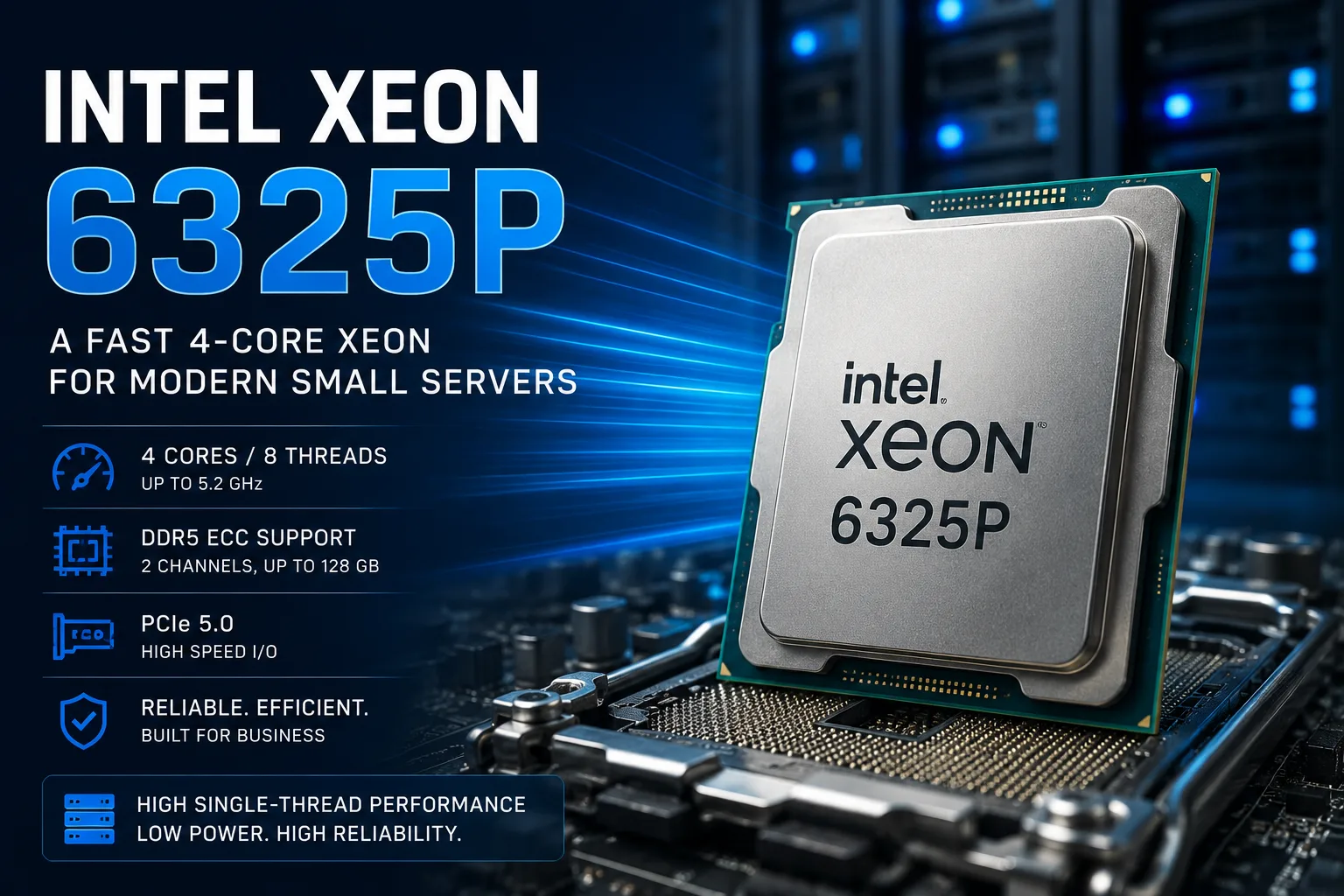
The Intel Xeon 6325P is one of the most controversial processors in the lower end of the Xeon 6 series. Formally a server CPU for 2025, it has only 4 cores, 8 threads, two memory channels, and an LGA1700 platform. Its purpose lies not in multi-threaded power but in high frequency, ECC support, and cost-effective server architecture for small systems.
What Kind of Processor Is This?
The Intel Xeon 6325P belongs to the Xeon 6300 series. While part of the Xeon 6 family, it is architecturally closer to its predecessors in the Xeon E line than to the larger Xeon Silver or Xeon Gold. It employs the Raptor Lake architecture, uses an LGA1700 socket, supports two channels of DDR5, and operates on a single-socket platform.
The main feature of the 6325P is its high frequency paired with a low core count. Its four performance cores operate at a base frequency of 3.5 GHz and can boost up to 5.2 GHz. This is a high figure for a lower-end server processor. Therefore, the 6325P should be viewed not as a universal CPU for virtualization but as a fast lower-end Xeon for light workloads.
| Specification | Intel Xeon 6325P |
|---|---|
| Lineup | Intel Xeon 6 / Xeon 6300-series |
| Architecture | Raptor Lake |
| Cores / Threads | 4 / 8 |
| Base Frequency | 3.5 GHz |
| Max Frequency | 5.2 GHz |
| Cache | 12 MB |
| TDP | 55 W |
| Memory | DDR5-4800 |
| Memory Channels | 2 |
| Max Memory Capacity | 128 GB |
| ECC | Yes |
| PCIe | PCIe 5.0 |
| Socket | FCLGA1700 |
| Configuration | 1S only |
| AVX-512 / AMX | No |
Why 4 Cores Isn’t Always a Problem
For a server in 2025, 4 cores may seem insufficient. However, these types of processors have their own niche.
The Xeon 6325P is suitable for tasks where a fast single thread is more important than a large number of parallel computations: office database, NAS, gateway, light web server, edge node, or bare metal for a single service. In such scenarios, not only the cores are valuable, but also the ECC memory, remote management via the server board, and low energy consumption.
There is also a licensing factor. Some enterprise programs calculate costs based on the number of cores. In such cases, a fast 4-core processor could be more cost-effective than a broader CPU that will remain underutilized but increases licensing costs.
Where 4 Cores Are Already Insufficient
The limitation of the Xeon 6325P is clear: four cores remain just four cores. For dense virtualization, a large number of containers, heavy databases, compilation, rendering, and multi-threaded server tasks, this processor is somewhat weak.
Even within the Xeon 6300 lineup, there are more powerful options. For example, the Xeon 6333P offers 6 cores and 12 threads with a similar maximum frequency. Higher-end models in the series go up to 8 cores. If the server is purchased with future scalability in mind, the 6325P appears too limited.
Comparison with Xeon E-2434 and Xeon 6333P
In terms of utility, the Xeon 6325P is closest to the Xeon E-2434. Both have 4 cores, 8 threads, 12 MB cache, DDR5-4800 support, and a TDP of 55 W. The difference lies in the maximum frequency: 5.2 GHz for the 6325P versus 5.0 GHz for the Xeon E-2434.
Compared to the Xeon 6333P, the situation is different. The 6325P excels in scenarios where a single fast thread and low consumption are essential. However, the 6333P, with 6 cores and 12 threads, is better suited for a server handling multiple parallel tasks.
The choice is straightforward: the 6325P offers a minimal server platform with ECC and high frequency; 6-core and 8-core Xeon 6300 options are preferable for anticipated workload increases.
AMD EPYC 4124P as a Significant Competitor
In this segment, AMD has a direct competitor in the EPYC 4124P. This is also a 4-core, 8-thread entry-level server processor but on the AM5 platform. It has a base frequency of 3.8 GHz, can boost to 5.1 GHz, features 16 MB of L3 cache, and has a TDP of 65 W.
On paper, AMD seems aggressive: more L3 cache, a higher base frequency, more PCIe lanes, and a lower official price. Intel leverages single-thread frequency and the more familiar Xeon + LGA1700 server board combination.
In this class, the whole platform's price also matters: the cost of the motherboard, IPMI, network, ECC, availability of ready-made servers, and the specific task requirements. Therefore, the 6325P is purchased not for record-breaking performance but for a simple manageable system with server functions.
Performance
According to PassMark, the Intel Xeon 6325P has an estimated score of around 16,000 points in CPU Mark and just over 4,200 points in Single Thread Rating. This reflects the character of the processor: a strong single thread and moderate multi-threaded performance.
It is a fast small server, not a replacement for older Xeon processors. The interface, light workload, file operations, and single tasks will be responsive, but parallel workloads will quickly consume the margin. Any modern 8-core Xeon or EPYC will be significantly faster in tasks that can utilize all cores.
Conclusion
The Intel Xeon 6325P is not a weak large Xeon but a highly specialized lower-end server processor. The issue is not with 4 cores, but with the name: it’s easy to expect a different class of power from a Xeon 6.
In reality, this is a fast 4-core CPU for NAS, office servers, light databases, gateways, or edge nodes. Its strengths lie in frequency, ECC, low consumption, and a manageable platform. For virtualization, dense hosting, heavy databases, and multi-threaded tasks, it is better to opt for 6-8 cores or consider AMD EPYC 4004/4005.
CPU Comparison
Compare Xeon 6325P with other CPUs
Basic
CPU Specifications
Memory Specifications
Interfaces and Ports
Benchmarks
Compared to Other CPU
Related CPU Comparisons


Share in social media
Or Link To Us
<a href="https://cputronic.com/cpu/intel-xeon-6325p" target="_blank">Intel Xeon 6325P</a>