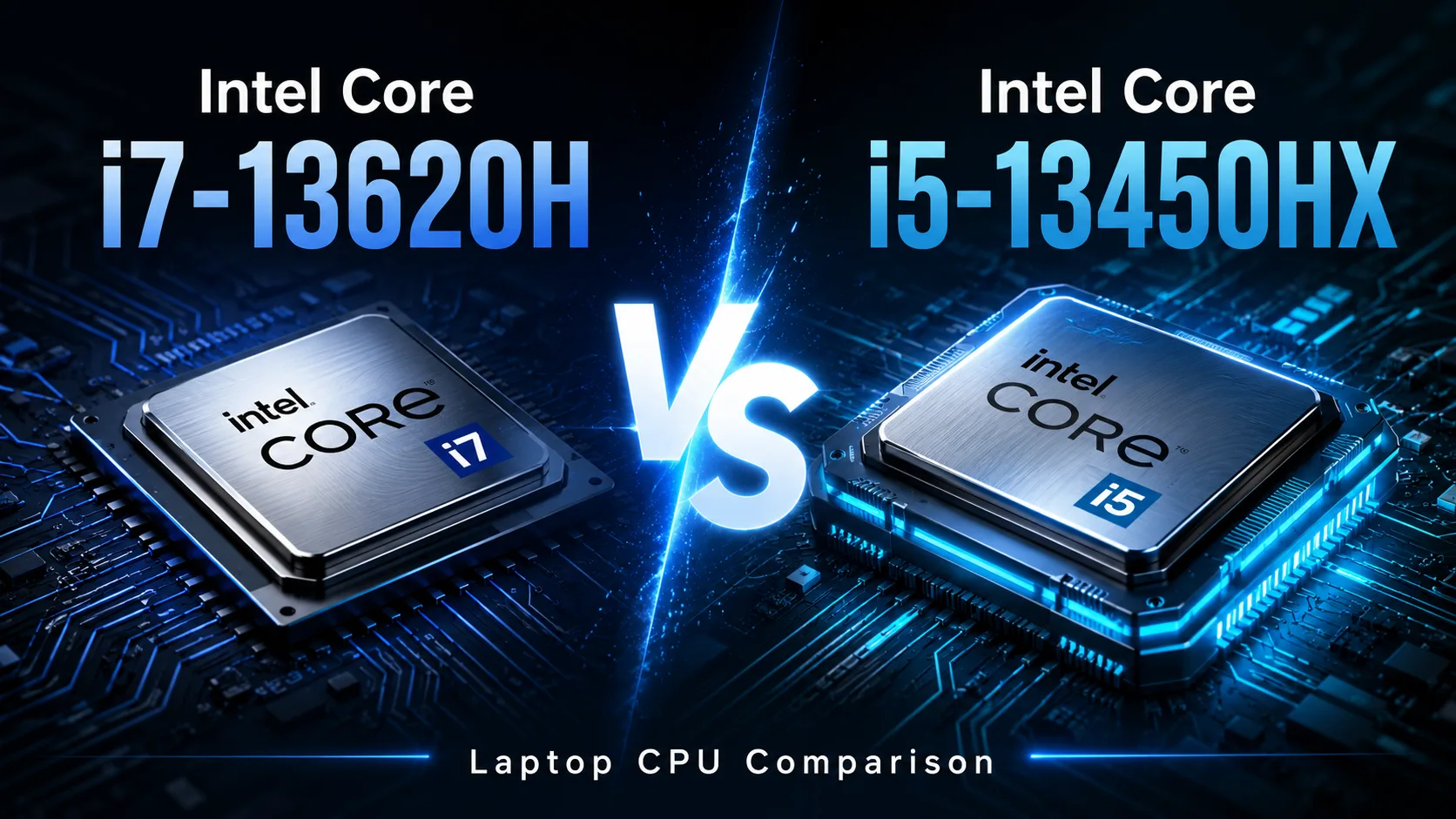
Intel Core i7-13620H
vs
Intel Core i5-13450HX
CPU Comparison Result
Intel Core i7-13620H vs Intel Core i5-13450HX: Which to Choose for a Laptop
The Intel Core i7-13620H and Core i5-13450HX belong to the 13th generation of Intel Core processors and are built on the Raptor Lake architecture. At first glance, the comparison seems ambiguous: on one hand, i7 appears higher in the lineup, while on the other, the i5-13450HX belongs to the more powerful HX series.
However, it’s important not to look solely at the name. This is not a situation where HX automatically means a faster processor. Both chips have the same core configuration: 6 performance P-cores and 4 energy-efficient E-cores, making a total of 10 cores and 16 threads. Thus, the difference between them lies not in the number of cores, but in their frequencies, cache, power limits, integrated graphics, and the positioning of laptops.
Core i7-13620H is a more versatile mobile processor. It is better suited for performance laptops that can operate well without a discrete graphics card while maintaining a high level of CPU performance.
Core i5-13450HX is designed for larger laptops, where a discrete graphics card is almost always expected, along with stronger cooling and operation from a wall socket. However, unlike the higher-end HX models, it does not offer more cores than the i7-13620H.
What H and HX Mean in the Name
The letters at the end of the Intel Core name indicate the processor class and the type of laptops they are designed for.
H - is a high-performance mobile series. These are not energy-efficient U processors, but they are better suited for relatively compact work, multimedia, and gaming laptops, where not just speed but also battery life, noise, weight, and operation in various modes are crucial.
HX - is a more powerful mobile series designed for large gaming laptops and workstations. Such processors are intended for high power limits, serious cooling, and coupling with a discrete graphics card. Laptops with HX are often closer in concept to portable desktop PCs than to classic mobile laptops.
An important nuance in this comparison is that the Core i5-13450HX is an HX platform but not an upper-tier processor in CPU characteristics. It requires more power and is more commonly found in larger laptops, but in terms of core count, it does not exceed the Core i7-13620H.
Key Differences
| Feature | Intel Core i7-13620H | Intel Core i5-13450HX |
|---|---|---|
| Processor Class | H-series | HX-series |
| Max Frequency of P-cores | up to 4.9 GHz | up to 4.6 GHz |
| Max Frequency of E-cores | up to 3.6 GHz | up to 3.4 GHz |
| L3 Cache | 24 MB | 20 MB |
| Base Power | 45 W | 55 W |
| Max Turbo Power | 115 W | 157 W |
| Integrated Graphics | Intel UHD, 64 EU | Intel UHD, 16 EU |
| Memory | DDR5-5200, DDR4-3200, LPDDR5/x, LPDDR4x | DDR5-4800, DDR4-3200 |
| Typical Laptops | more versatile and mobile | larger gaming models and workstations |
| Main Purpose | balance of CPU, iGPU, and battery life | operates in a system with a discrete GPU and powerful cooling |
Both have the same core configuration: 10 cores, 16 threads, 6P + 4E. Therefore, the table above shows the differences rather than duplicating identical parameters.
Performance in Real Tasks
In everyday work, the Core i7-13620H often appears more favorable. It has a higher maximum frequency, more cache, and lower power consumption. In browsing, office applications, launching apps, document work, light photo editing, and standard multitasking, it may feel faster or at least no worse.
The Core i5-13450HX is more interesting in another scenario. It has a higher maximum turbo power limit: 157 W compared to 115 W. This means that in a larger laptop with good cooling, it can maintain high power consumption for longer periods and show decent results under sustained load.
However, it does not have the same advantage as older HX processors with higher core counts. The i5-13450HX has the same 6P + 4E configuration as the i7-13620H. Therefore, its advantage in heavy tasks is not guaranteed and largely depends on the specific laptop.
In resource-intensive tasks like rendering, compiling, video processing, and engineering calculations, the outcome will depend on three factors:
- power limits;
- cooling quality;
- duration of the load.
If the i5-13450HX is housed in a large laptop with a good cooling system, it can be very competitive. But if the cooling is average, the Core i7-13620H, with its higher frequencies and larger cache, may prove just as good, if not better, in regular work.
Gaming and Integrated Graphics: The Main Difference in Positioning
The most notable difference between these processors is the integrated graphics.
At first glance, the situation seems odd: the Core i7-13620H belongs to the regular H-series but has Intel UHD Graphics with 64 execution units. In contrast, the Core i5-13450HX, despite being on the "heavier" HX platform, has only 16 execution units. But this is not a mistake; it reflects their different positioning.
The Core i7-13620H is better equipped to function without a discrete graphics card. Its integrated graphics are suitable for image output, hardware-accelerated video, interface handling, everyday graphics, and light gaming. This processor can be used in laptops where a separate GPU may not exist at all, while still providing high CPU performance.
This is a significant advantage for more mobile devices. A laptop with the i7-13620H can be powerful, relatively compact, and capable of longer battery life because it does not constantly rely on a discrete graphics card.
The Core i5-13450HX, on the other hand, is almost not intended for standalone operation of the integrated graphics. Its iGPU with 16 EU is primarily for basic image output and energy-saving modes. Serious graphical workloads in such laptops must almost always rely on a discrete graphics card.
This is where the manufacturer’s logic is clear:
- i7-13620H - a more self-sufficient mobile platform;
- i5-13450HX - a processor for a system where a discrete graphics card is nearly mandatory;
- the i7 has a stronger integrated graphics because it must be capable of working without a separate GPU;
- the i5 HX has a weak iGPU because HX laptops are usually not purchased for the integrated graphics.
In games, the Core i5-13450HX makes sense primarily in conjunction with a discrete graphics card. Without it, its weak iGPU sharply limits gaming capabilities. The Core i7-13620H also does not turn into a fully-fledged gaming processor without a discrete GPU, but it is considerably more practical for light games and basic graphics.
Therefore, comparing these chips only by CPU performance is incorrect. The i7-13620H is better suited for a versatile laptop without a mandatory discrete graphics card, while the i5-13450HX is for a large laptop where a separate graphics card is part of the very idea of the device.
Cooling, Noise, and Battery Life
The Core i7-13620H is easier to fit into a relatively compact chassis. Its base power is 45 W, and its maximum turbo power is 115 W. This is still a powerful mobile processor, but it is better suited for laptops where balancing speed, noise, and battery life is essential.
The Core i5-13450HX has a base power of 55 W and a maximum turbo power of 157 W. This implies different cooling requirements. Such a processor needs a larger chassis, powerful fans, and effective heat dissipation.
It is crucial to understand that the increased power consumption of the i5-13450HX does not come with a corresponding increase in core count compared to the i7-13620H. Thus, the buyer gains not "more cores" but a heavier platform meant for powerful cooling and discrete graphics.
In terms of battery life, the advantage will usually go to the Core i7-13620H. It is more energy-efficient, has a more powerful integrated GPU, and is better suited for scenarios where the laptop must operate without being constantly plugged in.
Who Should Consider the Intel Core i7-13620H
The Core i7-13620H will often be the better choice for most users looking for a fast, versatile laptop.
It is well-suited for:
- performance laptops without a discrete graphics card;
- more compact work and multimedia models;
- studying and programming;
- office work and multitasking;
- photo editing;
- amateur and semi-professional video editing;
- light gaming and basic graphics using the integrated GPU;
- traveling;
- users for whom weight, noise, and battery life are important.
The main advantage of the i7-13620H is balance. It does not require as heavy a platform as the HX, yet offers high processor performance, good frequencies, 24 MB of cache, and significantly stronger integrated graphics.
Who Should Consider the Intel Core i5-13450HX
The Core i5-13450HX should be considered if the laptop is being chosen primarily as a gaming or workstation system with a discrete graphics card.
It is suitable for:
- gaming laptops with a separate GPU;
- entry-level workstations;
- tasks where the laptop often runs off the wall socket;
- users for whom stability under load is more important than battery life;
- scenarios where chassis and cooling are more crucial than compactness.
However, buying the i5-13450HX just for the HX label is not very meaningful. Unlike the older HX processors, it does not offer more cores than the i7-13620H. Its advantage is only revealed in the right laptop: one with good cooling, appropriate power limits, and a discrete graphics card.
Competitors
The close competitors for the Core i7-13620H include the Intel Core i7-13700H, Core i7-13720H, AMD Ryzen 7 7840HS, and Ryzen 7 8845HS. The Ryzen 7 7840HS and 8845HS are particularly strong, offering good energy efficiency and significantly more powerful Radeon 780M integrated graphics.
For the Core i5-13450HX, competitors include the Intel Core i5-13500HX, Core i7-13650HX, AMD Ryzen 7 7745HX, and Ryzen 5/7 HX-series in large gaming laptops. However, it is especially important here to consider not just the CPU but also the graphics card, cooling, and overall laptop configuration.
Conclusion
The Intel Core i7-13620H and Core i5-13450HX are not simply comparisons of i7 vs. i5 or H vs. HX. This is a comparison of two distinct approaches to laptops.
The Core i7-13620H should be chosen if you need a fast, relatively mobile, and versatile laptop. It has the same core configuration as the i5-13450HX but offers higher frequencies, more cache, lower power consumption, and significantly stronger integrated graphics. It is better prepared to operate independently without a discrete graphics card.
The Core i5-13450HX should be chosen if the laptop is being bought as a large gaming or workstation system with a discrete GPU. Its weak integrated graphics are logical: the HX platform is not designed for standalone iGPU use but for coupling with a separate graphics card and powerful cooling.
If a versatile laptop that can operate without discrete graphics is needed, it’s better to look at the Core i7-13620H. If a large laptop with a discrete graphics card and good cooling is desired, the Core i5-13450HX can also be a reasonable option, but the HX label alone does not make it better.
Advantages
- Higher Max Turbo Frequency: 4.90 GHz (4.90 GHz vs 4.60 GHz)
- Larger L3 Cache: 24 MB (24 MB vs 20 MB)
Basic
CPU Specifications
Memory Specifications
GPU Specifications
AI Specifications
Interfaces and Ports
Miscellaneous
Benchmarks
Related CPU Comparisons


Share in social media
Or Link To Us
<a href="https://cputronic.com/cpu/compare/intel-core-i7-13620h-vs-intel-core-i5-13450hx" target="_blank">Intel Core i7-13620H vs Intel Core i5-13450HX</a>