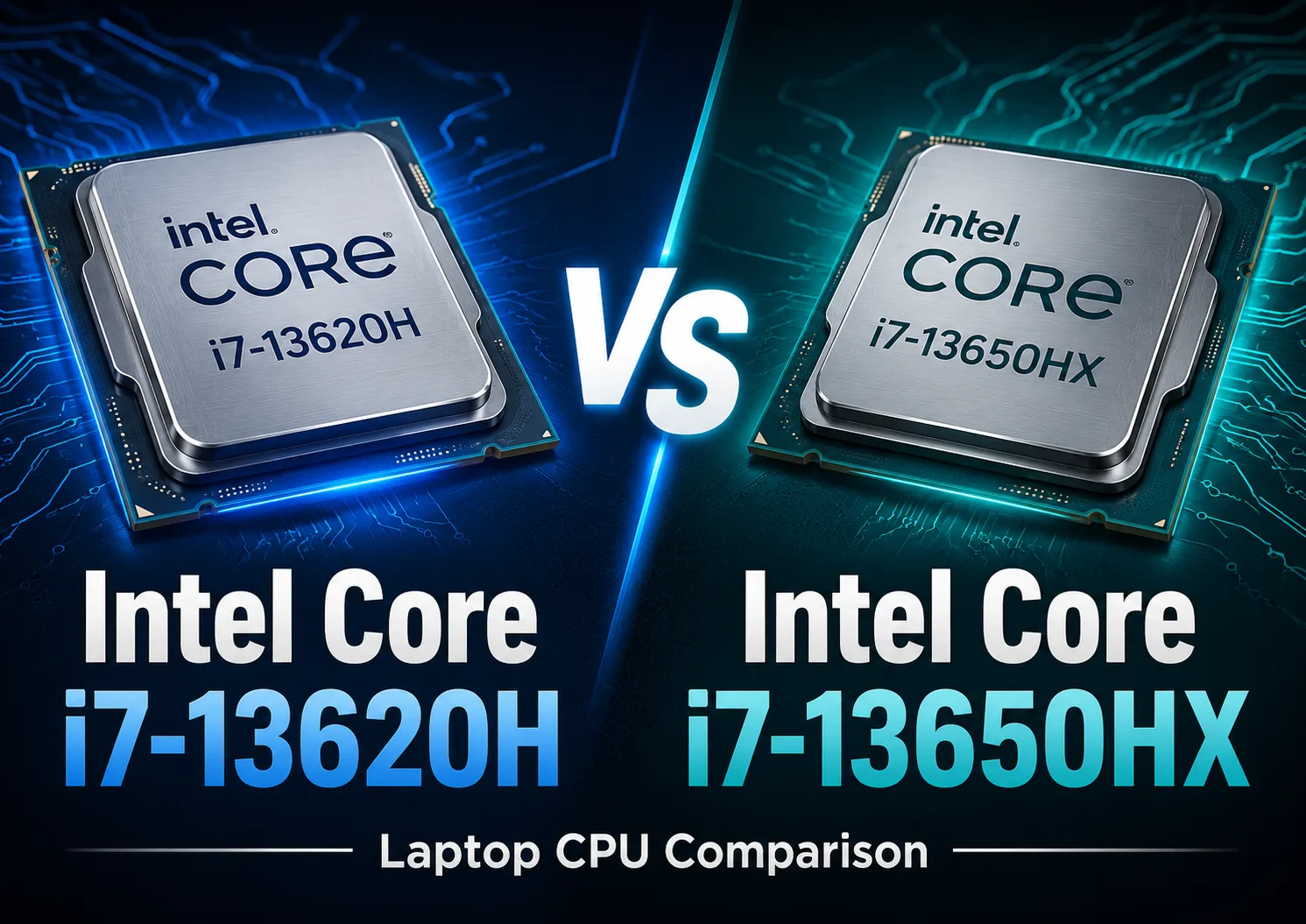
Intel Core i7-13650HX
vs
Intel Core i7-13620H
CPU Comparison Result
Intel Core i7-13650HX vs Intel Core i7-13620H: Which to Choose for a Laptop
The Intel Core i7-13650HX and Core i7-13620H belong to the 13th generation of Intel Core processors and are built on the Raptor Lake architecture. At first glance, they seem similar: both feature 6 performance P-cores, comparable single-thread performance, and a maximum frequency of up to 4.9 GHz. However, in practice, these processors target different classes of laptops.
Core i7-13620H is a processor designed for high-performance mobile laptops, where not just CPU power is important but also battery life, weight, noise, and the ability to operate without a discrete graphics card.
Core i7-13650HX is a more powerful processor for large gaming laptops and mobile workstations. It excels in heavy multi-threaded tasks but requires serious cooling and almost always assumes the presence of a discrete graphics card.
The main difference between them lies not in the maximum frequency but in the number of energy-efficient cores, power limits, integrated graphics, and overall platform positioning.
What H and HX Mean in the Processor Name
The letters at the end of the Intel Core name indicate the processor class.
H - high-performance mobile series. It is not the economical U series, but compared to HX, such processors are better suited for thinner and more versatile laptops. They are used where high performance is needed, but weight, battery life, and the ability to work in different modes are also important.
HX - the top mobile series from Intel for large gaming laptops and workstations. These processors are designed for high power limits, prolonged loads, and serious cooling systems. Laptops with HX are often seen as replacements for desktop PCs: they can be transported, but are not focused on lightweight design or long battery life.
In simpler terms: H is a powerful laptop processor for versatile devices, while HX is a processor for a large system closely akin to a gaming or workstation PC.
However, the HX index itself does not guarantee better performance. If cooling is inadequate, the processor won't be able to maintain high performance for long periods.
Key Differences
| Characteristic | Intel Core i7-13620H | Intel Core i7-13650HX |
|---|---|---|
| Processor Class | H-series | HX-series |
| Core Configuration | 6P + 4E | 6P + 8E |
| Cores / Threads | 10 / 16 | 14 / 20 |
| Base Power | 45 W | 55 W |
| Maximum Turbo Power | 115 W | 157 W |
| Integrated Graphics | Intel UHD, 64 EU | Intel UHD, 16 EU |
| Typical Laptops | thinner and more versatile | larger gaming models and workstations |
| Main Purpose | balance of power and mobility | faster performance in prolonged multi-threaded tasks |
Both processors have the same number of P-cores, so in light tasks and many games, they can be closer in performance than their names suggest. The advantage of the i7-13650HX becomes evident in scenarios where all cores are utilized and the laptop is designed for extended heavy loads.
Performance in Real Tasks
In everyday work, the difference between the Core i7-13620H and Core i7-13650HX is typically minimal. Browsing, office applications, messaging, video calls, working with documents, and running applications do not require 14 cores. In such scenarios, a fast SSD, sufficient RAM, and good optimization of the laptop itself are more critical.
The Core i7-13650HX becomes more appealing in demanding tasks:
- rendering;
- compiling large projects;
- 3D graphics;
- video processing;
- engineering calculations;
- batch photo processing;
- prolonged multi-threaded workloads.
Here, the additional E-cores and higher power limit provide a noticeable advantage. In a well-cooled laptop, the i7-13650HX can be around 20-35% faster in heavy multi-threaded work. However, the overall difference depends on the specific model: inadequate cooling can easily diminish the HX's advantage.
It's important to understand that the i7-13650HX does not automatically make a laptop faster in all tasks. In browsing, office work, program launches, and other short tasks, it won't feel like a different class of processor. Its purpose is not to provide “magical” interface speeds but to ensure stable performance under prolonged loads.
Gaming and Integrated Graphics: Different Positioning
The difference between the Core i7-13620H and Core i7-13650HX is clearly seen in their integrated graphics. At first glance, this may seem odd: the more powerful Core i7-13650HX has weaker integrated graphics, while the more mobile Core i7-13620H features considerably stronger graphics. However, this illustrates the positioning of the processors well.
Core i7-13620H is equipped with Intel UHD Graphics with 64 execution units. This makes it better suited for laptops that don’t need to rely on a discrete graphics card constantly. Such a chip can be used in high-performance mobile models, multimedia devices, and versatile laptops where a discrete GPU is not an essential part of the system.
In this scenario, integrated graphics are important not just for image output. They are responsible for power-saving mode, battery operation, video, interfaces, basic graphics, and light gaming. Thus, the i7-13620H is not merely a “junior processor”. It is better prepared for laptops where high CPU performance is required, but a separate graphics card may be absent.
This approach makes sense for devices that need to remain relatively mobile, last longer on battery, and not fall into the category of heavy gaming laptops.
Core i7-13650HX, on the other hand, has integrated graphics with only 16 execution units. This configuration indicates that integrated graphics are not a priority in the HX series. The logic is different: the HX series is designed for large gaming laptops and mobile workstations, where a discrete NVIDIA GeForce or AMD Radeon graphics card is almost always present.
Therefore, the weak integrated graphics of the i7-13650HX do not present a disadvantage within its class. The platform configuration shows that this processor is primarily designed to operate in tandem with a separate graphics card. Its goal is to provide high CPU performance, especially in prolonged multi-threaded loads, rather than to replace discrete graphics.
In gaming, this means the following:
- Core i7-13620H is more appealing for more mobile laptops that can operate without a discrete GPU or use it sporadically;
- Core i7-13650HX is intended for gaming laptops and workstations where a discrete graphics card is an almost mandatory part of the system;
- for light games, everyday graphics, video, and battery operation, the i7-13620H appears more practical due to its stronger iGPU;
- for serious gaming, the i7-13650HX makes sense primarily in conjunction with a powerful discrete graphics card.
This is why it is incorrect to compare them merely as “one is faster, the other is slower.” The i7-13620H is a more versatile mobile platform capable of functioning well without a discrete graphics card, while the i7-13650HX is a processor for a laptop that is fundamentally closer to a gaming PC.
Cooling, Noise, and Battery Life
The Core i7-13620H is easier to fit into a compact chassis and keep at comfortable temperatures. It is still a high-performance mobile processor, but it can be found in thinner and more versatile laptops. Such models tend to be lighter, quieter during normal operation, and better suited for portability.
The Core i7-13650HX demands a more robust chassis. With a higher maximum turbo power, the laptop requires large heat sinks, multiple fans, and an aggressive cooling profile. Under prolonged loads, such laptops are usually noisier, hotter, and more dependent on a power outlet.
In terms of battery life, the advantage typically lies with the Core i7-13620H. Laptops with HX processors are rarely purchased for long off-grid use. These devices are built for maximum performance, not light mobile scenarios.
Who Should Choose Intel Core i7-13620H
The Core i7-13620H is the better choice for most users who need a fast, versatile laptop.
It is well suited for:
- high-performance laptops without a discrete graphics card;
- thin work and multimedia models;
- studying and programming;
- office work and multitasking;
- photo processing;
- amateur and semi-professional video editing;
- light gaming and basic graphics on the integrated GPU;
- working on the go;
- users who value weight, noise, and battery life.
This is a rational option if the laptop is needed not only for high CPU performance but also for normal everyday use without a mandatory reliance on a discrete graphics card.
Who Should Choose Intel Core i7-13650HX
The Core i7-13650HX should be chosen if the laptop is needed as a replacement for a desktop PC.
It is better suited for:
- long rendering tasks;
- heavy compiling;
- 3D modeling;
- engineering calculations;
- working with large projects;
- gaming in conjunction with a powerful discrete graphics card;
- scenarios where the laptop primarily remains on a desk and plugged in.
This processor makes sense if you really utilize multi-threaded performance. There is little point in buying an HX just for browsing, office tasks, or casual gaming.
Competitors
The main competitors for the Core i7-13620H are the Intel Core i7-13700H, Core i7-13720H, AMD Ryzen 7 7840HS, and Ryzen 7 8845HS. The Ryzen 7 7840HS and 8845HS are particularly interesting as they often excel in energy efficiency and feature more powerful integrated Radeon 780M graphics.
The competitors of the Core i7-13650HX are different: Intel Core i7-13700HX, Core i7-14650HX, Core i9-13900HX, AMD Ryzen 7 7745HX, and Ryzen 9 7845HX. This is already the heavyweight category of gaming laptops and mobile workstations, where not only CPU specifications matter but also cooling, graphics cards, and power limits.
Conclusion
The Intel Core i7-13620H and Core i7-13650HX are not merely junior and senior versions of the same processor. They are solutions for different types of laptops.
The Core i7-13620H should be chosen if you need a fast and relatively mobile laptop that can operate well without a discrete graphics card. It has fewer cores, but it has stronger integrated graphics, lower power consumption, and more versatile positioning. It's not the most powerful option, but for everyday work, studying, multimedia, light gaming, and mobile scenarios, it is often more practical.
The Core i7-13650HX should be selected if the laptop is being purchased as a replacement for a desktop PC. It is faster in sustained multi-threaded tasks but almost always assumes the use of a discrete graphics card, a large chassis, and serious cooling. Its weak integrated graphics make sense: the HX platform is designed not for standalone iGPU operation but for pairing with a separate GPU.
If you need a versatile laptop that can function without discrete graphics, it's better to look at the Core i7-13620H. If maximum CPU performance in heavy tasks is the goal and the laptop will primarily be used while plugged in, the Core i7-13650HX will be stronger.
Advantages
- More Total Cores: 14 (14 vs 10)
Basic
CPU Specifications
Memory Specifications
GPU Specifications
AI Specifications
Interfaces and Ports
Miscellaneous
Benchmarks
Related CPU Comparisons


Share in social media
Or Link To Us
<a href="https://cputronic.com/cpu/compare/intel-core-i7-13650hx-vs-intel-core-i7-13620h" target="_blank">Intel Core i7-13650HX vs Intel Core i7-13620H</a>