AMD Ryzen 7 170
vs
Intel Core i7-13620H
CPU Comparison Result
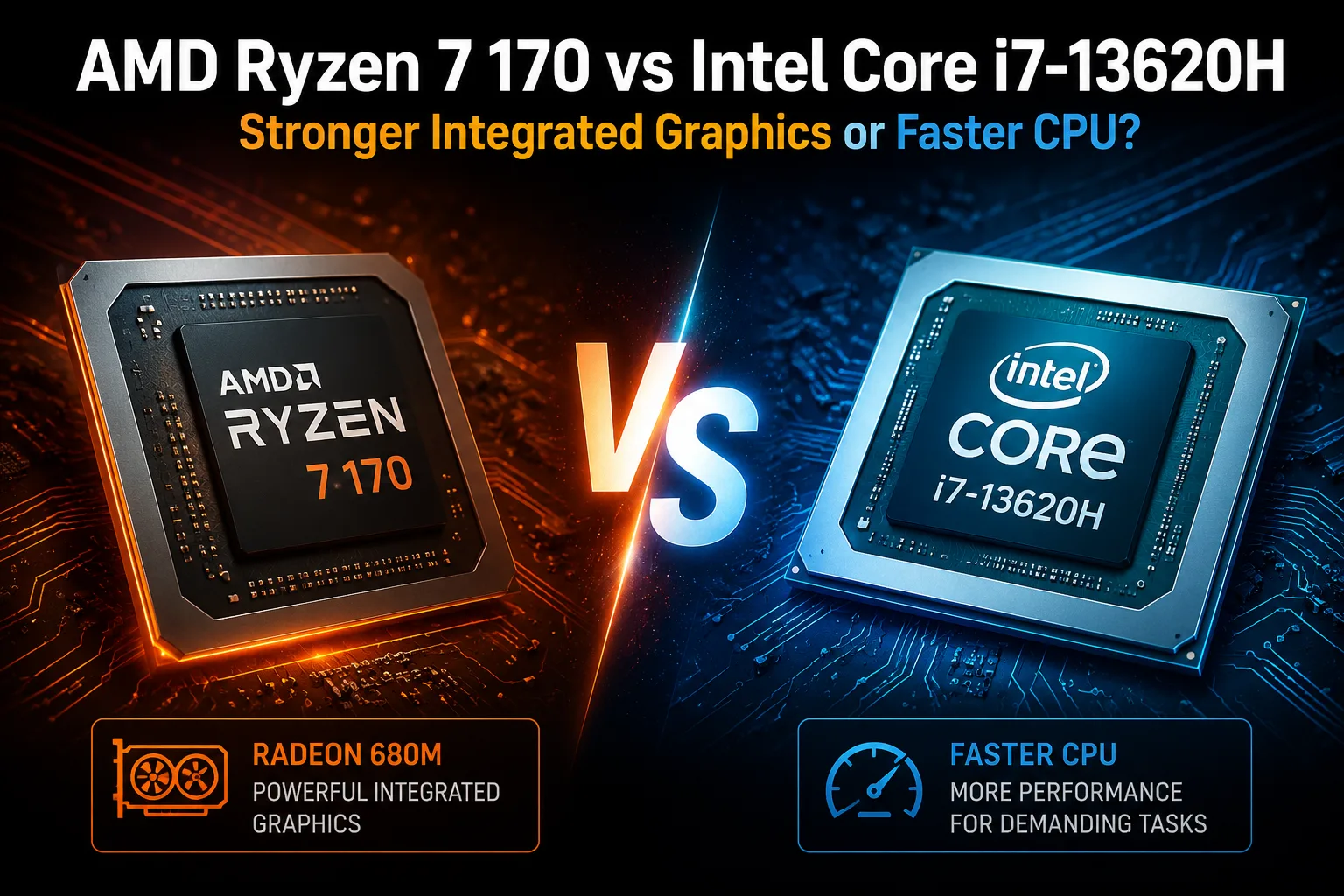
AMD Ryzen 7 170 vs Intel Core i7-13620H: Strong Integrated Graphics or Faster CPU
At first glance, the Ryzen 7 170 seems newer than the Core i7-13620H, but this impression is misleading. Behind the fresh branding lies the familiar Rembrandt with Zen 3+ cores and Radeon 680M graphics. Intel's chip came out earlier but features noticeably faster CPU cores. Therefore, the choice is simple: with a discrete GPU, the Core i7-13620H makes more sense, while without one, the Ryzen 7 170 is the better option.
Ryzen 7 170: Essentially Familiar Rembrandt
The Ryzen 7 170 combines eight Zen 3+ cores, 16 threads, and Radeon 680M graphics - the same configuration that defined the mobile Rembrandt platform. There is no new architecture here; AMD has simply reintroduced a familiar chip under a different label.
The Core i7-13620H is structured differently. It is a hybrid Raptor Lake with six performance cores and four efficiency cores. It also supports 16 threads, boosts up to 4.9 GHz, and features 24 MB of L3 cache compared to 16 MB in Ryzen.
| Parameter | AMD Ryzen 7 170 | Intel Core i7-13620H |
|---|---|---|
| Architecture | Zen 3+ | Raptor Lake |
| Cores and Threads | 8/16 | 10/16: 6 performance + 4 efficiency |
| Max Boost Clock | 4.75 GHz | 4.9 GHz |
| L3 Cache | 16 MB | 24 MB |
| Integrated Graphics | Radeon 680M | Intel UHD Graphics |
Core i7-13620H is Faster in CPU Tasks
Intel's performance cores outperform in tasks where single-thread speed is crucial. This advantage is evident in compiling, archiving, photo editing, and video exporting.
The four efficiency cores handle background processes and boost performance in multi-threaded workloads. Under adequate cooling, the Core i7-13620H surpasses the Ryzen 7 170 in both single-threaded and multi-threaded benchmarks.
All eight cores of the Ryzen 7 170 are identical. This configuration is simpler, but in terms of speed, Zen 3+ is already lagging behind Raptor Lake.
However, it's not enough to compare just the CPUs. Two laptops with the same chip can differ significantly in speed compared to models with different processors. The CPU determines potential performance, while cooling and power limits dictate whether that performance can be maintained under sustained loads.
Without Discrete Graphics, AMD Comes Out Ahead
It is the Radeon 680M that makes the Ryzen 7 170 a more practical choice in laptops without a dedicated GPU. The RDNA 2 architecture graphics features 12 compute units and significantly outperforms Intel's integrated GPU.
The Radeon 680M is suitable for esports and relatively undemanding games. Many can be played on low or medium settings, sometimes requiring reduced resolution. For smooth performance, fast RAM in dual-channel mode is essential.
Intel UHD Graphics in the Core i7-13620H is meant for simpler tasks. It handles interface, video, office applications, and external display connections well, but for gaming, the Intel CPU requires a discrete GPU.
Thus, in a laptop without a separate GPU, the Ryzen 7 170 is more practical. It may be slower in CPU tasks, but it allows gaming without a GeForce or Radeon RX.
With Discrete Graphics, the Advantage of Radeon 680M Nearly Disappears
If both laptops are equipped with the same discrete graphics card, the capabilities of the Radeon 680M cease to be a deciding factor. In this case, the Core i7-13620H takes the lead due to its faster CPU cores.
The Intel advantage is more noticeable in CPU-dependent games and during simultaneous video recording. It is also quicker in rendering, compiling, and exporting if cooling does not restrict clock speeds under sustained loads.
However, it is crucial to compare complete laptops. A model with the Ryzen 7 170 and RTX 4060, without stringent power limits, could outpace a device with the Core i7-13620H and a restricted GPU limit.
In a gaming laptop, the power of the graphics card and the quality of cooling often outweigh the difference between these two processors.
What to Choose
Choose Ryzen 7 170 if:
- The laptop is sold without a discrete GPU;
- Gaming on integrated graphics is required;
- The AMD model is significantly cheaper.
Core i7-13620H is a better fit if:
- The laptop includes a discrete GPU;
- The speed of CPU cores is crucial;
- The cooling solution is designed for sustained high loads.
Conclusion
The Core i7-13620H is faster in CPU tasks and better suited for laptops with a discrete GPU. The Ryzen 7 170 lags in core speed but its Radeon 680M allows gaming without a dedicated GPU.
Therefore, the choice should not be based solely on the newer branding but on the overall configuration of the laptop.
Advantages
- Higher Technology: TSMC 6nm FinFET (TSMC 6nm FinFET vs Intel 7)
- Newer Launch Date: October 2025 (October 2025 vs January 2023)
- More Total Cores: 10 (8 vs 10)
- Higher Max Turbo Frequency: 4.90 GHz (Up to 4.75 GHz vs 4.90 GHz)
- Larger L3 Cache: 24 MB (16 MB vs 24 MB)
Basic
CPU Specifications
Memory Specifications
GPU Specifications
Miscellaneous
Benchmarks
Related CPU Comparisons



Share in social media
Or Link To Us
<a href="https://cputronic.com/cpu/compare/amd-ryzen-7-170-vs-intel-core-i7-13620h" target="_blank">AMD Ryzen 7 170 vs Intel Core i7-13620H</a>