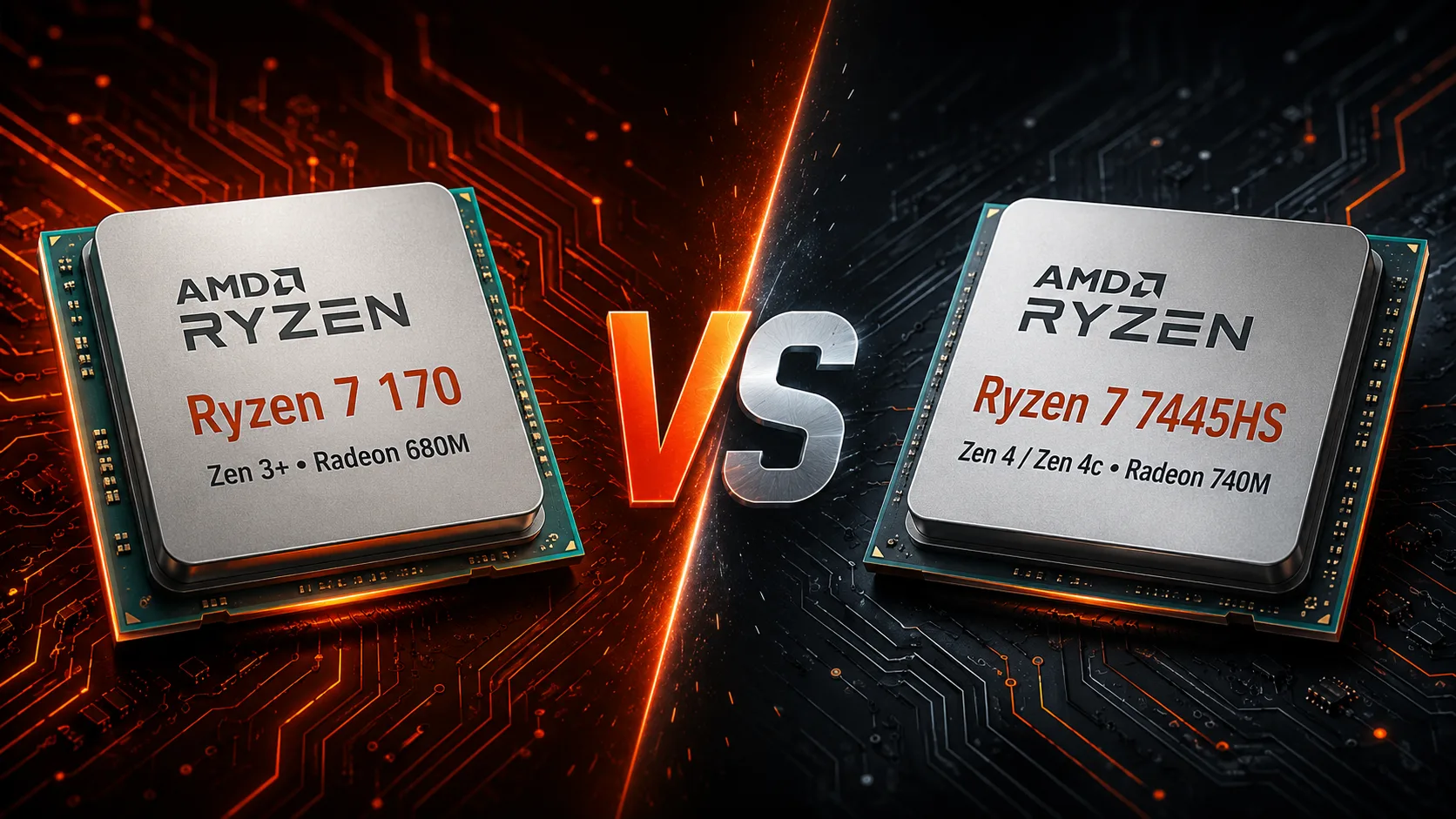
AMD Ryzen 7 170
vs
AMD Ryzen 7 7445HS
CPU Comparison Result
Ryzen 7 170 or Ryzen 7 7445HS: What Matters More - Eight Cores or New Architecture
The Ryzen 7 170 was released later but uses the Zen 3+ architecture. The Ryzen 7 7445HS has fewer cores, but they belong to the more modern Zen 4 generation. The first is faster in multi-threaded tasks and comes with a Radeon 680M, while the latter excels in single-threaded performance.
The model number here reveals little about actual speed: one processor has more cores and stronger integrated graphics, while the other has a more modern architecture and higher single-core performance.
Ryzen 7 170: A New Name for a Familiar Processor
The Ryzen 7 170 is built on the Rembrandt die and includes eight Zen 3+ cores with support for 16 threads. It is closely related in configuration to the Ryzen 7 7735HS.
Eight cores give the Ryzen 7 170 an advantage in rendering, compiling, and multitasking with several resource-heavy applications. It also features the Radeon 680M with 12 compute units-one of the most powerful integrated GPUs based on the RDNA 2 architecture.
The Ryzen 7 7445HS combines two Zen 4 cores and four compact Zen 4c cores-totaling six cores and 12 threads. The Zen 4c cores differ primarily in having a smaller die size and lower operating frequencies, while maintaining the same architectural foundation.
Key Differences
| Specification | Ryzen 7 170 | Ryzen 7 7445HS |
|---|---|---|
| Architecture | Zen 3+ | 2 × Zen 4 + 4 × Zen 4c |
| Cores / Threads | 8 / 16 | 6 / 12 |
| Max Frequency | 4.75 GHz | 4.7 GHz |
| L2 Cache | 4 MB | 6 MB |
| L3 Cache | 16 MB | 16 MB |
| Manufacturing Process | 6 nm | 4 nm |
| Power Range | 35-54 W | 20-40 W |
| Memory | DDR5-4800 | DDR5-5600, LPDDR5X-7500 |
| Integrated Graphics | Radeon 680M, 12 CU | Radeon 740M, 4 CU |
| AVX-512 | No | Yes |
The Ryzen 7 7445HS supports faster memory, AVX-512, USB4, and hardware encoding and decoding of AV1. The advantages of the Ryzen 7 170 are two additional cores and significantly more powerful integrated graphics.
Processor Performance
According to existing benchmarks, the Ryzen 7 7445HS is about 10% faster in the single-threaded PassMark test. Thanks to Zen 4, it outperforms in single-threaded and lightly parallelized tasks.
In multi-threaded tests, the Ryzen 7 170 surpasses its competitor by about 10-15%. The two additional cores give it an edge in rendering, archiving, compiling, and other tasks capable of utilizing all threads.
| PassMark | Ryzen 7 170 | Ryzen 7 7445HS |
|---|---|---|
| Single Thread | around 3160 | around 3470 |
| CPU Mark | around 20,900 | around 18,600 |
Exact results depend on cooling and power settings of the specific laptop.
Radeon 680M vs. Radeon 740M
In terms of integrated graphics, the Ryzen 7 170 is significantly stronger than its opponent. The Radeon 680M features 12 RDNA 2 compute units and operates at up to 2.2 GHz.
The Radeon 740M in the Ryzen 7 7445HS utilizes the newer RDNA 3 architecture but has only four compute units. The more modern architecture does not compensate for the threefold difference in quantity.
The Radeon 680M is better suited for less demanding and older games, emulators, and new projects at low settings. The performance of both integrated GPUs heavily depends on memory bandwidth, so the RAM configuration is crucial.
In a gaming laptop with a GeForce, the advantage of the Radeon 680M nearly disappears. In games, the discrete GPU handles most of the load, while the integrated GPU is used for everyday tasks and when operating on battery power.
In such a configuration, the single-threaded performance of the Ryzen 7 7445HS becomes more important. It may slightly boost frame rates in CPU-sensitive games. However, during simultaneous gaming, video recording, and running background applications, six cores may not suffice.
Power Consumption
The Ryzen 7 7445HS is manufactured using a 4nm process and has a power range of 20-40 W. The Ryzen 7 170 uses a 6nm process and operates within 35-54 W.
The lower power range makes cooling the Ryzen 7 7445HS easier in thin laptops. However, noise and battery life depend on the specific model: its display, battery, cooling system, and factory power settings.
Which to Choose
The Ryzen 7 170 is better suited for laptops without discrete graphics, as well as for rendering, compiling, and other multi-threaded workloads.
The Ryzen 7 7445HS makes sense to consider primarily in laptops with discrete graphics where the weak Radeon 740M does not become a limitation. It is faster on a per-core basis, supports faster memory, AVX-512, USB4, and hardware encoding and decoding of AV1.
At the same price point, the Ryzen 7 170 is preferable: it is faster in multi-threaded tasks and has significantly more powerful integrated graphics. The Ryzen 7 7445HS is more interesting in a laptop with a discrete graphics card, especially when USB4, AV1, and faster memory are important.
Advantages
- More Total Cores: 8 (8 vs 6)
- Higher Max Turbo Frequency: Up to 4.75 GHz (Up to 4.75 GHz vs 4.7 GHz)
- Newer Launch Date: October 2025 (October 2025 vs May 2023)
- Higher Technology: TSMC 4nm FinFET (TSMC 6nm FinFET vs TSMC 4nm FinFET)
Basic
CPU Specifications
Memory Specifications
GPU Specifications
Miscellaneous
Benchmarks
Related CPU Comparisons






Share in social media
Or Link To Us
<a href="https://cputronic.com/cpu/compare/amd-ryzen-7-170-vs-amd-ryzen-7-7445hs" target="_blank">AMD Ryzen 7 170 vs AMD Ryzen 7 7445HS</a>