AMD Ryzen 5 150
vs
AMD Ryzen 7 7730U
CPU Comparison Result
AMD Ryzen 5 150 vs AMD Ryzen 7 7730U: Six Fast Cores or Eight Efficient Ones?
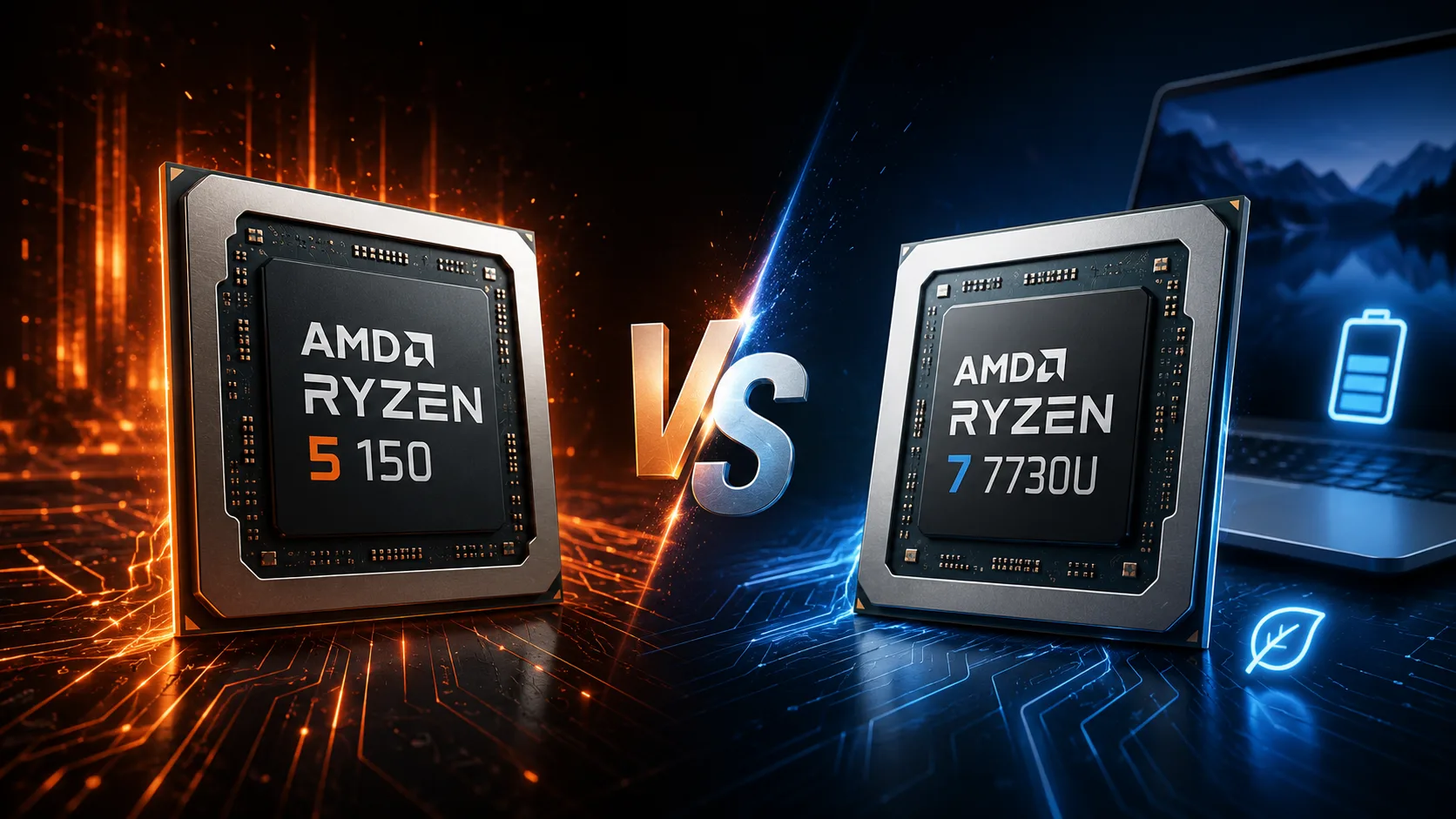
The labeling suggests that the Ryzen 7 7730U should be a higher-class processor, but in this comparison, the name can be misleading. It does indeed have more cores, but the Ryzen 5 150 operates at a significantly higher power limit, supports modern memory, and utilizes RDNA 2 graphics. Ultimately, the choice is determined not by the number 5 or 7, but by the type of laptop: a performance model or a compact device focused on battery life.
Key Differences
| Feature | AMD Ryzen 5 150 | AMD Ryzen 7 7730U |
|---|---|---|
| Architecture | Zen 3+ | Zen 3 |
| Cores / Threads | 6 / 12 | 8 / 16 |
| Frequencies | 3.3-4.55 GHz | 2.0-4.5 GHz |
| L3 Cache | 16 MB | 16 MB |
| TDP | 45 W | 15 W |
| Process Technology | 6 nm | 7 nm |
| Memory | DDR5, LPDDR5 | DDR4, LPDDR4X |
| Integrated Graphics | Radeon 660M, 6 CU | Radeon Vega 8, 8 CU |
| PCIe Interface | PCIe 4.0 | PCIe 3.0 |
The Ryzen 5 150 belongs to the Rembrandt platform and combines six Zen 3+ cores with Radeon 660M graphics. The Ryzen 7 7730U is based on Barcelo R: it features eight Zen 3 cores and integrated Vega graphics. Both processors use familiar AMD architectures, but the Ryzen 5 benefits from more modern memory and peripheral interfaces.
CPU Performance
On the side of the Ryzen 7 7730U are two additional cores and four threads. This is a significant advantage for rendering, video encoding, and other tasks that can load all compute units evenly. However, it is not possible to compare only the number of cores here.
The Ryzen 7 7730U was designed for thin laptops and nominally operates in the 15-watt class. The Ryzen 5 150 is designed for 45 W with the possibility to configure power in the range of 35-54 W. This allows its six cores to maintain higher frequencies under load for longer periods.
In short, single-threaded tasks, the advantage will most likely remain with the Ryzen 5 150. Its higher base frequency and increased power headroom help it perform operations faster that do not utilize all available threads.
In extended multi-threaded loads, the result depends more on the specific laptop. The Ryzen 5 150 can compensate for the lack of two cores with higher power consumption, but a well-tuned Ryzen 7 7730U can also show decent results. Therefore, declaring one processor an unequivocal winner would be incorrect.
Factors influencing overall speed include:
- Manufacturer-set power limits;
- Effectiveness of the cooling system;
- Duration of the load;
- Power mode of the laptop;
- Temperature of the CPU and chassis.
In a powerful chassis, the Ryzen 5 150 usually receives more favorable conditions. In a thin laptop, the advantages of the Ryzen 7 7730U are not so much in maximum speed as in performance per watt.
Radeon 660M vs Vega 8
The integrated graphics of the Ryzen 5 150 utilize RDNA 2 architecture and consist of six compute units. The Ryzen 7 7730U has eight Vega units. Directly comparing them by the number of compute units isn't valid: Radeon 660M is built on a newer architecture and works with DDR5 or LPDDR5.
Faster memory is particularly important for integrated graphics since it lacks its own video buffer. Therefore, Radeon 660M usually has an edge in modern gaming and graphics workloads. However, the gap is not guaranteed: Vega 8 with dual-channel memory may outperform Radeon 660M in a laptop with an unfortunate RAM configuration or low power limit.
Both graphics systems are suitable for online gaming, older titles, and undemanding modern releases at low settings. In heavy AAA games, the main limitation remains the graphics. Even the Radeon 660M does not turn the Ryzen 5 150 into a full replacement for a laptop with a discrete graphics card.
Platform and Features
The Ryzen 5 150 is considerably more modern in terms of platform capabilities. Support for DDR5 and LPDDR5 increases memory bandwidth, benefiting both CPU cores and integrated graphics.
PCIe 4.0 allows manufacturers to utilize faster storage solutions. However, for office applications and everyday tasks, the difference between good SSDs with PCIe 3.0 and PCIe 4.0 is usually negligible. This advantage is more apparent when copying large files and during prolonged disk loads.
The Ryzen 7 7730U is limited to DDR4, LPDDR4X, and PCIe 3.0, but for browsing, office applications, studying, and video playback, the platform's capabilities are still sufficient. Moreover, laptops with this processor are often cheaper.
Battery Life vs. Maximum Performance
The Ryzen 7 7730U is better suited for compact laptops. Its thermal package allows for less bulky cooling, reduces noise, and increases battery life. Actual battery life, of course, also depends on the display, battery capacity, and manufacturer settings.
The Ryzen 5 150 is oriented towards more powerful laptops. Under prolonged load, it consumes more power and requires active cooling, but it gains the ability to sustain high frequencies for longer.
Choose the Ryzen 5 150 for:
- Programming and compilation;
- Photo processing and editing;
- Extended computational tasks;
- Light gaming without discrete graphics;
- Laptops with DDR5 and efficient cooling.
The Ryzen 7 7730U is better for:
- Office work, studying, and browsing;
- Thin and lightweight laptops;
- Extended use without plugging in;
- Multitasking without constant heavy loads;
- Purchasing at a significant discount.
Conclusion
The Ryzen 5 150 appears preferable in a powerful laptop. It offers a more modern platform, high operating frequencies, DDR5, PCIe 4.0, and Radeon 660M graphics. With effective cooling, it can compete with the Ryzen 7 7730U even in multi-threaded tasks despite having fewer cores.
The Ryzen 7 7730U is interesting not for maximum speed, but for its combination of eight cores and moderate power consumption. It is better suited for compact models where battery life, low noise, and lightweight are important.
At a comparable price, the Ryzen 5 150 is usually the more attractive choice. The Ryzen 7 7730U makes sense if you're looking for a compact chassis, extended battery life, or significantly lower laptop cost. The final decision should be based on the specific device model: cooling quality and memory configuration can influence results more than the differences in processor names.
Advantages
- Higher Max Turbo Frequency: Up to 4.55 GHz (Up to 4.55 GHz vs Up to 4.5 GHz)
- Higher Technology: TSMC 6nm FinFET (TSMC 6nm FinFET vs TSMC 7nm FinFET)
- Newer PCI Express Version: PCIe® 4.0 (PCIe® 4.0 vs PCIe® 3.0)
- Higher Memory Type: DDR5 (DDR5 vs DDR4)
- Newer Launch Date: October 2025 (October 2025 vs January 2023)
- More Total Cores: 8 (6 vs 8)
Basic
CPU Specifications
Memory Specifications
GPU Specifications
Miscellaneous
Benchmarks
Related CPU Comparisons


Share in social media
Or Link To Us
<a href="https://cputronic.com/cpu/compare/amd-ryzen-5-150-vs-amd-ryzen-7-7730u" target="_blank">AMD Ryzen 5 150 vs AMD Ryzen 7 7730U</a>