AMD Ryzen AI Z2 Extreme

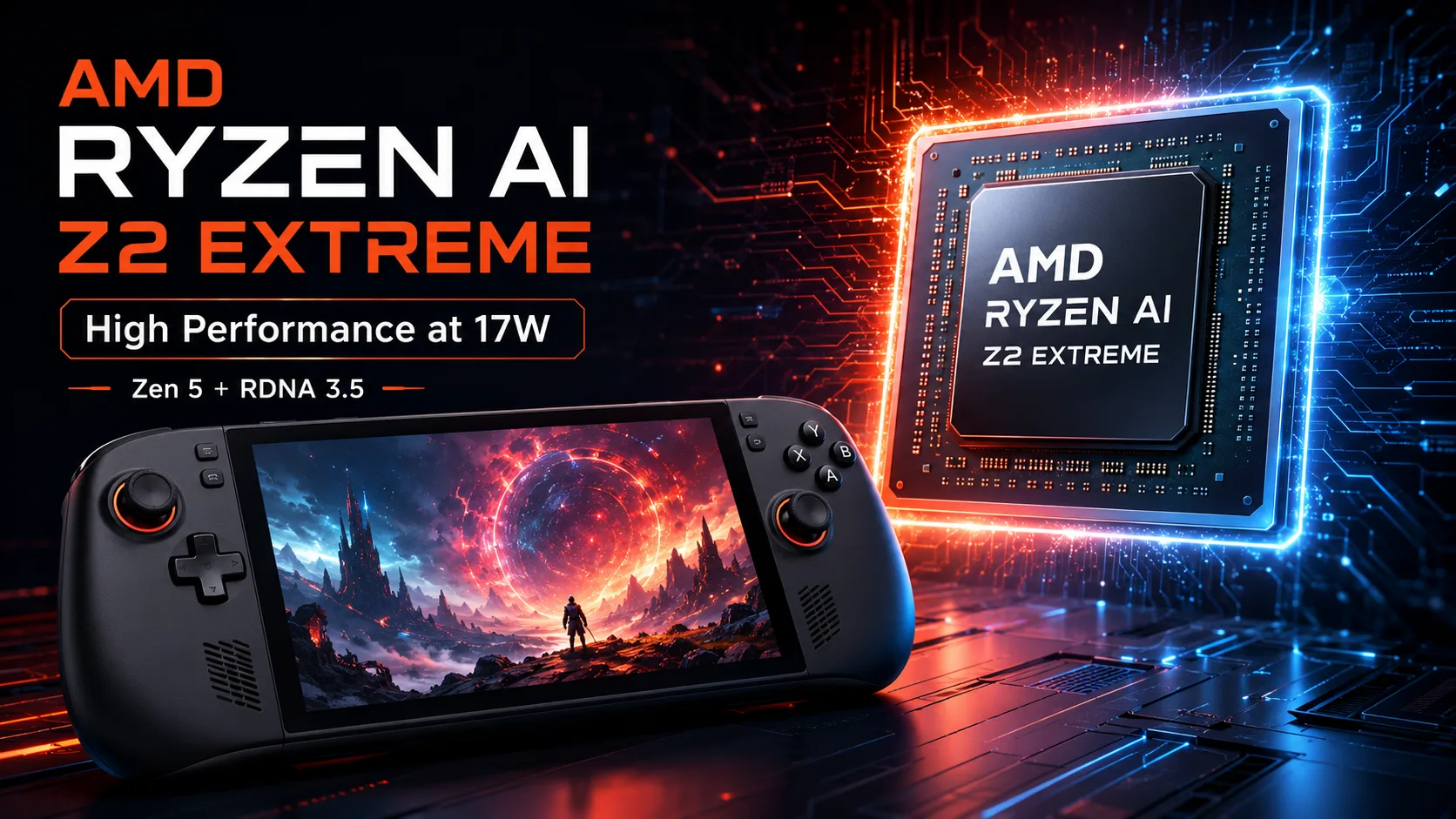
AMD Ryzen AI Z2 Extreme: High Performance Starts at Just 17 Watts
The AMD Ryzen AI Z2 Extreme differs from the standard Ryzen Z2 Extreme mainly due to its active NPU, but in gaming, what matters more is that the new chip is significantly faster than the Ryzen Z1 Extreme at a power limit of 13-17 watts. For a portable system, this is more beneficial than maximum performance when plugged in, as it’s the power-efficient modes that determine the device's battery life, heat generation, and noise levels.
The processor combines eight Zen 5 and Zen 5c cores, RDNA 3.5 integrated graphics with 16 compute units, and an XDNA 2 neuroprocessor capable of delivering up to 50 TOPS. However, the frame rate still primarily depends on the graphics component, memory speed, power limit, and device cooling.
Z2 Extreme with Active Neuroprocessor
In terms of CPU and GPU configuration, the Ryzen AI Z2 Extreme is similar to the regular Ryzen Z2 Extreme. Both processors utilize three high-performance Zen 5 cores, five compact Zen 5c cores, and integrated RDNA 3.5 graphics with 16 compute units.
The main difference in the AI version is the active XDNA 2 block. It is designed for local acceleration of Windows functions and applications capable of utilizing the neuroprocessor without adding additional load on the CPU and GPU.
Therefore, the Ryzen AI Z2 Extreme shouldn’t be seen as a separate leap compared to the regular Z2 Extreme. Their CPU and GPU parts are too close. Real progress is noticeable when compared to the Ryzen Z1 Extreme: the new chip features more modern cores, more powerful graphics, and better maintains performance when TDP is reduced.
In Which Devices the Processor Is Used
At the time of writing, the only widely available device featuring the Ryzen AI Z2 Extreme is the ASUS ROG Xbox Ally X. The console is equipped with 24 GB LPDDR5X-8000 and supports a processor power limit of up to 35 watts.
The specialized ROG Xbox Ally X kits should not be considered separate implementations of the processor: they use the same casing, cooling system, and memory configuration.
Other notable portable computers, including the MSI Claw A8 and Lenovo Legion Go 2, have the standard Ryzen Z2 Extreme. Therefore, it’s currently impossible to compare the AI Z2 Extreme across multiple chassis with different cooling and power settings.
Benchmarks in Specific Portable Devices
The table compares the ROG Xbox Ally X with two models using related processors. The results may vary depending on firmware, power profile, and background load from Windows.
| Device | Processor | Geekbench 6 Single Core | Geekbench 6 Multi Core |
|---|---|---|---|
| ASUS ROG Xbox Ally X | Ryzen AI Z2 Extreme | 2813 | 12 789 |
| MSI Claw A8 | Ryzen Z2 Extreme | 2779 | 12 315 |
| ASUS ROG Ally X | Ryzen Z1 Extreme | 2544 | 11 255 |
In CPU tests, the Ryzen AI Z2 Extreme only slightly outpaces the regular Z2 Extreme. The difference is about 1% in single-threaded mode and approximately 4% under full load. This gap may fluctuate depending on the power limit and cooling of the particular device.
Against the Ryzen Z1 Extreme, the advantage is more noticeable: around 11% in single-threaded tests and 14% in multi-threaded ones. However, Geekbench presents only part of the picture. For a portable gaming system, the speed of integrated graphics under limited power consumption is more critical.
Why the 17 Watt Mode Is More Important Than Maximum 35 Watts
In 3DMark Steel Nomad Light, the ROG Xbox Ally X scores around 3209 points at 17 watts and 2940 points at 13 watts. The previous ROG Ally X with the Ryzen Z1 Extreme shows approximately 2721 and 2537 points at the same limits.
The advantage of the new processor is about 18% at 17 watts and 16% at 13 watts. Moreover, the Ryzen AI Z2 Extreme in 13-watt mode approaches the results of the Z1 Extreme operating at a significantly higher power limit.
A similar pattern is observed in Cyberpunk 2077:
| ROG Xbox Ally X Mode | Average Frame Rate |
|---|---|
| 13 W | 42.4 FPS |
| 17 W | 58.2 FPS |
| 35 W | 73.8 FPS |
The jump from 13 to 17 watts yields a significant performance increase. When the processor's power limit is raised from 17 to 35 watts, the frame rate increases by approximately 27%, despite the available power more than doubling.
Based on these results, the 17-watt mode appears to be the most rational choice. A higher limit boosts the speed further, but it degrades energy efficiency, reduces battery life, and increases casing temperature.
What the NPU Offers
In most modern games, the neuroprocessor has little impact on performance. FSR scaling, frame generation, and standard rendering are handled by the integrated graphics.
The NPU can be used for system image scaling, video processing, gaming clip creation, and other Windows functions that run concurrently with gaming. However, their practical value depends on software support.
Therefore, there are currently no grounds to choose the Ryzen AI Z2 Extreme solely for its claimed 50 TOPS. In current devices, its main advantage remains the efficiency of the CPU and integrated graphics.
Conclusion
The AMD Ryzen AI Z2 Extreme is not a radically accelerated version of the regular Ryzen Z2 Extreme. Their CPU and GPU components are close, with the main hardware difference being the active NPU.
Noticeable progress is evident when compared to the Ryzen Z1 Extreme. The new chip performs better in CPU tests, is significantly more efficient in gaming, and maintains better performance under power limits of 13-17 watts.
It is this efficiency that makes the Ryzen AI Z2 Extreme an important upgrade for portable gaming devices. The maximum mode increases frame rates, but the processor’s main advantage is best seen at 17 watts, where high performance is maintained without a sharp increase in power consumption.
A comprehensive comparison of different implementations will only be possible once other devices using this processor become available.
CPU Comparison
Compare Ryzen AI Z2 Extreme with other CPUs
Basic
CPU Specifications
GPU Specifications
Miscellaneous
Benchmarks
Compared to Other CPU
Related CPU Comparisons






Share in social media
Or Link To Us
<a href="https://cputronic.com/cpu/amd-ryzen-ai-z2-extreme" target="_blank">AMD Ryzen AI Z2 Extreme</a>