AMD Ryzen 7 PRO 9755X3D

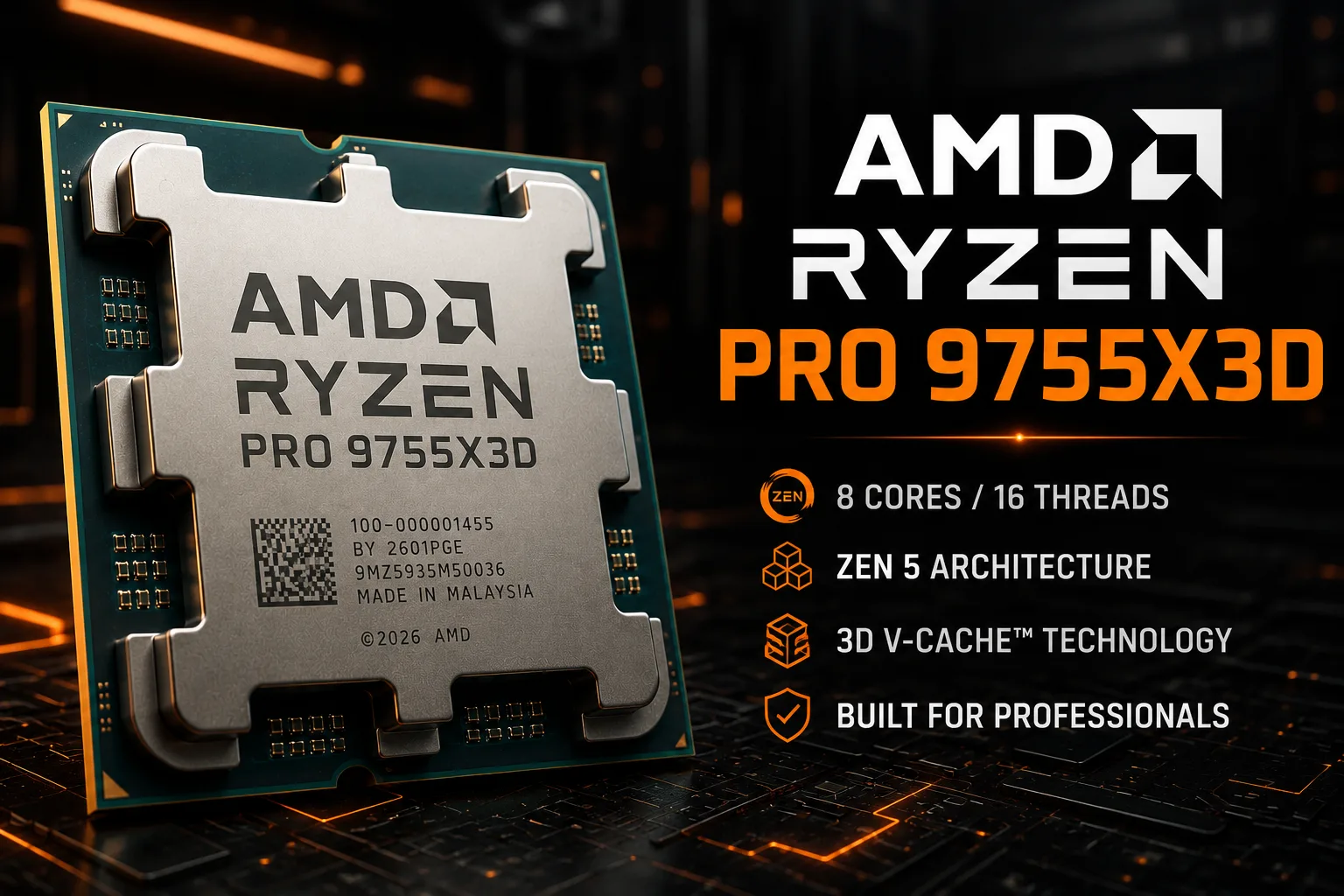
AMD Ryzen 7 PRO 9755X3D: 3D V-Cache Comes to Workstations
The AMD Ryzen 7 PRO 9755X3D is an unusual model even within the Ryzen 7 lineup. By formula, it resembles the gaming X3D chip: 8 Zen 5 cores, 16 threads, high frequency levels, and a large L3 cache of 96 MB. However, it serves a different purpose. The Ryzen 7 PRO 9755X3D is designed not for standalone gaming builds but for corporate desktop systems and workstations, where not only FPS or synthetic benchmarks are important, but also stability, manageability, security, and a long platform lifecycle.
Why This Processor is Interesting
The main feature of the Ryzen 7 PRO 9755X3D is the combination of 8 fast Zen 5 cores and 3D V-Cache. For an 8-core processor, 96 MB of L3 cache is a significant advantage; this amount helps in scenarios where the CPU frequently accesses recurring datasets and is sensitive to memory latency.
While 3D V-Cache is typically discussed in the context of gaming, it can also be beneficial in a workstation. It can assist in engineering calculations, simulations, interactive visualizations, compiling large projects, and some scientific and industrial tasks. This is particularly interesting for professional PCs: some workloads depend not only on the number of threads but also on how quickly the processor can access the necessary data.
However, it’s important not to turn 3D V-Cache into a magic solution. If a task scales well only with the number of threads, the 8-core Ryzen 7 PRO 9755X3D will not replace a 16-core Ryzen 9. If an application is bottlenecked by the graphics card or memory bandwidth, a large cache may not always yield a noticeable gain. The strong point of this processor is not absolute multi-threaded power but fast responsiveness, high per-core performance, and a large cache in a managed corporate platform.
Performance and Benchmarks in PassMark
Currently, there are no direct public PassMark results for the Ryzen 7 PRO 9755X3D. Therefore, it is useful to look at the nearest models for reference: Ryzen 7 PRO 9755 without 3D V-Cache, retail Ryzen 7 9800X3D / 9850X3D with similar X3D architecture, and one current high-end Intel model.
| Processor | CPU Mark | Single Thread | Comments |
|---|---|---|---|
| Intel Core Ultra 7 265K | 58 695 | 4 930 | Strong Intel benchmark, more cores, and different platform |
| AMD Ryzen 7 9850X3D | 41 363 | 4 711 | Fast retail X3D benchmark |
| AMD Ryzen 7 9800X3D | 39 973 | 4 425 | Close retail X3D counterpart |
| AMD Ryzen 7 PRO 9755 | 38 100 | 4 604 | PRO version without 3D V-Cache, result for 1 sample |
| AMD Ryzen 7 9700X | 37 067 | 4 649 | Regular 8-core Ryzen without X3D |
This table shows which processors can serve as benchmarks when evaluating the Ryzen 7 PRO 9755X3D. On one hand, there’s the Ryzen 7 PRO 9755 - almost the same corporate logic but without 3D V-Cache. On the other hand, there are the Ryzen 7 9800X3D and Ryzen 7 9850X3D, which are similar 8-core X3D models without the PRO suffix. Therefore, future results for the Ryzen 7 PRO 9755X3D are logically expected to be somewhere near the retail Ryzen 7 X3D, but adjusted for the specific configurations of ready-made systems.
The Intel Core Ultra 7 265K is here not as a direct analog but as a reference for the high-end desktop segment. It has more cores and a higher CPU Mark, so it appears stronger in coarse multi-threaded synthetic benchmarks. The Ryzen 7 PRO 9755X3D focuses on something different: 8 fast Zen 5 cores, large L3 cache, AM5, DDR5, PCIe 5.0, and AMD PRO corporate features.
How Ryzen 7 PRO 9755X3D Differs from Ryzen 7 9800X3D
In basic logic, the Ryzen 7 PRO 9755X3D closely resembles the Ryzen 7 9800X3D. Both processors feature 8 cores, 16 threads, 96 MB of L3 cache, and a TDP of 120W. The frequencies are also similar: the PRO model is rated at 4.7 GHz base and up to 5.2 GHz boost.
However, their intended uses are different. The Ryzen 7 9800X3D is a retail processor for gaming and enthusiast builds. The Ryzen 7 PRO 9755X3D is designed for ready-made commercial PCs and workstations. Therefore, it includes AMD PRO Technologies, DASH, remote management, hardware inventory, AMD Memory Guard, Secure Processor, Secure Boot, and other features that are crucial for companies and IT departments.
There is also an important limitation: overclocking, AMD EXPO, Precision Boost Overdrive, and Curve Optimizer are officially disabled on the Ryzen 7 PRO 9755X3D. For a home user, this seems like a downside, but for a corporate system, the rationale is clear. A workstation manufacturer needs a predictable configuration, stable settings, and fewer variables when maintaining a fleet of devices.
Where It Excels
The Ryzen 7 PRO 9755X3D is best suited for workstations requiring quick system response, high per-core performance, and the advantages of a large cache. This may include CAD/CAM, engineering modeling, compilation, interactive 3D visualization, working with large projects, and heavy multitasking.
For pure CPU rendering or tasks that fully utilize all threads, the 16-core Ryzen 9 PRO 9965X3D may be more logical. For a gaming home PC, it's easier to choose either the Ryzen 7 9800X3D or the Ryzen 7 9850X3D. However, the Ryzen 7 PRO 9755X3D is particularly interesting as a processor for mid- to high-end workstations, where balance between speed, cache, power consumption, and corporate manageability is crucial.
Platform and Integrated Graphics
The processor uses the AM5 socket and supports DDR5, PCIe 5.0, up to 256 GB of memory, and ECC if supported by the motherboard. This is more important than it may seem: in a workstation, performance often depends not only on the CPU but also on RAM capacity, storage speed, platform stability, and the graphics card.
Integrated graphics are also present - AMD Radeon Graphics with 2 graphics cores. This is useful for image output, diagnostics, and basic office work, but not beyond that. In a professional system, this processor will almost certainly work alongside a discrete graphics card.
Conclusion
The AMD Ryzen 7 PRO 9755X3D is an X3D processor for workstations, where not only gaming scenarios but also stability, security, remote management, and predictable configurations are important.
Its strong point is balance. It does not attempt to replace multi-core Ryzen 9 or higher-end Intel processors in heavy multi-threaded synthetics, but rather offers fast Zen 5 cores, 96 MB of L3 cache, a modern AM5 platform, and a suite of AMD PRO features.
If you're looking for a processor for a home gaming PC, the Ryzen 7 9800X3D or 9850X3D would be more straightforward choices. If maximum multi-threaded power is your goal, then it’s worth considering Ryzen 9. However, for a ready-made workstation with AM5, 3D V-Cache, AMD PRO features, and an emphasis on stable professional work, the Ryzen 7 PRO 9755X3D is a very logical option.
CPU Comparison
Compare Ryzen 7 PRO 9755X3D with other CPUs
Basic
CPU Specifications
Memory Specifications
GPU Specifications
Miscellaneous
Benchmarks
Compared to Other CPU
Share in social media
Or Link To Us
<a href="https://cputronic.com/cpu/amd-ryzen-7-pro-9755x3d" target="_blank">AMD Ryzen 7 PRO 9755X3D</a>