AMD Ryzen 7 PRO 217
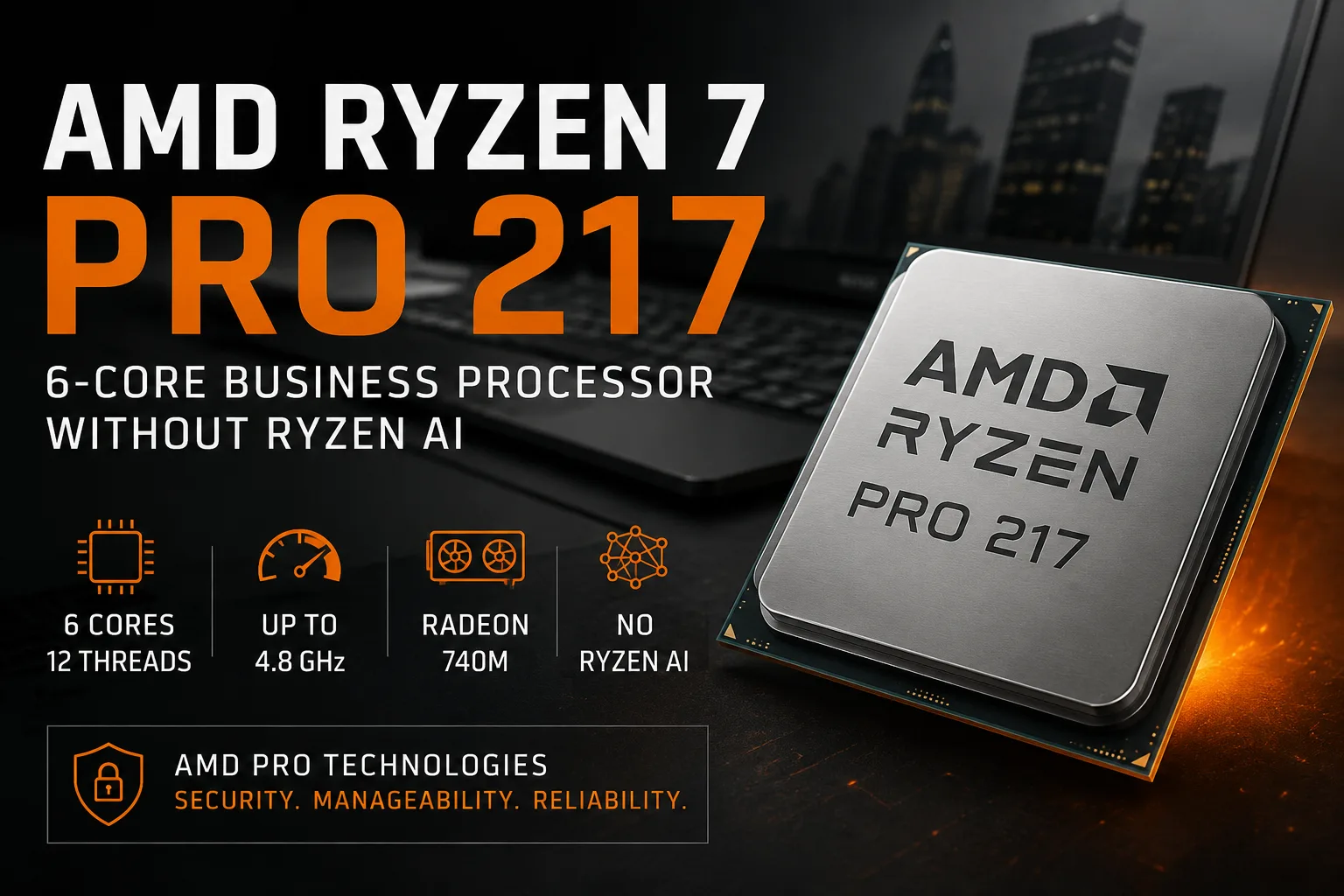
AMD Ryzen 7 PRO 217: 6-Core Ryzen 7 PRO Based on Hawk Point
The AMD Ryzen 7 PRO 217 stands out in the Ryzen PRO 200 lineup not for its performance, but rather for its controversial positioning. By name, it is a Ryzen 7, but its configuration is closer to that of a Ryzen 5: 6 cores, 12 threads, Radeon 740M, and the absence of Ryzen AI. Thus, it is incorrect to directly compare it with higher-end 8-core Ryzen 7 models. This is a corporate mobile processor intended for laptops, mini-PCs, and OEM systems, where security and centralized management are prioritized over maximum performance.
The processor is built on the Zen 4 architecture and belongs to the Hawk Point family. This is not a new architectural step but rather an evolution of an already familiar AMD mobile platform. A similar base can be seen in the Ryzen 5 8540U and Ryzen 5 PRO 8540U: the same 6 cores, 12 threads, Radeon 740M, and no Ryzen AI. The Ryzen 7 PRO 217 has received a higher index and corporate positioning, but remains similar to the 6-core Ryzen 8000 models in terms of configuration.
For office workloads, the Ryzen 7 PRO 217 has sufficient capacity. What remains contentious is that there are models in the same lineup with 8 cores, Radeon 780M, and Ryzen AI. Against these models, the Ryzen 7 PRO 217 appears more as an intermediate corporate model based on the older Hawk Point architecture than as a full-fledged high-end Ryzen 7.
What You Should Know About Ryzen 7 PRO 217
The performance of the Ryzen 7 PRO 217 is adequate for a corporate laptop. The six Zen 4 cores and 12 threads are enough for browsing, office applications, video calls, CRM, remote desktop access, and light data processing. The frequency of up to 4.8 GHz is important for short single-threaded workloads, and the cTDP range of 15-40 W allows adjusting the processor for thin laptops or models with a higher power limit.
The name Ryzen 7 should not be the primary argument in the selection process. Its advantage lies in the combination of Zen 4, the FP8 platform, and AMD PRO corporate features, rather than high performance relative to older Ryzen 7 models. Essentially, it is not a replacement for 8-core Ryzen 7 but a higher-marked 6-core model for the business segment.
Connection to Ryzen 8000
While the Ryzen 7 PRO 217 may seem new by name, it is technically close to the lower-end Ryzen 8000 processors, primarily the Ryzen 5 8540U and Ryzen 5 PRO 8540U. They share the same class of configuration: 6 cores, 12 threads, integrated Radeon 740M graphics, and no Ryzen AI. Therefore, the Ryzen 7 PRO 217 should not be seen as a next-generation processor. It is a new corporate model based on the already familiar Hawk Point family.
There is still a difference. The Ryzen 5 8540U and Ryzen 5 PRO 8540U use a 2x Zen 4 + 4x Zen 4c architecture and are typically designed for 28 W. The Ryzen 7 PRO 217 has a limit of 35 W, with a cTDP up to 40 W, and is listed by AMD simply as Zen 4 without distinction between Zen 4 and Zen 4c. Due to a higher power limit, it may be faster in sustained multi-threaded workloads, but it does not offer a fundamentally new level of performance.
Indeed, comparison with the Ryzen 8000 better explains the essence of this model. The Ryzen 7 PRO 217 is not an heir to higher-end Ryzen 7s with 8 cores, powerful graphics, and an NPU, but rather a corporate 6-core model at the level of the Ryzen 5 8540U / Ryzen 5 PRO 8540U, elevated to a higher index.
How Ryzen 7 PRO 217 Differs from Neighboring Models
The positioning of the Ryzen 7 PRO 217 is better observed alongside closely related 6-core models and the higher Ryzen 7 PRO 253.
| Model | Cores / Threads | Frequencies | TDP | Graphics | Ryzen AI |
|---|---|---|---|---|---|
| Ryzen 5 PRO 8540U | 6 / 12 | up to 4.9 GHz | 28 W | Radeon 740M | no |
| Ryzen 5 PRO 216 | 6 / 12 | 2.9-4.7 GHz | 28 W | Radeon 740M | no |
| Ryzen 7 PRO 217 | 6 / 12 | 3.0-4.8 GHz | 35 W | Radeon 740M | no |
| Ryzen 7 PRO 253 | 8 / 16 | 3.6-4.9 GHz | 45 W | Radeon 780M | yes, up to 16 TOPS |
Compared to the Ryzen 5 PRO 216, the Ryzen 7 PRO 217 remains a model of the same level but with slightly higher frequencies and TDP. The number of cores has not changed, the graphics remain the same, and Ryzen AI has not been introduced. In laptops with sufficient cooling, the performance gain will be limited and will not change the class of the processor.
Against the backdrop of the Ryzen 5 PRO 8540U, the situation is similar. The Ryzen 7 PRO 217 gains a higher thermal limit and a new corporate name but retains the same basic set: 6 cores, 12 threads, Radeon 740M, and the absence of an NPU. This makes it not a new class of processors but an updated position within the corporate lineup.
The limitations are more pronounced compared to the Ryzen 7 PRO 253. The higher model receives 8 cores, 16 threads, a Radeon 780M, and a separate NPU. It is significantly stronger in multi-threaded tasks, graphics, and local AI scenarios. Therefore, it is logical to consider the Ryzen 7 PRO 217 as an intermediate model between the lower-end 6-core Ryzen PRO and the higher-end Ryzen PRO 200.
Such a model is convenient for OEM lines and corporate pricing lists. AMD can offer a processor for business laptops under the Ryzen 7 PRO label, but with lower cost and thermal package compared to higher configurations. For corporate procurement, this is a comfortable intermediate position: the laptop receives the Ryzen 7 PRO index but remains close in configuration to 6-core models.
Radeon 740M: Basic Graphics for Work Tasks
The integrated Radeon 740M graphics are built on RDNA 3 architecture but have only 4 graphics cores. This is the basic level for a modern AMD mobile platform. Such graphics are suitable for interfaces, video, office tasks, the browser, simple image editing, and working with multiple monitors.
For gaming and heavy graphical tasks, the Radeon 740M is poorly suited. It falls significantly short of the Radeon 760M and especially the Radeon 780M, which has more graphics blocks. Therefore, the Ryzen 7 PRO 217 should not be chosen as a universal processor for work and gaming. It is designed for work tasks, where integrated graphics are primarily needed for outputting images, video, and basic interface acceleration.
If a laptop needs strong integrated graphics, it is better to look at models with Radeon 780M. If graphics are only required for office scenarios, the Radeon 740M will suffice.
No Ryzen AI
The Ryzen 7 PRO 217 does not have Ryzen AI, meaning it lacks a separate NPU for local AI tasks. For a typical corporate laptop, this is not critical: documents, browsers, video calls, emails, remote access, and corporate applications do not require a separate AI block.
This limitation becomes significant when purchasing laptops intended for local AI functions. In that case, the Ryzen 7 PRO 217 is weaker than Ryzen PRO models equipped with Ryzen AI. This is not a processor for laptops focused on local AI but a standard corporate model on Zen 4.
What the PRO Suffix Provides
The "PRO" suffix in the name is more important here than "Ryzen 7." The Ryzen 7 PRO 217 is targeted at the business segment and supports AMD's corporate technologies. Their role is not to accelerate gaming or rendering, but to simplify the maintenance of a large fleet of devices.
Remote management, data protection, support for corporate policies, platform stability, predictable supply, and compatibility with business OS images are crucial for companies. This is exactly what Ryzen PRO processors are released for.
The Ryzen 7 PRO 217 includes AMD PRO Technologies, AMD Memory Guard, AMD Secure Processor, fTPM, support for virtualization, and Windows security features. For home users, this often does not become a decisive argument. For a corporate IT department, these capabilities are often more important than additional graphics blocks or maximum frequency in tests.
Suitable Devices
The Ryzen 7 PRO 217 is appropriate for work laptops and compact systems where a modern AMD platform is needed, but there are no requirements for powerful graphics and local AI accelerators. This processor is designed for everyday corporate workloads: documents, web applications, video calls, email, remote desktops, administration, and light analytical tasks.
Suitable scenarios include:
- Mid-range corporate laptops;
- Mini-PCs for office workstations;
- Managed systems for companies;
- Devices for remote work;
- Business configurations where PRO features and moderate power consumption are important.
For home users, the Ryzen 7 PRO 217 is only interesting if the specific laptop is offered at a good price. If a model like the Ryzen 7 PRO 253, Ryzen 7 250, or another 8-core chip with stronger graphics is available nearby, the Ryzen 7 PRO 217 makes sense only due to price, battery life, or corporate functions.
Main Takeaway
The AMD Ryzen 7 PRO 217 is a work-oriented corporate processor, but its name promises more than its configuration delivers. It is a 6-core Zen 4 processor with basic Radeon 740M graphics and no Ryzen AI. In architecture and equipment, it is closer to the 6-core Ryzen 8000 level of the Ryzen 5 8540U / Ryzen 5 PRO 8540U, rather than to higher-end mobile Ryzen 7 models.
It occupies an intermediate position between the lower-end 6-core Ryzen PRO and the more expensive models with 8 cores, powerful graphics, and an NPU. In a corporate laptop, such a configuration is justified if manageability, security, and platform cost remain priorities.
For a basic corporate configuration, the Ryzen 7 PRO 217 is suitable. If 8 cores, strong integrated graphics, or a local AI block are important, it is better to look at the higher-end models in the lineup.
CPU Comparison
Compare Ryzen 7 PRO 217 with other CPUs
Basic
CPU Specifications
Memory Specifications
GPU Specifications
Miscellaneous
Benchmarks
Compared to Other CPU
Related CPU Comparisons


Share in social media
Or Link To Us
<a href="https://cputronic.com/cpu/amd-ryzen-7-pro-217" target="_blank">AMD Ryzen 7 PRO 217</a>