AMD Ryzen 7 8845H
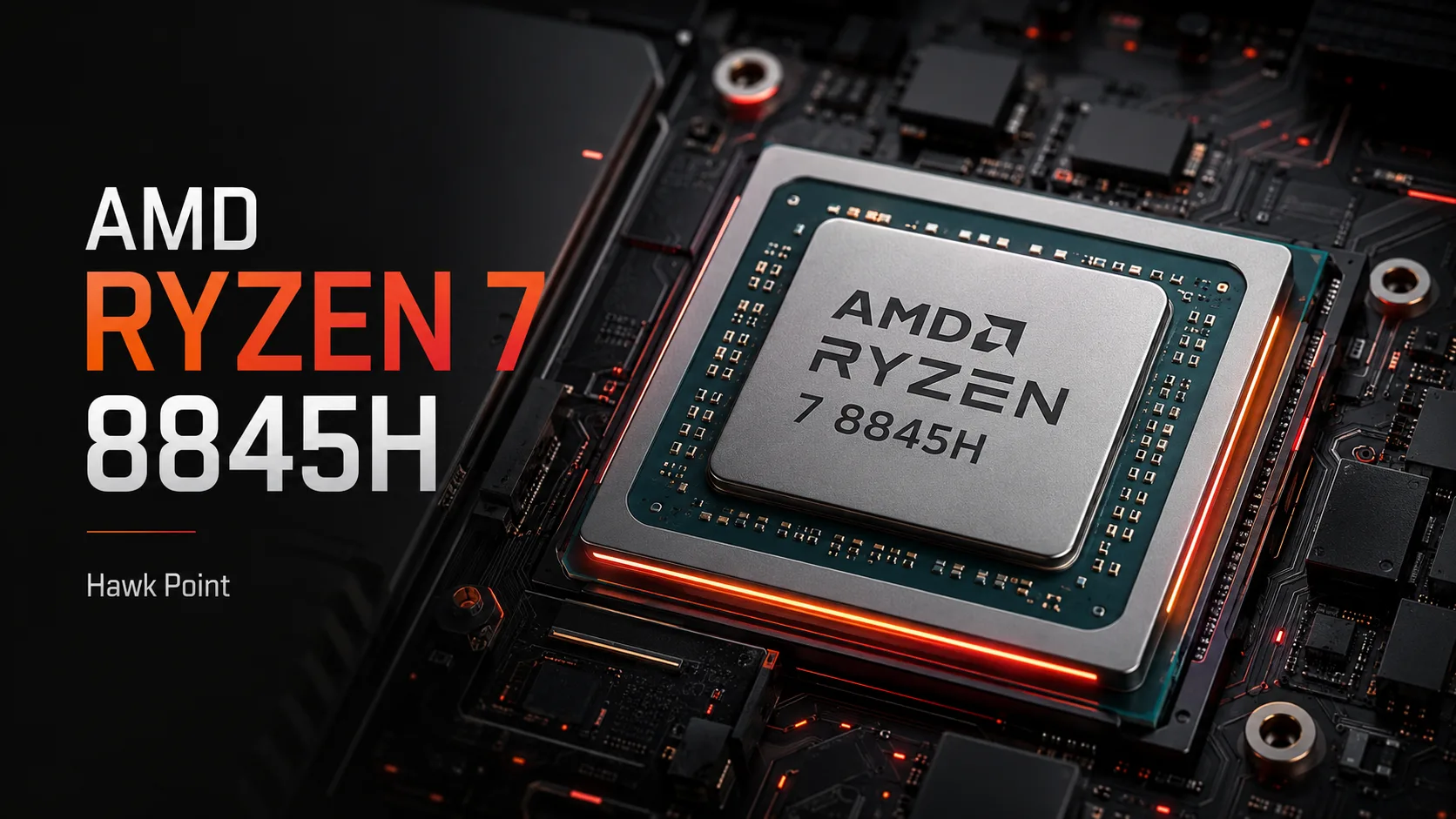
AMD Ryzen 7 8845H: the same as 8845HS, but for Chinese/OEM devices
The AMD Ryzen 7 8845H can easily be misunderstood. The letter H gives the impression that it's a separate, lower version compared to the Ryzen 7 8845HS, but in terms of key specifications, it's effectively the same senior Hawk Point. The difference is not in cores, graphics, or Ryzen AI, but in positioning: 8845H is associated with Chinese/OEM devices, while 8845HS has broader availability.
That’s why the Ryzen 7 8845H should not be viewed as a stripped-down version of the 8845HS. The real divergence does not occur between the 8845H and the 8845HS, but between the 8845H and the Ryzen 7 8745H. The 8745H is significantly simpler: lower boost, slightly lower frequency of the Radeon 780M, and no Ryzen AI.
8845H, 8845HS, and 8745H: where the real differences lie
The Ryzen 7 8845H and Ryzen 7 8845HS offer little technical intrigue: they operate at a similar computational level. Therefore, it's more important to look not at corresponding characteristics but at where the models truly diverge.
| Parameter | Ryzen 7 8845H | Ryzen 7 8845HS | Ryzen 7 8745H |
|---|---|---|---|
| Official availability | China | Global | China |
| Form Factor by AMD | Laptops | Laptops, Desktops | Laptops, Desktops |
| Max Boost CPU | up to 5.1 GHz | up to 5.1 GHz | up to 4.9 GHz |
| Radeon 780M | up to 2700 MHz | up to 2700 MHz | up to 2600 MHz |
| Ryzen AI / NPU | Yes, up to 16 TOPS | Yes, up to 16 TOPS | No |
| Practical significance | Regional/OEM analogue of 8845HS | More widely available version | More basic Hawk Point |
In short: 8845H and 8845HS are in the same class, while 8745H is a simpler option. It retains 8 Zen 4 cores and Radeon 780M, but it loses the NPU and has slightly lower frequencies.
This is an important distinction. When comparing 8845H with 8845HS, the debate is almost not about performance. When comparing 8845H with 8745H, the choice becomes real: pay for the more complete configuration or opt for the cheaper, simpler chip.
How to read the price tag
The main question isn’t "Is 8845H worse or better than 8845HS?", but why does a specific laptop or mini-PC with 8845H cost what it does? If a model with Ryzen 7 8845H is cheaper than an equivalent with 8845HS while having similar memory, SSD, screen, and cooling, it's not suspicious - it might be a good deal. The processors are essentially at the same level, and the difference often lies in the market, the sales channel, and the OEM configuration.
With Ryzen 7 8745H, the logic is different. It's technically simpler but not weak. If a device with 8745H is significantly cheaper and Ryzen AI isn't needed, that option may be more sensible. If the price difference is small, 8845H looks more appealing: it offers higher frequencies, full Ryzen AI, and the maximum capabilities of Hawk Point.
The final value is most affected by:
- Memory - Radeon 780M requires fast RAM and dual-channel mode;
- Cooling - a 45-watt APU quickly loses its edge in a tight case with stringent limits;
- SSD - a slow storage drive will ruin the experience even with a good processor;
- Display - brightness, refresh rate, and color coverage may be more important than the difference between 8845H and 8845HS;
- Ports - USB4, HDMI, and DisplayPort depend on the specific model, not just the platform;
- Sales channel - regional/OEM positioning may have a stronger impact on price than the CPU labeling itself.
Therefore, comparisons should be made not between bare processor names but between finished devices. In this group, a single letter in the name can easily mislead.
The main value - Zen 4 and Radeon 780M
The Ryzen 7 8845H is interesting not as “just another mobile Ryzen,” but as a base for a powerful laptop or mini-PC without a discrete GPU. Its strength lies in the combination of Zen 4 and Radeon 780M: the fast CPU handles work tasks, while the integrated graphics enable multimedia, emulation, online gaming, and some light projects without a separate GPU.
The Radeon 780M doesn’t turn such a laptop into a gaming machine, but it distinctly separates it from basic office systems. This is especially valuable for mini-PCs: the box remains compact and economical but no longer looks helpless in graphic tasks.
The main condition is memory. Radeon 780M uses system RAM, so a weak or single-channel configuration cuts the FPS noticeably more than specifications suggest. The same goes for cooling: a good APU loses its significance easily if the manufacturer constrains power limits for the sake of a thin case and silence.
Ryzen AI: an advantage over 8745H, but not magic
Ryzen AI is the true distinction between Ryzen 7 8845H and Ryzen 7 8745H. The 8845H has a separate NPU for local AI tasks, while the 8745H does not. This makes the 8845H a more complete version of Hawk Point.
However, this block should not be overestimated. The NPU of the 8845H reaches up to 16 TOPS, while Microsoft’s Copilot+ for PC-class requires 40+ TOPS. Therefore, Ryzen AI here should be seen as a useful addition compared to 8745H, not as the main argument for buying at any cost.
In regular tasks, the CPU, GPU, memory, SSD, and cooling still do the heavy lifting. The NPU will be useful where applications can genuinely utilize it: neural network effects, local image, video, voice processing, and individual AI functions. If this isn't needed, the Ryzen 7 8745H at a good price remains a suitable compromise.
Where Ryzen 7 8845H excels
The Ryzen 7 8845H shines best not in “a gaming laptop without a video card,” but in a compact system where strong integrated graphics are required: a mini-PC, a thin work laptop, a home versatile computer, or a mobile machine with the ability to play without a discrete GPU.
In a good implementation, it provides a fast CPU, a robust Radeon 780M, and Ryzen AI all in one platform. In a poor implementation, the same processor can easily lag due to slow memory, inadequate cooling, or hard power limits. For heavy 3D rendering, professional editing, and modern gaming on high settings, it’s still better to opt for a device with discrete graphics or a more powerful H/HX platform.
Conclusion
The AMD Ryzen 7 8845H is not a weakened version of the Ryzen 7 8845HS. In terms of key specifications, it is of the same class as Hawk Point: Zen 4, Radeon 780M, 45-watt level, and Ryzen AI. The difference is not in speed, but in the market, OEM configurations, and the price of the finished device.
The main question is not "8845H or 8845HS?", but "why does this laptop with 8845H cost what it does?" If it’s cheaper than an equivalent of 8845HS with a similar configuration, it could be a strong purchase. If the price is the same, then screen, memory, SSD, cooling, and build quality come into play.
The real choice begins with the Ryzen 7 8745H. It’s simpler: with lower frequencies, no Ryzen AI, and slightly weaker integrated graphics. But if the price is significantly lower, that can be a sensible savings. If the difference is small, the Ryzen 7 8845H looks stronger: it offers a more complete Hawk Point configuration, but still requires checking the memory, cooling, and price of the specific device.
CPU Comparison
Compare Ryzen 7 8845H with other CPUs
Basic
CPU Specifications
Memory Specifications
GPU Specifications
Interfaces and Ports
Miscellaneous
Benchmarks
Compared to Other CPU
Related CPU Comparisons




Share in social media
Or Link To Us
<a href="https://cputronic.com/cpu/amd-ryzen-7-8845h" target="_blank">AMD Ryzen 7 8845H</a>