AMD Ryzen 7 8745H
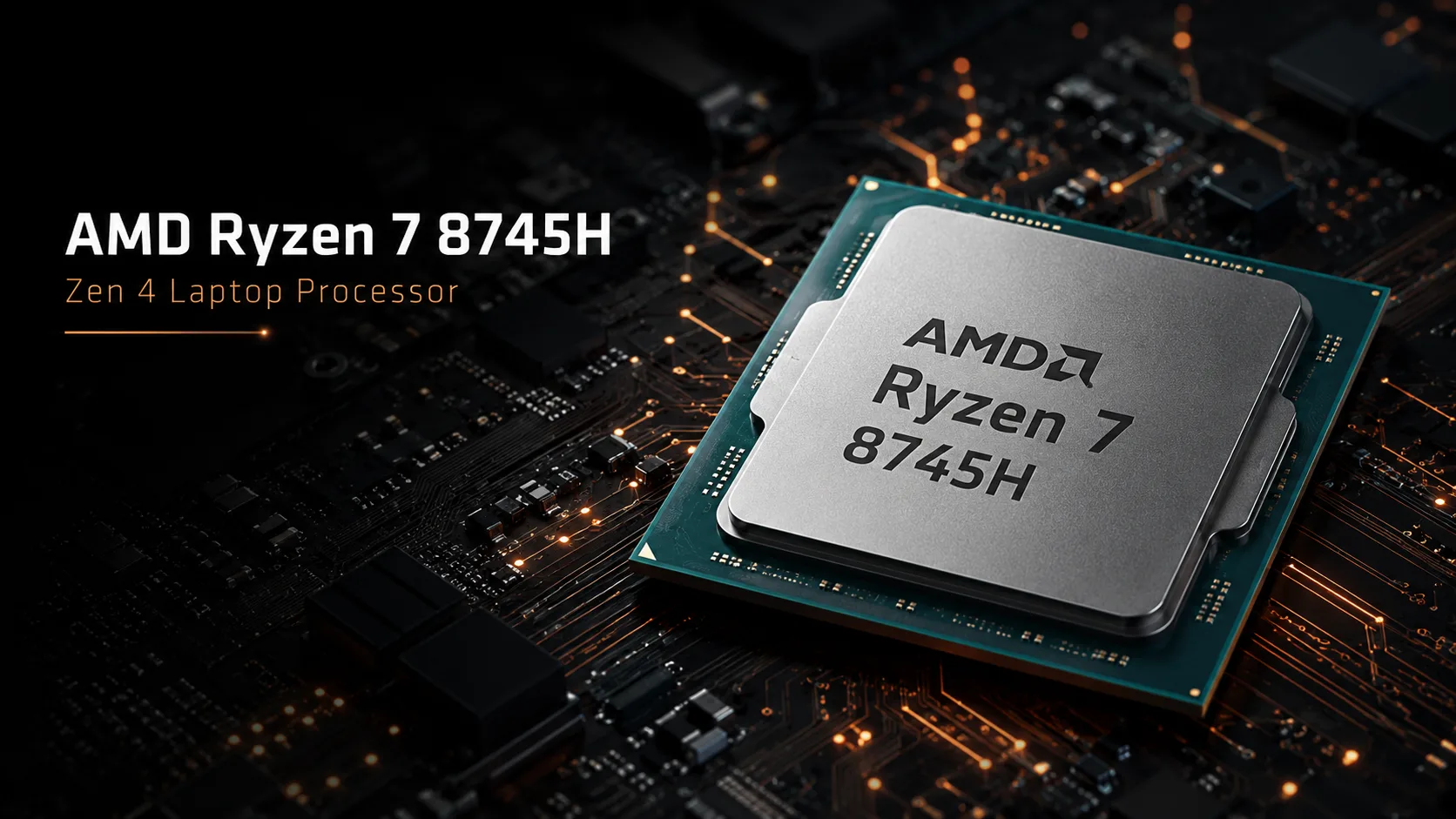
AMD Ryzen 7 8745H: almost 8845HS, just without Ryzen AI
AMD Ryzen 7 8745H is an unusual mobile processor from the Ryzen 8000 line. In terms of configuration, it is similar to the Ryzen 7 8845HS: both have 8 Zen 4 cores, a comparable performance class, and integrated Radeon 780M graphics. The main difference is the absence of Ryzen AI.
Thus, the 8745H should not be perceived as a weak cut-down model. It is more of a straightforward version of Hawk Point: a fast CPU, strong integrated graphics, modern memory, and without a separate NPU, which is still not essential for all scenarios.
What this processor is and why it appeared
The Ryzen 7 8745H is built on the Zen 4 architecture and belongs to the Hawk Point mobile platform. It features 8 cores and 16 threads, a base frequency of 3.8 GHz, and can boost up to 4.9 GHz. The typical TDP is 45 W, but actual performance depends on the power and cooling limits of a specific laptop or mini-PC.
Overall, it is the senior mobile Ryzen 7 of its generation: 8 MB L2, 16 MB L3, support for DDR5-5600 and LPDDR5X-7500, PCIe 4.0, USB4, HDMI 2.1, and DisplayPort 2.1. On paper, the platform appears modern, but the ports, memory, SSD, and cooling are determined by the device manufacturer.
The key nuance is positioning. The Ryzen 7 8745H is primarily linked to the Chinese market and OEM configurations. It is an example of a processor where AMD retained the core hardware base of Hawk Point but released a model with different frequencies, without Ryzen AI, aimed at more specific market tasks.
Ryzen 7 8745H vs. Ryzen 7 8845HS
The most straightforward comparison for the Ryzen 7 8745H is with the Ryzen 7 8845HS. These processors are very similar but differ in terms of frequency, AI block, and availability.
| Specification | Ryzen 7 8745H | Ryzen 7 8845HS |
|---|---|---|
| Architecture | Zen 4 / Hawk Point | Zen 4 / Hawk Point |
| Cores / Threads | 8 / 16 | 8 / 16 |
| Max Boost Frequency | up to 4.9 GHz | up to 5.1 GHz |
| Typical TDP | 45 W | 45 W |
| Integrated Graphics | Radeon 780M | Radeon 780M |
| Ryzen AI / NPU | no | yes |
| Positioning | China / OEM | wider availability |
The Ryzen 7 8845HS formally appears stronger: slightly higher boost and has Ryzen AI. However, if the NPU is not a crucial criterion, the Ryzen 7 8745H remains in almost the same class of processor: 8 fast Zen 4 cores and Radeon 780M.
The absence of the NPU is significant for local AI scenarios: processing models on the device, neural network effects, and applications that can utilize a separate AI block. For browsing, office work, development, photo editing, light video editing, and most games, the difference is barely noticeable. Here, CPU, GPU, memory, SSD, and cooling are more important.
Performance and Radeon 780M
In terms of CPU performance, the Ryzen 7 8745H is in the mid-high class of mobile processors. Eight cores and 16 threads are sufficient for heavy browsing, IDEs, office tasks, light virtual environments, photo editing, and moderate video editing.
In multithreaded tasks, it significantly outperforms lower-end 6-core Ryzen and most economical U-series processors. In single-threaded performance, Zen 4 also remains brisk: the system responds quickly, and power reserve is well felt when multiple applications run in parallel.
However, the final speed heavily depends on the device. In a mini-PC or laptop with good cooling, the 8745H can maintain high frequencies for a long time. In a thin chassis with strict power limits, the same chip will run quieter, cooler, but weaker under prolonged loads.
A distinct advantage is the Radeon 780M. It is one of the strongest integrated graphics of its generation. It does not replace a discrete graphics card but is suitable for online gaming, older AAA titles, not-demanding modern games, emulators, and multimedia tasks.
For mini-PCs, this is particularly valuable: the device stays compact and energy-efficient without turning into a purely office system. In 1080p for demanding games, you will need to lower the settings, but in less demanding projects, the Radeon 780M provides a workable level.
A critical point is memory. The Radeon 780M uses system RAM, so dual-channel mode and fast DDR5/LPDDR5X directly influence FPS performance. Weak or single-channel memory can noticeably cut down graphical performance.
Where the Ryzen 7 8745H shines the most
The best scenario for the Ryzen 7 8745H is a versatile laptop or mini-PC without a discrete graphics card. This processor is well-suited for work, study, programming, browsing, photo editing, light video editing, and moderate gaming.
When choosing a device with the Ryzen 7 8745H, it's important to look not only at the processor itself but also at its implementation:
- Memory - dual-channel DDR5 or fast LPDDR5X is preferred; otherwise, the Radeon 780M will lose some performance;
- Cooling - in a thin chassis, the chip may perform significantly worse than in a well-ventilated mini-PC;
- SSD - a fast drive is important for overall system responsiveness;
- Ports - USB4, HDMI 2.1, and DisplayPort 2.1 may be supported by the platform, but are not always available in a specific device;
- Power limits - one manufacturer may allow the processor to run freely, while another may limit it for quieter operation and lower temperatures.
For heavy 3D rendering, professional video editing, and modern gaming at high settings, it's better to choose a device with discrete graphics or a more powerful H/HX platform. The Ryzen 7 8745H is strong specifically as a versatile mobile APU.
Conclusion
The AMD Ryzen 7 8745H is a practical OEM processor based on Hawk Point. It does not offer Ryzen AI but retains the essentials: 8 Zen 4 cores, Radeon 780M, and a modern mobile platform.
It should not be considered a weak version of the Ryzen 7 8845HS. It serves as a simpler and often more rational option for laptops and mini-PCs where CPU performance, strong integrated graphics, and favorable price-to-performance ratio are important. In a device with good cooling, dual-channel memory, and a fast SSD, the Ryzen 7 8745H reveals itself as a very capable all-rounder APU.
CPU Comparison
Compare Ryzen 7 8745H with other CPUs
Basic
CPU Specifications
Memory Specifications
GPU Specifications
Interfaces and Ports
Miscellaneous
Benchmarks
Compared to Other CPU
Related CPU Comparisons



Share in social media
Or Link To Us
<a href="https://cputronic.com/cpu/amd-ryzen-7-8745h" target="_blank">AMD Ryzen 7 8745H</a>