AMD Ryzen 5 8600G
AMD Ryzen 5 8600G: AM5 without a discrete graphics card
The Ryzen 5 8600G does not aspire to be the fastest six-core AM5 processor. Its purpose is different: to build a modern PC without a discrete graphics card and without stepping down to the level of a weak office computer.
In a classic gaming build with a separate GPU, the Ryzen 5 7600 or newer Ryzen models without a strong emphasis on integrated graphics look more logical. The Ryzen 5 8600G is needed where a graphics card is not being purchased yet: due to budget constraints, compact cases, or tasks that do not involve heavy gaming.
What’s Inside the Ryzen 5 8600G
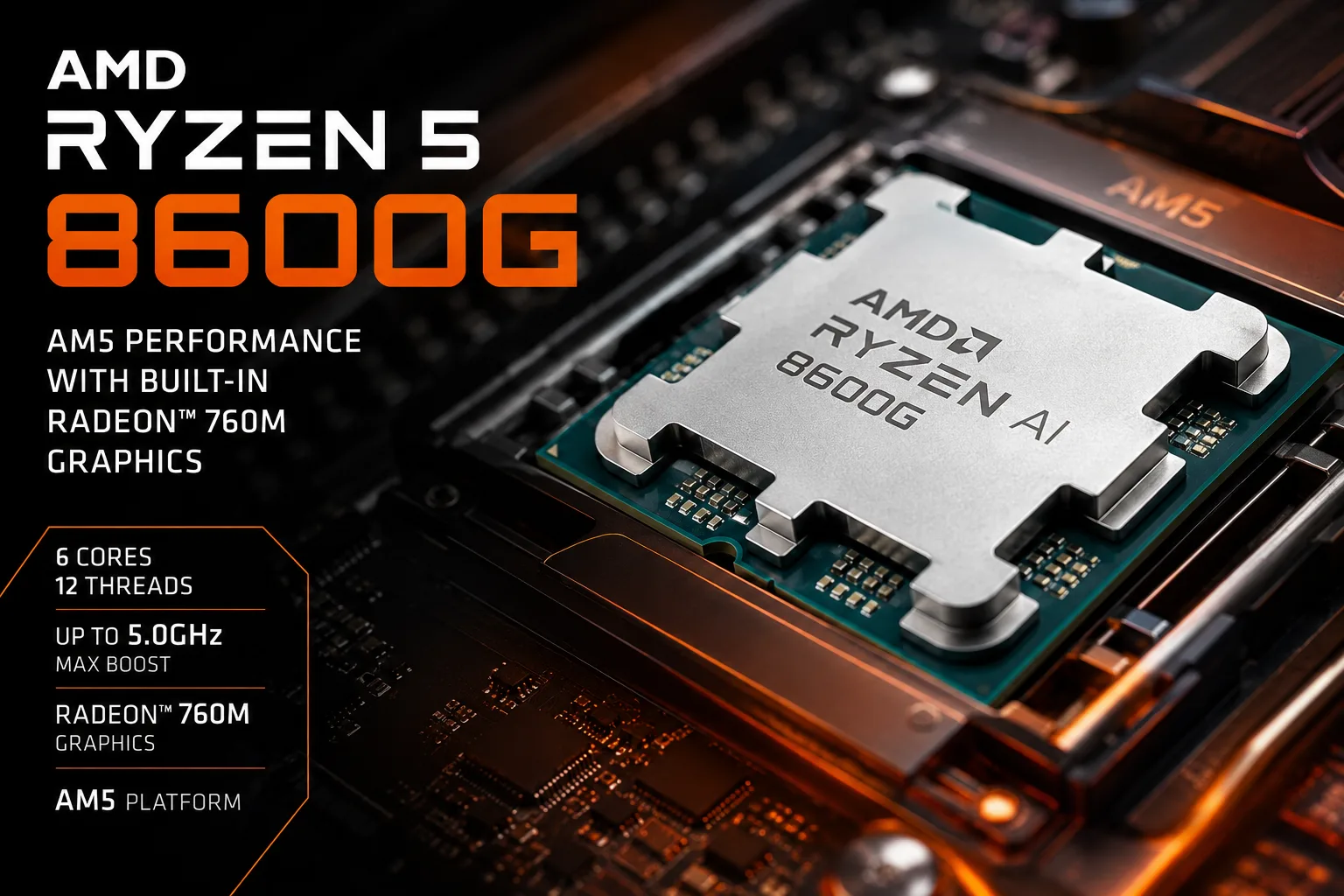
The Ryzen 5 8600G belongs to the AMD Ryzen 8000G series. It has 6 cores and 12 threads based on the Zen 4 architecture, clock speeds of 4.3-5.0 GHz, 16 MB of L3 cache, and a thermal design power (TDP) of 65W. The processor operates on the AM5 socket and uses DDR5 memory.
A key feature of this model is the integrated Radeon 760M graphics. This iGPU is based on the RDNA 3 architecture, featuring 8 compute units and a clock speed of up to 2.8 GHz. It does not replace a discrete graphics card, but it is more than just a video output for desktop use.
The processor also has a Ryzen AI block with a performance of up to 16 TOPS. For most home tasks, this is not yet a primary argument: the utility of the NPU depends on support in specific applications. However, for the new platform, it is a useful reserve if local AI functions become more frequently used in everyday applications.
Performance in Benchmarks
In Geekbench 6, the Ryzen 5 8600G displays a solid performance level for a six-core Zen 4: 2593 points in Single Core and 12069 points in Multi Core. This is not a record for AM5, but for an APU with strong integrated graphics, the result is good.
| Test | Result |
|---|---|
| Geekbench 6 Single Core | 2593 |
| Geekbench 6 Multi Core | 12069 |
| 3DMark CPU Profile Max Threads | 6185 |
| 3DMark Time Spy Graphics | approximately 2800-3100 |
Benchmarks reveal the main limitation of the model: as a CPU, the Ryzen 5 8600G keeps up with modern six-core processors but does not compete directly with Ryzens that have larger caches and stronger CPU components. Its advantage lies in the integrated Radeon 760M.
The performance of the Radeon 760M directly depends on the memory. The integrated graphics use system DDR5, so dual-channel mode is essential. Using a single memory stick significantly reduces bandwidth and impacts the performance of the iGPU.
Why This is Not a Replacement for the Ryzen 5 7600
On paper, the Ryzen 5 8600G looks similar to a regular Ryzen 5: 6 cores, 12 threads, Zen 4, AM5. But this is a different type of processor. It has less L3 cache, simpler PCIe support, and resources allocated in favor of the integrated graphics.
The Ryzen 5 7600 is better suited for builds with a discrete graphics card. There, the iGPU is of little importance, and the CPU performance and cache carry greater weight. The Ryzen 5 8600G, on the other hand, shines in systems without a separate GPU.
The choice between them depends not on the name but on the scenario. If a graphics card is being purchased immediately, the 8600G loses some of its appeal. If there is no graphics card, it looks more reasonable due to the Radeon 760M.
Radeon 760M - The Main Argument
The Radeon 760M does not make the Ryzen 5 8600G a replacement for a gaming graphics card. Modern heavy games at 1080p on high settings are not its task. However, among integrated graphics options, it is one of the stronger alternatives.
This iGPU is sufficient for older games, less demanding projects, online games, and esports disciplines on low settings. Sometimes it can handle 1080p, but more often it is reasonable to aim for 720p or reduced graphical settings.
The main advantage is not that the 8600G replaces a graphics card. Instead, it allows you to avoid buying a temporary cheap GPU just for display and light gaming. For a budget build, this can be more significant than a portion of CPU performance.
Position in the 8000G Lineup
The Ryzen 5 8600G sits between the budget Ryzen 5 8500G and the higher-end Ryzen 7 8700G.
The Ryzen 5 8500G is cheaper, but it has weaker integrated graphics and a mixed core configuration of Zen 4 + Zen 4c. This is sufficient for a simple office PC. For a system where integrated graphics is important, the 8600G looks significantly better.
The Ryzen 7 8700G is faster: it has 8 cores and a more powerful Radeon 780M. This is the best option if maximum integrated graphics performance on AM5 is required. However, if balancing price, CPU, and iGPU is important, the Ryzen 5 8600G is more rational.
Compared to the Ryzen 5 5600G, the new 8600G represents a significant step forward. It features the fresh Zen 4 core, DDR5, AM5 platform, and RDNA 3 graphics instead of the old Vega. The Ryzen 5 5600G may still be cost-effective for a cheap AM4 build, but for a new system, the 8600G is a better fit.
What is the Compromise
The Ryzen 5 8600G should not be chosen without considering the scenario. Its strong side is integrated graphics, but this comes with limitations.
The main downsides are:
- Less L3 cache than standard desktop Ryzer;
- PCIe 4.0 instead of PCIe 5.0;
- Dependence of iGPU on the speed and mode of DDR5;
- Weak rationale for purchase if a discrete graphics card is already available.
For a compact PC or a build without a GPU, this is an acceptable compromise. For a powerful gaming system with a discrete graphics card, it is a contentious choice.
For What Builds is the Ryzen 5 8600G Suitable
The Ryzen 5 8600G is suitable for PCs where a discrete graphics card is not purchased immediately. This could be a compact home system, a mini-PC, a study computer, an office machine with extra power, or a budget build for online gaming.
The most successful scenario is to build an AM5 PC now and buy a graphics card later. The processor allows you to avoid installing a temporary 'placeholder,' not relying on an old GPU, and to have a working system with a noticeably stronger iGPU than typical desktop Ryzens.
If there is already a graphics card in the budget, it's better to look at standard Ryzens. In that case, it is wiser to direct the budget towards a stronger CPU part rather than the iGPU.
Conclusion
The AMD Ryzen 5 8600G should be chosen not because it is the best Ryzen 5, but because it allows you to build an AM5 computer without a discrete graphics card.
It is suitable for compact PCs, home systems, study computers, and builds with a delayed GPU upgrade. The Radeon 760M does not replace a full-fledged graphics card, but it is sufficient for work, video, casual gaming, and everyday graphical tasks.
If a graphics card is being purchased right away, the Ryzen 5 8600G is not the best choice. If you need an AM5 computer without a discrete GPU, it is one of the most justified options in the Ryzen 8000G series.
CPU Comparison
Compare Ryzen 5 8600G with other CPUs
Basic
CPU Specifications
Memory Specifications
GPU Specifications
Miscellaneous
Benchmarks
Compared to Other CPU
Related CPU Comparisons


Share in social media
Or Link To Us
<a href="https://cputronic.com/cpu/amd-ryzen-5-8600g" target="_blank">AMD Ryzen 5 8600G</a>