Qualcomm Snapdragon 8 Gen 3
vs
MediaTek Dimensity 9500s

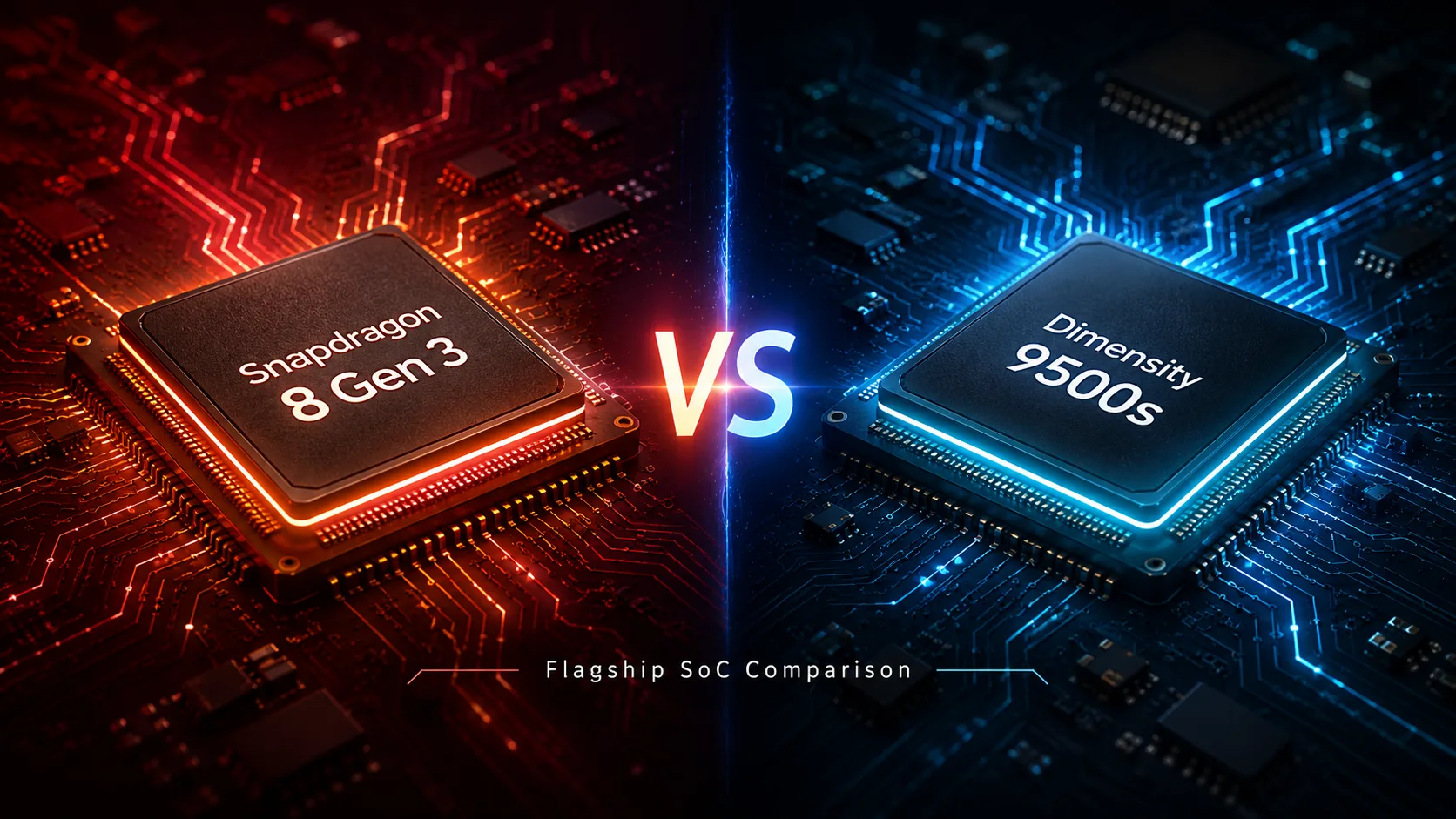
SoC Comparison Result
Snapdragon 8 Gen 3 vs Dimensity 9500s: Old Flagship vs. 3nm MediaTek
The Snapdragon 8 Gen 3 and Dimensity 9500s represent a comparison between chips of different generations. Qualcomm released its flagship earlier, and it has already been tested in dozens of smartphones. The Dimensity 9500s is newer, manufactured using a 3nm process, and features a CPU configuration without small cores, which shows significantly higher performance in benchmarks.
Looking solely at the SoC, the Dimensity 9500s is stronger. However, this does not render the Snapdragon 8 Gen 3 outdated: it still boasts the Adreno 750, polished drivers, good gaming compatibility, and a powerful Snapdragon X75 modem.
Dimensity 9500s Is Not Just an Enhanced Dimensity 9500
The name may be misleading. The Dimensity 9500s should not be considered just an upgraded version of the Dimensity 9500. It has its own CPU configuration: one Cortex-X925, three Cortex-X4, and four Cortex-A720. Logically, this aligns more with the evolution of the Dimensity 9400/9400+ line than a complete transition to the regular Dimensity 9500 architecture.
This is an important clarification in comparison to the Snapdragon 8 Gen 3. The advantages of the Dimensity 9500s are based not only on the name but also on the 3nm process, larger cores instead of smaller Cortex-A520 cores, and higher peak performance.
CPU: Advantage to MediaTek
The Snapdragon 8 Gen 3 uses a 1+5+2 scheme: one Cortex-X4, five Cortex-A720, and two Cortex-A520. This is a balanced configuration with a powerful main core, a productive mid-cluster, and small cores for light tasks.
The Dimensity 9500s is configured differently. It does not have small Cortex-A520 cores; all eight cores are performance-oriented. The main Cortex-X925 operates at frequencies up to 3.73 GHz, alongside three Cortex-X4 and four Cortex-A720.
In Geekbench 6, this gives the Dimensity 9500s an edge in both single-core and multi-core performance. The newer Cortex-X925 aids in single-threaded tests, while the eight performance cores outperform the pair of small Cortex-A520 in multi-threaded scenarios. The Snapdragon 8 Gen 3 remains fast, but against the 9500s, it appears as a flagship from the previous generation: powerful, but not record-breaking.
In a simple interface, browser, and messaging apps, the difference is nearly negligible. It becomes apparent in photo and video processing, archiving, generative functions, heavy multitasking, and other tasks where the CPU is truly loaded.
GPU: Dimensity Faster in Tests, Snapdragon More Stable in Games
The Snapdragon 8 Gen 3 uses the Adreno 750. This is one of the main advantages of the Qualcomm platform: graphics are well-supported in games, emulators, and applications where drivers and stability are important.
The Dimensity 9500s is equipped with the Arm Immortalis-G925 with hardware ray tracing. In graphic benchmarks and GPU compute tests, it is on average faster than the Snapdragon 8 Gen 3. MediaTek has the advantage here in testing.
Game performance is more complicated. Frame rates depend on cooling, power limits, firmware, and the optimization of specific projects. Therefore, while the Dimensity 9500s performs better in graphical tests, the Snapdragon 8 Gen 3 remains more convenient in areas where compatibility, stability, and emulators are critical.
Benchmarks
According to average results, the Dimensity 9500s confidently outpaces the Snapdragon 8 Gen 3. The gap is particularly noticeable in AnTuTu and graphics computing.
| Test | Snapdragon 8 Gen 3 | Dimensity 9500s | Who is Faster |
|---|---|---|---|
| AnTuTu 11 | around 2.34M | around 3.04M | Dimensity 9500s |
| Geekbench 6 Single-Core | around 2200 | around 2680 | Dimensity 9500s |
| Geekbench 6 Multi-Core | around 7200 | around 8350 | Dimensity 9500s |
| Geekbench GPU Compute | around 15,200 | around 21,000 | Dimensity 9500s |
These figures demonstrate a generational difference. The Snapdragon 8 Gen 3 is still fast, but the Dimensity 9500s shows higher performance in peak CPU and GPU loads.
In real-world smartphones, the gap may be smaller. A Snapdragon 8 Gen 3 model with good cooling can maintain high clock speeds longer than a thinner device with the newer chip. Therefore, the outcome depends not only on the SoC but also on the chassis, firmware, and thermal limits.
Memory, Camera, and Platform
Both chips support fast LPDDR5X memory and modern UFS storage. The Dimensity 9500s has a higher claimed memory bandwidth-up to 85.3 GB/s versus approximately 76.8 GB/s for the Snapdragon 8 Gen 3. This is important for gaming, cameras, AI processing, and tasks where the CPU, GPU, ISP, and NPU are loaded simultaneously.
On paper, the Dimensity 9500s also appears stronger regarding camera capabilities: it supports cameras up to 320 MP and 8K60 video capture. However, photo quality is not determined by the chip alone. The sensor, optics, stabilization, and manufacturer’s algorithms are more important than the specifications listed.
In platform capabilities, the Dimensity 9500s is ahead. For actual camera quality and overall speed, it is essential to consider the specific smartphone.
Connectivity: Snapdragon's Strong Point
The Snapdragon 8 Gen 3 features the Snapdragon X75 5G modem, supporting both sub-6 and mmWave. This is a significant advantage for global smartphone versions, travel, and operation across various networks.
The Dimensity 9500s also supports modern 5G and Wi-Fi 7, and in terms of peak Wi-Fi performance, it may appear better. However, regarding the versatility of cellular connectivity, the Snapdragon remains superior, especially in areas requiring mmWave support and a broad range of bands.
For most users, the modem will not be a decisive factor. However, when purchasing smartphones for different regions, the Snapdragon 8 Gen 3 retains a significant argument.
Heat and Stability
The 3nm process gives the Dimensity 9500s an efficiency advantage. In short bursts of performance, it can show higher output within the same thermal envelope.
However, the architecture without small cores requires good cooling. If the manufacturer limited power or used weak heat dissipation, part of the advantage may be lost to throttling. In short tests, the chip will show high results, but in prolonged gaming, it may throttle frequencies sooner.
The Snapdragon 8 Gen 3 is older, but it is well understood by manufacturers. In successful smartphones, it maintains stable performance and does not require constant caveats regarding drivers, games, and compatibility. Here, the specific implementation makes a significant difference.
What to Choose
The Dimensity 9500s is stronger as a processing platform. It has newer CPU architecture, a thinner manufacturing process, higher AnTuTu and Geekbench scores, faster memory, and more modern graphics. The clear performance victory goes to MediaTek.
The Snapdragon 8 Gen 3 may be weaker in peak figures, but it remains relevant. It should be considered if the smartphone is significantly cheaper, well-cooled, has a quality camera, and comes with decent firmware. For gaming, emulators, and global connectivity, the Adreno 750 and Snapdragon X75 still provide strong arguments for the platform.
In summary: the Dimensity 9500s is faster and technologically fresher. The Snapdragon 8 Gen 3 is no longer a benchmark leader, but it is still a flagship chip, not an outdated platform. At a similar price, it is more rational to choose a smartphone with the Dimensity 9500s. If a model with the Snapdragon 8 Gen 3 is significantly cheaper, the difference in synthetic benchmarks does not make it a poor choice.
Advantages
- Higher Technology: 3 nm (4 nm vs 3 nm)
- Higher Frequency: 3730 MHz (3300 MHz vs 3730 MHz)
- Newer Launch Date: January 2026 (October 2023 vs January 2026)
Basic
5x (3x3.2 GHz/2x3.0GHz) – Cortex-A720
2x 2.3 GHz – Cortex-A520
3x 3.3 GHz – Cortex-X4
4x 2.4 GHz – Cortex-A720
GPU Specifications
Connectivity
Memory Specifications
Miscellaneous
- FLAC
- HE-AACv1
- HE-AACv2
- MP3
- H.265
- AV1
- VP9
Benchmarks
Comparison of Devices
Related SoC Comparisons



Share in social media
Or Link To Us
<a href="https://cputronic.com/soc/compare/qualcomm-snapdragon-8-gen-3-vs-mediatek-dimensity-9500s" target="_blank">Qualcomm Snapdragon 8 Gen 3 vs MediaTek Dimensity 9500s</a>