Qualcomm Snapdragon 8 Elite
vs
Samsung Exynos 1680


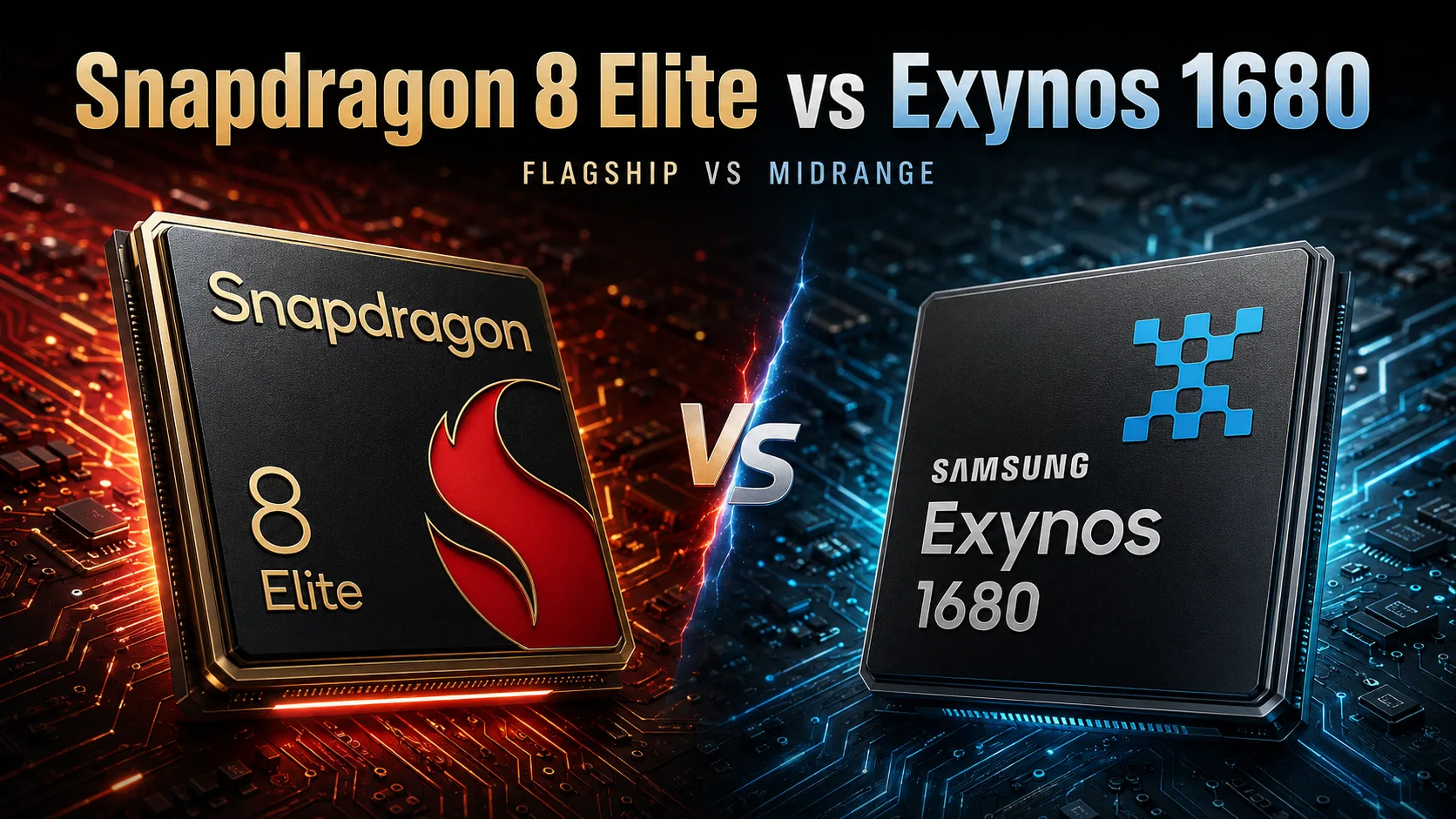
SoC Comparison Result
Snapdragon 8 Elite vs Exynos 1680: How Big is the Gap Between Flagship and Mid-Range
Snapdragon 8 Elite and Exynos 1680 belong to different classes of mobile processors. Snapdragon is intended for flagship smartphones, while Exynos 1680 is used in the Galaxy A57 5G and occupies the mid-range segment. In pure performance, Qualcomm wins without question. It is much more useful to find out how much the Galaxy A57 lags behind smartphones with Snapdragon 8 Elite and whether it is worth preferring it to an older flagship at a similar price.
Key Differences
| Characteristic | Qualcomm Snapdragon 8 Elite | Samsung Exynos 1680 |
|---|---|---|
| Processor Class | Flagship | Mid-range |
| Process Technology | 3 nm TSMC | 4 nm Samsung EUV |
| CPU Configuration | 2 high-performance + 6 performance Oryon cores | 1 high-performance + 4 performance + 3 energy-efficient Arm cores |
| Maximum Frequency | Up to 4.32 GHz in the standard version | Up to 2.9 GHz |
| Graphics | Adreno 830 | Xclipse 550 |
| GPU Architecture | Custom Qualcomm architecture | AMD RDNA 3 |
| Memory | LPDDR5X up to 5.3 GHz | LPDDR5X |
| Maximum Camera Resolution | Up to 320 MP | Up to 200 MP |
| Wireless Network | Wi-Fi 7 | Wi-Fi 6E |
Snapdragon 8 Elite utilizes custom Qualcomm Oryon cores and Adreno 830 GPU. The Exynos 1680 combines a tri-cluster Arm CPU and Xclipse 550 graphics with two WGP modules. According to Samsung, the new graphics are 16% faster than the Xclipse 540 in Exynos 1580.
The chips are initially targeted at different devices and workloads. Snapdragon 8 Elite is designed for flagships, heavy gaming, and resource-intensive video processing. Exynos 1680 is meant for everyday tasks and gaming without maximum settings.
Examples of Results from Specific Smartphones
| Smartphone | Processor | Geekbench 6, Single-Core | Geekbench 6, Multi-Core | AnTuTu 11 |
|---|---|---|---|---|
| Samsung Galaxy A57 5G | Exynos 1680 | 1,389 | 4,453 | 1,390,055 |
| OnePlus 13 | Snapdragon 8 Elite | 2,899 | 8,945 | 3,116,931 |
| Xiaomi 15 | Snapdragon 8 Elite | 2,940 | 9,243 | 3,084,263 |
| ASUS ROG Phone 9 Pro | Snapdragon 8 Elite | 3,298 | 10,812 | 3,290,813 |
The table presents user results collected by NanoReview. They provide a performance benchmark, but these results were obtained outside of a single laboratory comparison. Factors such as firmware, temperature, power mode, RAM size, and test version can influence the outcomes.
Processor Performance
In the mentioned devices, Snapdragon 8 Elite scores approximately 2900-3300 points in single-core and 8900-10,800 points in multi-core Geekbench 6. Exynos 1680 scores around 1400 and 4450 points respectively. Snapdragon is roughly twice as fast, while in the best of the given results, the gap reaches 2.4 times.
In messengers, browsers, and social media, the Galaxy A57 operates quickly. The 120 Hz display makes scrolling and system animations smoother but does not speed up app installations, photo processing, or video export. The difference becomes noticeable when working with media content and multiple heavy applications.
Snapdragon 8 Elite unpacks large files faster, processes videos, and switches between resource-intensive programs more efficiently. It will also retain headroom for newer Android versions and more demanding applications for longer.
Gaming and Graphics
Graphical performance is better reflected in 3DMark tests rather than Geekbench Compute. Wild Life Extreme creates a heavy load via Vulkan, while Steel Nomad Light places even more strain on mobile graphics.
Smartphone Results in 3DMark
| Smartphone | Processor | 3DMark Wild Life Extreme | 3DMark Steel Nomad Light |
|---|---|---|---|
| Samsung Galaxy A57 5G | Exynos 1680 | 1,708 | 776 |
| OnePlus 13 | Snapdragon 8 Elite | 6,241 | 2,455 |
| Xiaomi 15 | Snapdragon 8 Elite | 5,995 | 2,362 |
| ASUS ROG Phone 9 Pro | Snapdragon 8 Elite | 5,625 | 2,065 |
The results are sourced from various origins: UL Solutions database and tests from individual publications. The testing conditions varied, so the figures should be considered approximate.
In Wild Life Extreme, smartphones with Snapdragon 8 Elite outperform the Galaxy A57 by about 3.3-3.7 times. In Steel Nomad Light, the advantage is around 2.7-3.2 times. This is not a small gap but a significant divide between the mid-range and flagship classes.
Snapdragon 8 Elite enables high settings, increased frame rates, and demanding emulators. Exynos 1680 is suitable for popular online games and less demanding projects. In the most resource-intensive games, quality settings often need to be lowered or frame rates capped.
Even after improvements relative to Exynos 1580, the Galaxy A57 remains an ordinary mid-range smartphone, not a gaming model.
Cameras, Connectivity, and Artificial Intelligence
Snapdragon 8 Elite supports cameras with resolutions up to 320 MP, video recording up to 4K at 120 fps, and Wi-Fi 7. The mobile connection is handled by the Snapdragon X80 modem, which boasts a claimed download speed of up to 10 Gbps.
Exynos 1680 supports sensors up to 200 MP, Wi-Fi 6E, and an NPU with a performance of 19.6 TOPS. In the Galaxy A57, the NPU is involved in image processing, object recognition, and photo editing.
Camera quality cannot be determined solely by the processor: it depends on the sensors, optics, and algorithms of the specific smartphone. Snapdragon 8 Elite offers broader photo and video processing capabilities, but the final results depend on device implementation.
Which Smartphone to Choose
Snapdragon 8 Elite is significantly better suited for gaming, emulation, video editing, and heavy multitasking. Despite its earlier release, it remains much faster than Exynos 1680.
Choosing Exynos 1680 essentially means choosing the Galaxy A57. The strengths of this smartphone are its guarantee, rugged casing, 120 Hz display, and long-term support rather than high performance. The model is promised up to six generations of Android and One UI updates, as well as up to six years of security updates.
At a similar price, a reliable smartphone with Snapdragon 8 Elite is much faster than the Galaxy A57. However, before purchasing an older flagship, it's wise to check the battery's condition, remaining warranty, and update timelines. The Galaxy A57 makes more sense for those who prioritize warranty, a fresh battery, and long-term software support.
Advantages
- Higher Technology: 3 nm (3 nm vs 4 nm)
- Higher Frequency: 4320 MHz (4320 MHz vs 2900 MHz)
- Newer Launch Date: March 2026 (October 2024 vs March 2026)
Basic
4x 2.6 GHz – Cortex-A720
3x 1.95 GHz – Cortex-A520
GPU Specifications
Connectivity
Memory Specifications
Miscellaneous
- AIFF
- CAF
- MP3
- MP4
- WAV
- H.265
- VP8
- VP9
Benchmarks
Comparison of Devices
Related SoC Comparisons





Share in social media
Or Link To Us
<a href="https://cputronic.com/soc/compare/qualcomm-snapdragon-8-elite-vs-samsung-exynos-1680" target="_blank">Qualcomm Snapdragon 8 Elite vs Samsung Exynos 1680</a>