Qualcomm Snapdragon 8 Elite Gen 5
vs
MediaTek Dimensity 9500

SoC Comparison Result
Qualcomm Snapdragon 8 Elite Gen 5 vs MediaTek Dimensity 9500
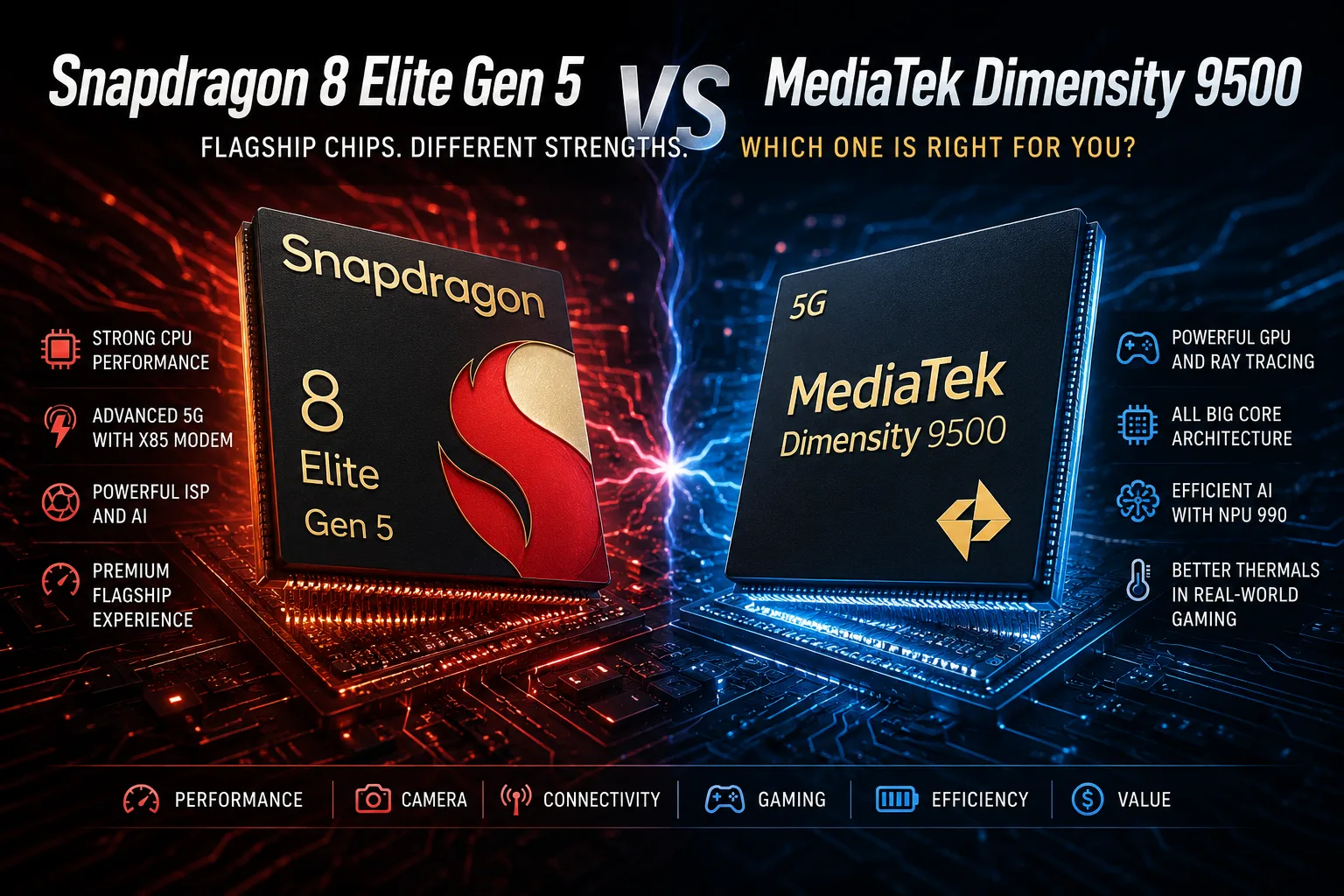
Snapdragon 8 Elite Gen 5 and Dimensity 9500 are two flagship chips from the same generation, but with different focuses. Qualcomm bets on custom Oryon cores, strong single-threaded performance, the X85 modem, and its traditionally powerful platform for high-end Android flagship devices. MediaTek counters with an All Big Core architecture, new Mali-G1 Ultra graphics, and serious advancements in gaming, ray tracing, and energy efficiency.
The main intrigue is that the Dimensity 9500 can no longer be seen as “almost flagship.” In CPU performance, Snapdragon is still ahead, but in graphics, MediaTek has come very close this generation, and in specific tests, even surpasses it.
Key Differences
| Parameter | Snapdragon 8 Elite Gen 5 | Dimensity 9500 |
|---|---|---|
| CPU | Qualcomm Oryon | Arm C1-Ultra / C1-Premium / C1-Pro |
| Max Frequency | up to 4.6-4.74 GHz, depending on the version | up to 4.21 GHz |
| GPU | Next-Gen Adreno | Arm Mali-G1 Ultra MP12 |
| Gaming Focus | Adreno, UE5, Mesh Shading, Tile Memory Heap | Mali-G1 Ultra, ray tracing, UE 5.5+, Vulkan 1.4 |
| AI Block | Hexagon NPU | MediaTek NPU 990 |
| Camera and Video | triple 20-bit ISP, APV codec | Imagiq 1190, 4K120 Dolby Vision |
| Connectivity | X85 5G, Wi-Fi 7 | 5G R17, Wi-Fi 7, Bluetooth 6.0 |
| Strength | CPU, modem, overall platform | GPU, ray tracing, efficiency in specific scenarios |
CPU: Snapdragon is Faster
Snapdragon 8 Elite Gen 5 uses the third generation of Qualcomm Oryon. These are custom Qualcomm cores, which give the chip its main advantage in the processing department. Depending on the version, the maximum frequency may vary, but the gist is that Snapdragon remains stronger where high frequency and powerful single-core performance matter.
Dimensity 9500 is built on a 1 + 3 + 4 scheme: one C1-Ultra core up to 4.21 GHz, three C1-Premium cores up to 3.5 GHz, and four C1-Pro cores up to 2.7 GHz. This is already the third generation of the All Big Core approach without traditional small cores.
In real comparisons, the OPPO Find X9 Ultra with Snapdragon 8 Elite Gen 5 outperformed the OPPO Find X9 Pro with Dimensity 9500 by about 13-14% in Geekbench 6 Single-Core and Multi-Core tests. It's not a massive gap, but the advantage is noticeable.
For the average user, both chips are already overly fast. The interface, browser, camera, and messaging apps will more often depend on the firmware, memory, and optimization of the smartphone. However, if emulators, heavy photo processing, archiving, editing, or CPU-intensive tasks are needed, Snapdragon looks stronger.
GPU and Gaming: Dimensity 9500 is Challenging Snapdragon
In the past, graphics comparisons typically favored Qualcomm almost automatically. This generation, however, is more complicated. Snapdragon 8 Elite Gen 5 features a new Adreno with claimed performance improvements and better energy efficiency, but Dimensity 9500 with Mali-G1 Ultra MP12 no longer appears to be lagging behind.
MediaTek has heavily invested in the GPU domain: new cache, improved ray tracing pipeline, support for Vulkan 1.4, and a focus on more modern gaming effects.
In 3DMark Wild Life Extreme, Dimensity 9500 was ahead by about 5-6% in comparisons with OPPO, and in Solar Bay, where ray tracing is crucial, the advantage reached around 13%. Moreover, the Dimensity version ran noticeably cooler in that specific test.
However, this does not automatically mean that Dimensity will be faster in all games. In real-world projects, drivers, optimization for specific engines, smartphone cooling, and manufacturer settings are important. Snapdragon still remains a very strong and more familiar gaming platform. The difference is that now MediaTek is no longer a “cheaper alternative,” but a direct competitor.
AI, Camera, and Video
Both chips are designed for local AI tasks: photo and video processing, voice recognition, generative functions, and on-device assistant capabilities. Snapdragon uses Hexagon NPU, while Dimensity uses NPU 990, but in reality, what's more important is how the smartphone manufacturer utilizes it in the firmware.
For the camera, Snapdragon is interesting with its triple 20-bit ISP and support for APV codec. Dimensity 9500 offers Imagiq 1190, 4K120 Dolby Vision, and 4K60 Cinematic Portrait Video.
A winner in the camera category cannot solely be determined by the SoC. The sensor, optics, processing algorithms, and firmware are more critical than the mere mention of Snapdragon or Dimensity in specifications.
Benchmarks
Synthetic tests provide a good overview of overall performance, but they should not be taken as precise numbers for each smartphone. The same chip can score differently in a thin flagship, a gaming device with active cooling, and a model with conservative power-saving settings.
| Test | Snapdragon 8 Elite Gen 5 | Dimensity 9500 | Insights |
|---|---|---|---|
| AnTuTu 11 | approximately 3.7-4.7 million | approximately 3.3-4.4 million | Snapdragon is often higher in total scores, but the variance is significant |
| Geekbench 6 Single-Core | around 3500-3650 | around 3300-3600 | Snapdragon is usually faster in single-core performance |
| Geekbench 6 Multi-Core | around 10200-11000 | around 9900-10900 | The gap is smaller; both chips are very strong |
| PCMark Work 3.0 | around 18000-19000 | around 15000-16000 | Snapdragon excels in mixed system tasks |
| 3DMark Wild Life Extreme | around 6500-7100 | around 6500-7000 | Graphics are close; the winner depends on the smartphone |
| 3DMark Solar Bay | around 12200-13500 | around 13300-14000 | Dimensity 9500 often performs better in ray tracing |
| Sustained Load | depends on cooling | depends on cooling | After several runs, the body and settings matter more than peak performance |
In terms of CPU, the picture is clear: Snapdragon 8 Elite Gen 5 is usually ahead in single-core and system tests. This is crucial for emulators, some games, photo processing, browser tasks, and work applications.
In graphics, the competition is closer: in Wild Life Extreme, results can be almost equal, while in Solar Bay, Dimensity 9500 often looks stronger due to ray tracing. However, in gaming, peak scores are not the only deciding factor; cooling, drivers, and frequency stability are essential.
Which One to Choose Ultimately
It makes more sense to choose Snapdragon 8 Elite Gen 5 if you need maximum CPU performance, a strong modem, high single-threaded performance, and a more predictable flagship platform. It’s better suited for heavy applications, emulators, photo and video processing, as well as for smartphones where connectivity, camera quality, and overall performance headroom are important.
Dimensity 9500 is more appealing if gaming, GPU power, ray tracing, temperature, and the price of the specific smartphone are priorities. It lags behind Snapdragon in CPU performance, but it no longer seems like a second choice: in graphics, MediaTek can now directly compete with Qualcomm.
The main takeaway is simple: Snapdragon 8 Elite Gen 5 is stronger as a CPU and modem platform, while Dimensity 9500 is one of MediaTek’s most serious responses in terms of graphics and efficiency. Therefore, the choice should not be based on the chip's name, but rather on the specifics of the smartphone: cooling, battery, camera, firmware, and price.
Advantages
- Higher Frequency: 4600 MHz / 4740 MHz (4600 MHz / 4740 MHz vs 4210)
Basic
GPU Specifications
Connectivity
Memory Specifications
Miscellaneous
- FLAC
- HE-AACv1
- HE-AACv2
- MP3
- H.265
- AV1
- VP9
Benchmarks
Comparison of Devices
Related SoC Comparisons


Share in social media
Or Link To Us
<a href="https://cputronic.com/soc/compare/qualcomm-snapdragon-8-elite-gen-5-vs-mediatek-dimensity-9500" target="_blank">Qualcomm Snapdragon 8 Elite Gen 5 vs MediaTek Dimensity 9500</a>