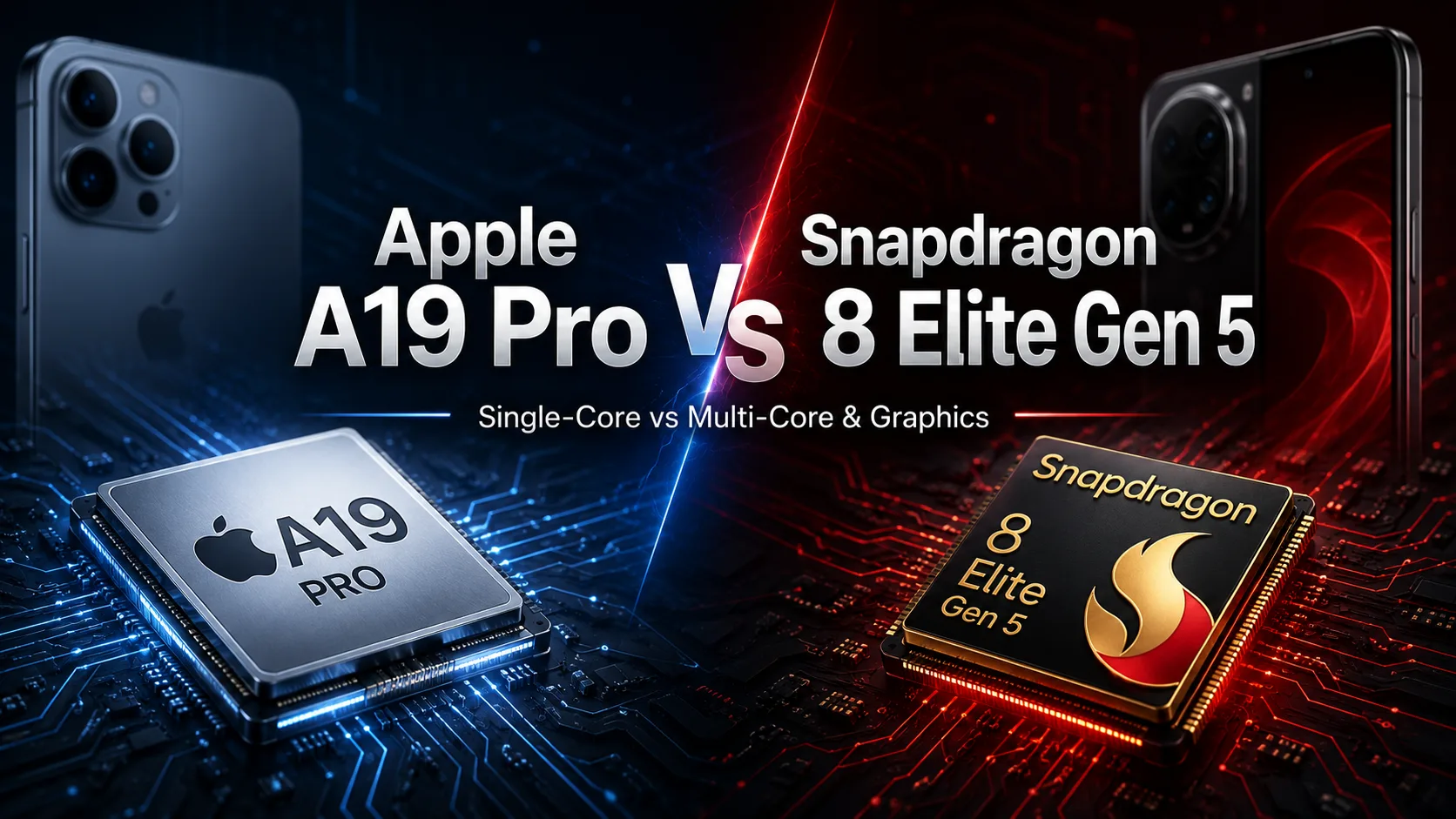
Apple A19 Pro
vs
Qualcomm Snapdragon 8 Elite Gen 5


SoC Comparison Result
Apple A19 Pro vs Snapdragon 8 Elite Gen 5: Apple Faster on Single-Core, Qualcomm Wins in Graphics and Multi-Core
The Apple A19 Pro is still faster on a single core, but the Snapdragon 8 Elite Gen 5 is not far behind and significantly outperforms in Multi-Core. In heavy graphics tests, the Snapdragon typically performs better as well. However, the difference depends on the specific smartphone, its cooling solution, and power limits.
| Characteristic | Apple A19 Pro | Qualcomm Snapdragon 8 Elite Gen 5 |
|---|---|---|
| CPU | 6 cores: 2 performance + 4 efficiency | 8 Oryon cores: 2 Prime + 6 performance |
| Maximum Frequency | About 4.26 GHz | Up to 4.74 GHz |
| GPU | Apple GPU, 6 cores in iPhone 17 Pro/Pro Max | Qualcomm Adreno |
| NPU / AI | 16-core Neural Engine + Neural Accelerators in GPU | Hexagon NPU |
| Process Technology | 3 nm | 3 nm |
| Hardware Ray Tracing | Yes | Yes |
| Typical Devices | iPhone 17 Pro, iPhone 17 Pro Max | Galaxy S26 Ultra, OnePlus 15, Honor Magic8 Pro, iQOO 15 |
CPU Performance
The Snapdragon 8 Elite Gen 5 has almost caught up to the A19 Pro in single-core performance. The gap that was previously one of Apple’s major advantages has shrunk to just a few percentage points.
In multi-threaded tests, the situation is the opposite. The Snapdragon has eight CPU cores compared to six in the A19 Pro, making it significantly faster in Multi-Core.
Geekbench 6 on Specific Smartphones
| Smartphone | Processor | Single-Core | Multi-Core |
|---|---|---|---|
| iPhone 17 Pro | Apple A19 Pro | 3,834 | 9,988 |
| iPhone 17 Pro Max | Apple A19 Pro | 3,871 | 9,968 |
| OnePlus 15 | Snapdragon 8 Elite Gen 5 | 3,618 | 11,116 |
| Samsung Galaxy S26 Ultra | Snapdragon 8 Elite Gen 5 for Galaxy | 3,785 | 11,563 |
When comparing the iPhone 17 Pro Max and the Galaxy S26 Ultra, the A19 Pro is about 2% faster in Single-Core while the Snapdragon has around a 16% advantage in Multi-Core.
Graphics
The A19 Pro features a six-core GPU with hardware ray tracing and integrated Neural Accelerators. However, in heavy graphics tests, the Adreno in the Snapdragon 8 Elite Gen 5 is typically faster.
| Smartphone | SoC | 3DMark Wild Life Extreme Unlimited | FPS |
|---|---|---|---|
| iPhone 17 Pro Max | Apple A19 Pro | 5,855 | 35.03 |
| Samsung Galaxy S26 Ultra | Snapdragon 8 Elite Gen 5 for Galaxy | 6,645 | 39.8 |
In this test, the Galaxy S26 Ultra outperforms the iPhone 17 Pro Max by about 13%.
In Wild Life Unlimited, the OnePlus 15 scored 173.83 FPS compared to 159.53 FPS for the iPhone 17 Pro Max.
Why One Snapdragon Might Be Faster Than Another
The processor's name does not guarantee the same performance. Manufacturers set their own power limits and thermal thresholds and employ different cooling systems.
Additionally, Samsung uses a special version of the Snapdragon 8 Elite Gen 5 for Galaxy. Therefore, the performance metrics of the Galaxy S26 Ultra do not reflect the performance of all smartphones with this chip. Models from OnePlus, Samsung, Honor, and iQOO with the same SoC can vary significantly in performance.
There is also a difference between versions of the A19 Pro. The iPhone 17 Pro and Pro Max have a six-core GPU, while the iPhone Air uses a version with five graphics cores. Thus, the results of the iPhone Air cannot be directly compared to those of the six-core version of the A19 Pro.
Gaming
For heavy gaming, the Snapdragon 8 Elite Gen 5 is currently the preferred choice. Its Adreno GPU is faster in tested 3DMark loads, and models with robust cooling maintain performance better during prolonged gameplay.
The vapor chamber in the iPhone 17 Pro and Pro Max helps reduce performance drops under extended loads, but in peak graphics tests, the A19 Pro still trails behind the best implementations of Snapdragon.
Therefore, when choosing a gaming smartphone, it’s important to consider not only the SoC but also the cooling solution of the specific model.
AI
Comparing the Neural Engine and Hexagon solely based on claimed TOPS is misleading: Apple and Qualcomm use different architectures and measurement methods. The actual speed of local AI functions depends on the models used and software optimization.
Conclusion
In terms of pure performance, the advantage goes to the Snapdragon 8 Elite Gen 5. It outperforms the A19 Pro in Multi-Core and heavy graphics, while Apple maintains a slight edge in Single-Core.
However, when purchasing a flagship smartphone, these differences are unlikely to be decisive. Both SoCs provide a very high level of performance, and the choice between iPhone and Android depends much more on the operating system, ecosystem, cameras, battery life, and the device itself. An iPhone user is unlikely to switch to Android for just a few percentage points in benchmarks-and vice versa.
Therefore, the results of the A19 Pro and Snapdragon 8 Elite Gen 5 reflect a technical balance of power between Apple and Qualcomm rather than directly answering which smartphone to buy.
Advantages
- Higher Frequency: 4600 MHz / 4740 MHz (4260 MHz vs 4600 MHz / 4740 MHz)
Basic
GPU Specifications
Connectivity
Memory Specifications
Miscellaneous
- AAX
- AAX+
- AC-3
- AIFF
- CAF
- E-AC-3
- MP3
- MP4
- WAV
- H.265
- AV1
- VP8
- VP9
- Motion JPEG
Benchmarks
Comparison of Devices
Related SoC Comparisons





Share in social media
Or Link To Us
<a href="https://cputronic.com/soc/compare/apple-a19-pro-vs-qualcomm-snapdragon-8-elite-gen-5" target="_blank">Apple A19 Pro vs Qualcomm Snapdragon 8 Elite Gen 5</a>