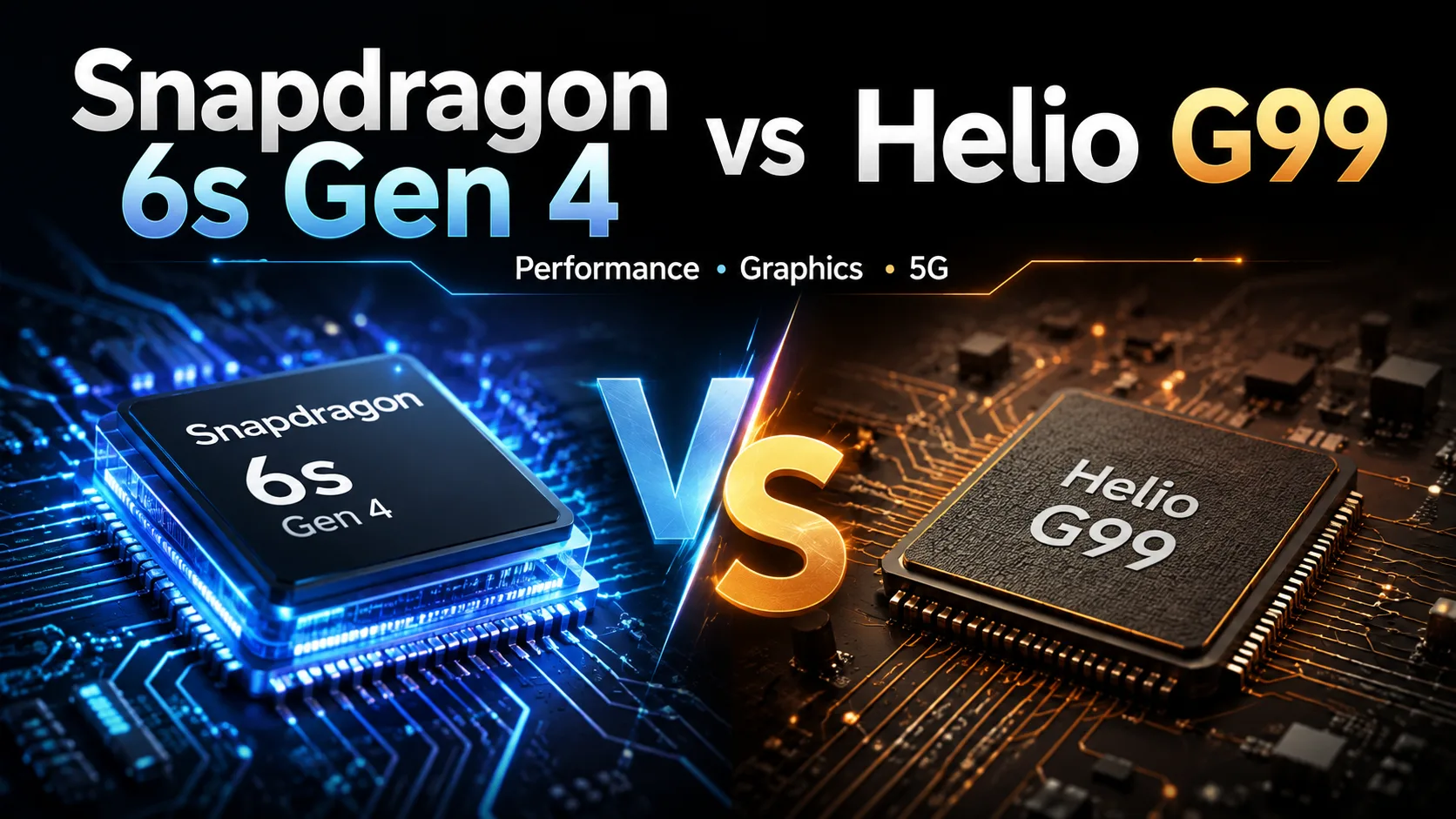
Qualcomm Snapdragon 6s Gen 4
vs
MediaTek Helio G99

SoC Comparison Result
Snapdragon 6s Gen 4 vs Helio G99: The New Qualcomm Is Significantly Faster
The Snapdragon 6s Gen 4 and Helio G99 are both found in budget smartphones, but the Snapdragon is noticeably more modern. It features four Cortex-A78 cores compared to two Cortex-A76 cores in the Helio G99, a 4nm process instead of a 6nm process, 5G support, and significantly more powerful graphics. The gap is especially marked in 3DMark and GFXBench.
Key Differences
| Characteristic | Snapdragon 6s Gen 4 | Helio G99 |
|---|---|---|
| Process Node | 4 nm | 6 nm |
| CPU | 4× Cortex-A78 up to 2.4 GHz + 4× Cortex-A55 up to 1.8 GHz | 2× Cortex-A76 up to 2.2 GHz + 6× Cortex-A55 up to 2.0 GHz |
| GPU | Adreno 710 | Mali-G57 MC2 |
| Mobile Network | 5G + 4G | 4G |
| Memory | Up to LPDDR5X | LPDDR4X |
| Storage | Up to UFS 3.1 | UFS 2.2 |
| Wi-Fi | Wi-Fi 6E | Wi-Fi 5 |
| Display | FHD+ up to 144 Hz | FHD+ up to 120 Hz |
| Camera | Up to 200 MP | Up to 108 MP |
The main difference in CPU is the number of high-performance cores. Snapdragon has four Cortex-A78 cores, whereas Helio G99 has only two older Cortex-A76 cores.
LPDDR5X, UFS 3.1, and Wi-Fi 6E are supported by the Snapdragon 6s Gen 4 itself, but the smartphone manufacturer is not obligated to use these capabilities.
CPU Performance
In Geekbench 6, smartphones with the Snapdragon 6s Gen 4 score around 1000 points in single-core testing and over 2700 in multi-core. The Galaxy A15 4G and A16 4G with Helio G99 score about 730 points in single-core and 1940 in multi-core.
Benchmarks on Specific Smartphones
| Smartphone | Processor | Geekbench 6 Single | Geekbench 6 Multi | AnTuTu 11 |
|---|---|---|---|---|
| Motorola Moto G57 Power | Snapdragon 6s Gen 4 | 1009 | 2892 | 829 894 |
| Motorola Moto G57 | Snapdragon 6s Gen 4 | 1002 | 2733 | - |
| Samsung Galaxy A16 4G | Helio G99 | 728 | 1943 | 526 733 |
| Samsung Galaxy A15 4G | Helio G99 | 728 | 1942 | 522 075 |
In Geekbench 6, Snapdragon outperforms Helio G99 by about 38% in single-core testing and by 40-50% in multi-core.
In AnTuTu 11, Moto G57 Power scores around 830,000 points compared to 520-530 thousand for the Galaxy A15 4G and A16 4G.
Graphics and Gaming
The gap in GPU performance is even larger than that in CPU performance. The Adreno 710 in the Moto G57 Power scores 2938 points in 3DMark Wild Life, while the Mali-G57 MC2 in the Galaxy A16 4G scores 1178 points. The difference is about 2.5 times.
Graphics Benchmarks
| Test | Moto G57 Power - Snapdragon 6s Gen 4 | Galaxy A16 4G - Helio G99 |
|---|---|---|
| 3DMark Wild Life | 2938 | 1178 |
| GFXBench Aztec Ruins Normal, Onscreen | 30 FPS | 15 FPS |
| GFXBench Aztec Ruins Normal, 1080p Offscreen | 34 FPS | 16 FPS |
| GFXBench Aztec Ruins High, Onscreen | 18 FPS | 9.2 FPS |
| GFXBench Aztec Ruins High, 1440p Offscreen | 12 FPS | 5.9 FPS |
In GFXBench tests, the Adreno 710 also outperforms the Mali-G57 MC2 by approximately double.
For less demanding games, the Helio G99 is still sufficient, but in heavier games, the Mali-G57 MC2 is noticeably weaker than the Adreno 710. One can expect higher settings and stable FPS with the Snapdragon 6s Gen 4.
Support for displays up to 144 Hz does not mean 144 FPS in games; it refers only to the maximum refresh rate of the display.
5G and Connectivity
The Snapdragon 6s Gen 4 supports 5G, whereas the Helio G99 operates only on 4G networks.
Wi-Fi capabilities also differ: Snapdragon supports Wi-Fi 6E, while Helio G99 supports Wi-Fi 5.
Cameras and Multimedia
The Snapdragon 6s Gen 4 supports sensors with resolutions of up to 200 MP, while the Helio G99 supports up to 108 MP. Both platforms can record video up to 2K at 30 frames per second.
The maximum sensor resolution does not determine the quality of the shots; it largely depends on the camera itself, optics, and processing algorithms.
Where These Chips Are Found in Smartphones
The Snapdragon 6s Gen 4 is currently used in a small number of smartphones, including the Motorola Moto G57 and Moto G57 Power.
The Helio G99 is found, for example, in the Samsung Galaxy A15 4G and Galaxy A16 4G. The Helio G99 Ultra variant is used in the POCO M6 Pro 4G and Redmi Note 13 Pro 4G.
What This Means When Choosing a Smartphone
At the same price point, smartphones with the Snapdragon 6s Gen 4 are preferable. They are about 40% faster in CPU tests, nearly twice as powerful in graphics, and support 5G.
The Helio G99 model should be considered if it is significantly cheaper or offers advantages in display, memory, battery life, or camera.
Conclusion
The Snapdragon 6s Gen 4 is significantly stronger than the Helio G99. It is faster in CPU performance, approximately twice as powerful in graphics, and supports 5G, unlike the Helio G99.
Given comparable pricing and specifications, there is no reason to choose a smartphone with Helio G99 over the Snapdragon 6s Gen 4.
Advantages
- Higher Technology: 4 nm (4 nm vs 6 nm)
- Higher Frequency: 2400 MHz (2400 MHz vs 2200 MHz)
- Newer Launch Date: October 2025 (October 2025 vs May 2022)
Basic
GPU Specifications
Connectivity
Memory Specifications
Miscellaneous
- AIFF
- CAF
- MP3
- MP4
- WAV
- H.265
- VP9
Benchmarks
Comparison of Devices
Related SoC Comparisons




Share in social media
Or Link To Us
<a href="https://cputronic.com/soc/compare/qualcomm-snapdragon-6s-gen-4-vs-mediatek-helio-g99" target="_blank">Qualcomm Snapdragon 6s Gen 4 vs MediaTek Helio G99</a>