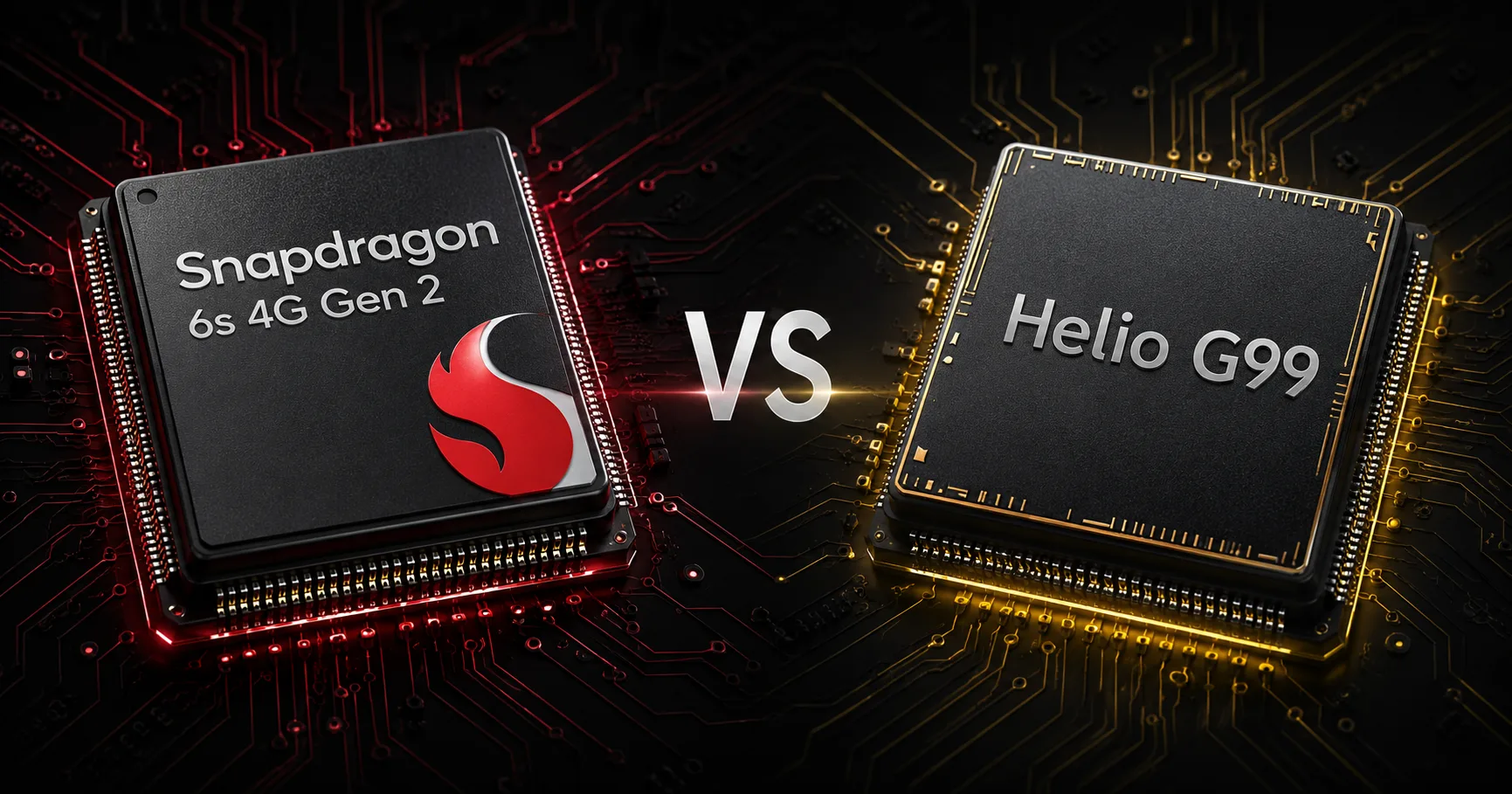
Qualcomm Snapdragon 6s 4G Gen 2
vs
MediaTek Helio G99

SoC Comparison Result
Qualcomm Snapdragon 6s 4G Gen 2 vs MediaTek Helio G99: New Name vs Proven 4G Chip
Qualcomm Snapdragon 6s 4G Gen 2 and MediaTek Helio G99 are chips designed for budget 4G smartphones. These platforms are not meant for heavy gaming but are suitable for devices with average interface speed, good battery life, and a reasonable price.
At first glance, the Snapdragon 6s 4G Gen 2 appears more appealing. It's newer, featuring a Kryo CPU clocked up to 2.9 GHz, Adreno graphics, Triple ISP, and support for cameras up to 108 MP. However, the Helio G99 should not be dismissed simply due to its age. It is one of the most reliable 4G chips in recent years: it has long been used in budget smartphones, is well-recognized from actual devices, and usually does not cause significant heating issues.
The main intrigue here is simple: Qualcomm’s new name versus the old but familiar Helio G99. Benchmark results show that the winner is not so obvious.
Benchmarks and CPU: Snapdragon is Faster in Single-Thread Performance
| Test | Snapdragon 6s 4G Gen 2 | Helio G99 | Difference |
|---|---|---|---|
| Geekbench 6 Single Core | 928 | 733 | Snapdragon +27% |
| Geekbench 6 Multi Core | 2049 | 1994 | Snapdragon +3% |
| AnTuTu 10 | 405227 | 423470 | Helio G99 +5% |
The Snapdragon 6s 4G Gen 2 is significantly faster in Geekbench 6 Single Core. This is important for short tasks: opening an app, quickly performing a system task, loading a page in a browser, switching between a messenger and the camera. In such situations, a stronger single thread can indeed give the impression of a more responsive smartphone.
However, in multi-core performance, the difference nearly disappears: Snapdragon is ahead by only 3%. In AnTuTu 10, the Helio G99 is even slightly higher. This does not make MediaTek definitively faster, but it effectively demonstrates the main point: there is no significant gap between these chips.
The Helio G99 has a simpler and clearer architecture: two powerful Cortex-A76 and six energy-efficient Cortex-A55. The architecture may no longer be new, but it is well-known. For everyday applications, it is still sufficient if the manufacturer hasn't skimped on memory and storage.
Interestingly, the Helio G99 has proven so successful in its niche that MediaTek has continued this formula with little change in the Helio G100. The same two Cortex-A76 and six Cortex-A55, LPDDR4X, and UFS 2.2 remain, with the major noticeable upgrade being the ISP supporting cameras up to 200 MP. This means G99 hasn't just lingered on the market; its foundation has proven robust enough to receive a reissue under a new name.
Graphics and Gaming: No Big Promises
The Snapdragon 6s 4G Gen 2 uses Adreno graphics, while the Helio G99 employs Mali-G57 MC2. On paper, Adreno looks more promising, but in this class, just a name for the GPU is insufficient. Game optimization, cooling, memory capacity, and the specific smartphone matter more.
For PUBG Mobile, Mobile Legends, Standoff 2, Asphalt 9, and simpler online games, both chips perform adequately. However, Genshin Impact, Wuthering Waves, and Zenless Zone Zero are beyond their capabilities for high settings and stable high FPS.
The main takeaway regarding gaming is straightforward: Snapdragon might be slightly more exciting due to Adreno and its stronger single-thread performance, but there isn't a vast chasm between it and the Helio G99. For serious mobile gaming, it is better to look at higher-class chips.
Camera and Video: 108 MP Does Not Guarantee Good Shooting
Both chips support cameras up to 108 MP. The Snapdragon 6s 4G Gen 2 comes with Qualcomm Spectra Triple ISP, while Helio G99 features a 3x ISP and support for 108-megapixel sensors. The gap in dry numbers is small.
However, 108 MP in a budget smartphone does not guarantee good photography. More critical are the sensor, optics, stabilization, night mode, and processing. Therefore, a smartphone with the Helio G99 can take better photos than one with the Snapdragon 6s 4G Gen 2, assuming the manufacturer has optimized the camera well.
In terms of video, the Helio G99 supports 2K at 30 FPS, FHD at 60 FPS, and HD at 120 FPS. For a budget smartphone, this is sufficient, but the weak points often lie not in resolution but in stabilization, night shooting, and detail in difficult lighting conditions.
What Matters More Than the Chip: Memory, Storage, Display, and Battery
In a budget smartphone, the configuration is often more important than the minor differences between SoCs. A model with 8 GB of RAM, a fast storage solution, decent firmware, and a good display will be perceived as better than an equivalent device with the same processor but 4-6 GB of RAM and heavy software.
Regarding connectivity and heating, there is little difference: both chips remain within the 4G segment, support Wi-Fi 5 and Bluetooth 5.2, and are designed for moderate load. Ultimately, battery life depends more on the battery, screen, and firmware than on the choice between these two SoCs.
Conclusion
The Snapdragon 6s 4G Gen 2 is slightly more interesting for the same price: it has a stronger single thread, making the smartphone feel faster for short tasks. However, the Helio G99 does not appear weak: multi-core performance is nearly equal, AnTuTu 10 is even slightly higher, and the platform has been long validated and essentially received a follow-up in the Helio G100.
Therefore, there is little sense in overpaying just for the Qualcomm name. If a smartphone with the Helio G99 is cheaper but offers a good display, 8 GB of RAM, fast storage, and a large battery, it could be the more successful purchase.
Advantages
- Higher Frequency: 2900 MHz (2900 MHz vs 2200 MHz)
- Newer Launch Date: December 2025 (December 2025 vs May 2022)
Basic
GPU Specifications
Connectivity
Memory Specifications
Miscellaneous
Benchmarks
Related SoC Comparisons



Share in social media
Or Link To Us
<a href="https://cputronic.com/soc/compare/qualcomm-snapdragon-6s-4g-gen-2-vs-mediatek-helio-g99" target="_blank">Qualcomm Snapdragon 6s 4G Gen 2 vs MediaTek Helio G99</a>