MediaTek Helio G100
vs
Qualcomm Snapdragon 6s 4G Gen 2


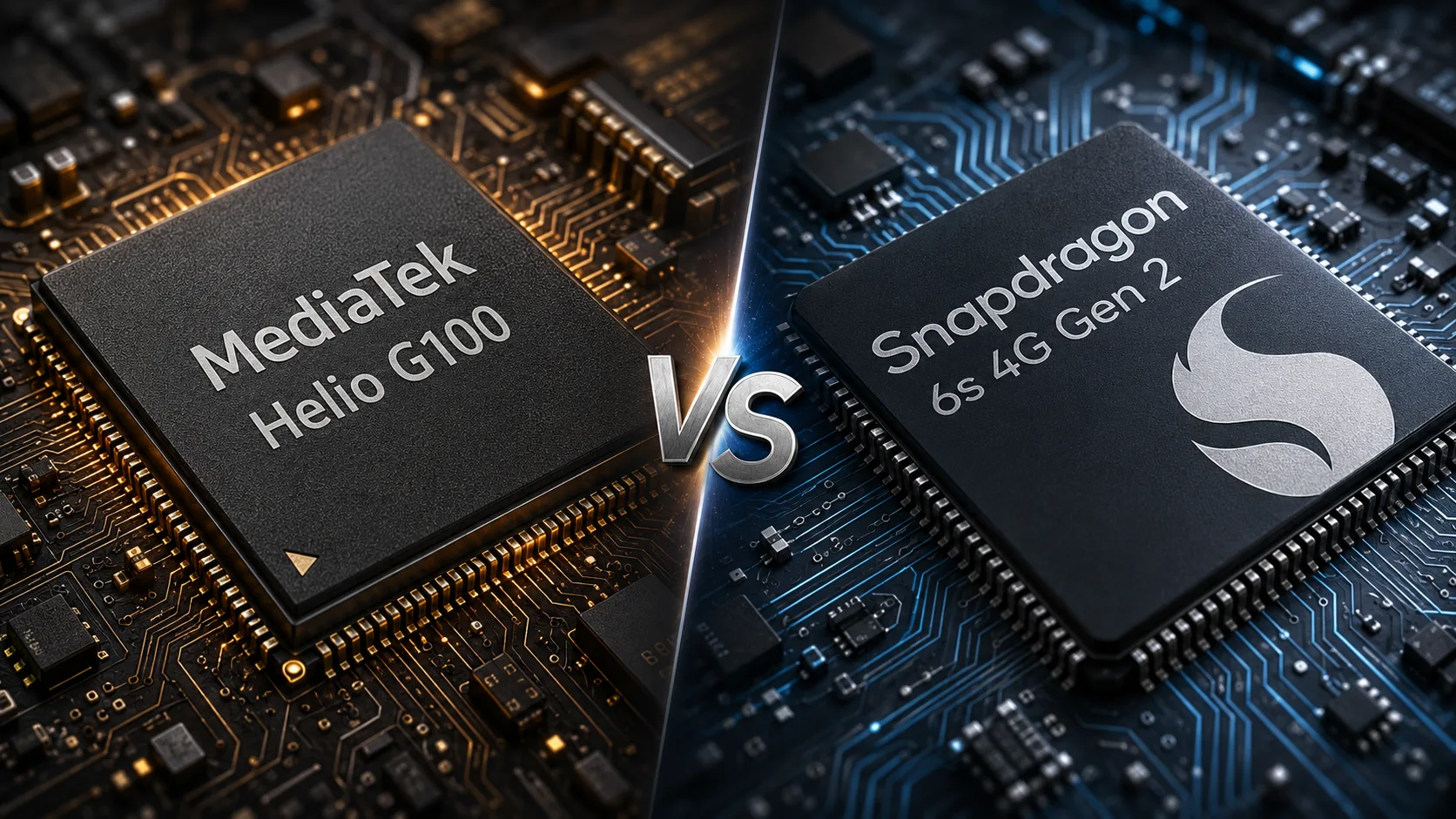
SoC Comparison Result
MediaTek Helio G100 vs Qualcomm Snapdragon 6s 4G Gen 2: fresh Snapdragon against the more straightforward Helio
MediaTek Helio G100 and Qualcomm Snapdragon 6s 4G Gen 2 are two 4G chips for budget smartphones. At first glance, Snapdragon looks more appealing: a newer name, higher CPU frequency of up to 2.9 GHz, and the Qualcomm brand. However, if you look beyond the name and consider the entire set of specifications, the Helio G100 appears to be a more balanced platform.
The key point is not that one chip is “new” while the other is “old.” Both belong to the affordable 4G segment. The difference lies elsewhere: the Helio G100 has a clear CPU configuration, disclosed graphics, stronger camera capabilities, and less ambiguity regarding its positioning. The Snapdragon 6s 4G Gen 2 can also serve as a decent foundation for a budget smartphone, but it shouldn't be confused with modern 5G Snapdragon 6 series chips.
Key Differences
| Item | MediaTek Helio G100 | Snapdragon 6s 4G Gen 2 | What it means |
|---|---|---|---|
| CPU | 2x Cortex-A76 + 6x Cortex-A55 | Kryo CPU up to 2.9 GHz | Helio offers a clearer configuration, Snapdragon has a higher frequency |
| Process | 6 nm TSMC | 6 nm | Rough parity |
| Graphics | Mali-G57 MC2 | Adreno GPU | The exact GPU model of Snapdragon is officially undisclosed |
| Memory | LPDDR4X | LPDDR4X | Parity |
| Storage | UFS 2.2 | UFS 2.2 | Parity |
| Camera | up to 200 MP | up to 108 MP | Helio has a greater camera capability |
| Display | FHD+ up to 120 Hz | FHD+ up to 120 Hz | Parity |
| Connectivity | 4G | 4G | 5G is not available on either |
Performance
The Helio G100 utilizes two high-performance Cortex-A76 cores up to 2.2 GHz and six energy-efficient Cortex-A55 cores up to 2.0 GHz. Although this architecture is not new, it still appears adequate for a low-cost 4G smartphone: the interface, browser, messaging apps, video playback, navigation, and banking applications should not be problematic.
The Snapdragon 6s 4G Gen 2 emphasizes a frequency of up to 2.9 GHz, but a high frequency does not guarantee superiority on its own. Architecture, power limits, cooling, and the specific smartphone firmware are crucial factors. Qualcomm does not disclose the exact configuration of the CPU cores in its open specifications, so comparing architectures directly should be approached cautiously.
Based on early benchmarks, the Helio G100 often appears faster as a complete package, but the numbers should be viewed as a rough guide: there are fewer real devices and results available for the Snapdragon 6s 4G Gen 2.
| Item | MediaTek Helio G100 | Snapdragon 6s 4G Gen 2 | Conclusion |
|---|---|---|---|
| AnTuTu 11 | around 570k | around 520k | Helio leads in overall score |
| CPU | 2x Cortex-A76 + 6x Cortex-A55 | Kryo up to 2.9 GHz | Snapdragon may excel in short CPU loads due to its high peak frequency |
| GPU | Mali-G57 MC2 | Adreno GPU | Helio offers a clearer understanding of its graphics capabilities |
Gaming and Graphics
For gaming, the Helio G100 appears to be the more favorable choice. Its graphics capabilities are clearer: MediaTek discloses the Mali-G57 MC2, while Qualcomm only provides the general name Adreno GPU without a specific model. This does not mean that a smartphone with the Helio G100 will become a gaming powerhouse, but it shows superior GPU potential.
Both chips should handle casual games adequately. Titles like PUBG Mobile, Mobile Legends, Standoff 2, and similar projects should run on reasonable settings. In more intensive games like Genshin Impact or Honkai: Star Rail, you may need to lower the graphics and not expect stable high FPS. Here, the chip alone isn't the only determining factor; cooling, memory size, storage speed, and optimization for specific models also play significant roles.
The Snapdragon 6s 4G Gen 2 is also suitable for light and medium games, but its graphic specifications are less disclosed. Therefore, in this comparison, the Helio G100 appears stronger for gaming tasks.
Camera and Multimedia
In terms of camera capabilities, the Helio G100 is notably more interesting. It supports sensors up to 200 MP, dual cameras, electronic stabilization, hardware bokeh, and multi-frame noise reduction. For a budget smartphone, this does not guarantee excellent photos, but it offers manufacturers more room to optimize camera performance.
The Snapdragon 6s 4G Gen 2 supports cameras up to 108 MP and video recording up to 1080p at 60 FPS. This is sufficient for a typical budget smartphone, but in terms of multimedia capability, the Helio G100 seems to have the edge. Especially if the manufacturer really includes a good sensor and does not cut corners on processing.
The important point is that photo quality in this class depends not just on the chip. The sensor, optics, processing algorithms, and firmware can alter the outcome significantly, more than mere numbers indicating “up to 200 MP” or “up to 108 MP.”
Connectivity, Display, and Battery Life
In terms of basic capabilities, the chips are close. Both are designed for 4G smartphones, support FHD+ displays up to 120 Hz, LPDDR4X memory, UFS 2.2 storage, Wi-Fi 5, and Bluetooth 5.2. This is a standard set for a budget device without 5G.
Choosing a winner in battery life is tough in advance. Both chips are made using a 6-nm process, but power consumption will depend on the display, battery, firmware, modem, and cooling. Under identical conditions, a massive difference due to the manufacturing process is not expected.
What to Choose
The Helio G100 is better suited for those who prioritize gaming, camera capabilities, and overall balance. It has a clear CPU configuration, disclosed graphics, support for cameras up to 200 MP, and a clearer positioning for affordable 4G smartphones.
The Snapdragon 6s 4G Gen 2 should be considered if the smartphone featuring it is significantly cheaper, better assembled, has a good display, battery, or camera. The chip itself is decent, but its name may lead to inflated expectations. It is not an equivalent to modern 5G Snapdragon 6 Gen chips but a distinct entry-level 4G platform.
Conclusion
In the comparison of MediaTek Helio G100 vs Qualcomm Snapdragon 6s 4G Gen 2, the Helio G100 stands out as the stronger option. It performs better in graphics, is more interesting in camera capabilities, and provides a clearer overall configuration.
If the smartphones are priced equally, the Helio G100 appears to be the more favorable option based on the totality of specifications. The Snapdragon 6s 4G Gen 2 should be selected not because of the chip's name, but if the specific model offers advantages in display, battery, camera, or price.
Advantages
- Higher Frequency: 2900 MHz (2200 MHz vs 2900 MHz)
- Newer Launch Date: December 2025 (August 2024 vs December 2025)
Basic
GPU Specifications
Connectivity
Memory Specifications
Miscellaneous
Benchmarks
Related SoC Comparisons



Share in social media
Or Link To Us
<a href="https://cputronic.com/soc/compare/mediatek-helio-g100-vs-qualcomm-snapdragon-6s-4g-gen-2" target="_blank">MediaTek Helio G100 vs Qualcomm Snapdragon 6s 4G Gen 2</a>