Qualcomm Snapdragon 6s 4G Gen 2
vs
MediaTek Dimensity 7300

SoC Comparison Result
Snapdragon 6s 4G Gen 2 vs Dimensity 7300: When a New Name Doesn’t Make a Chip Modern
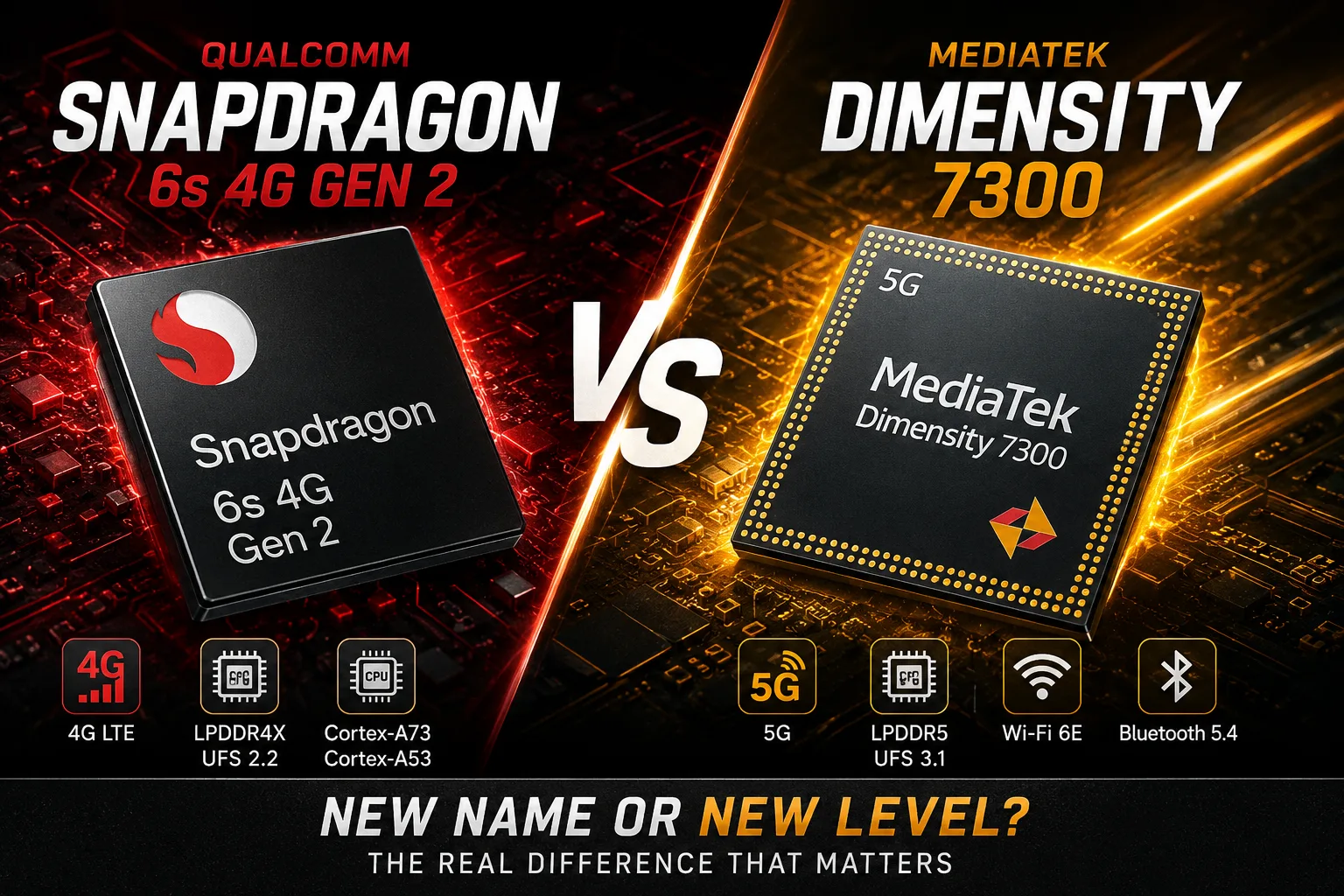
At first glance, the Snapdragon 6s 4G Gen 2 and Dimensity 7300 belong to the same class, but the comparison quickly falls apart. Snapdragon is a budget 4G platform with old CPU cores and weak graphics. The Dimensity 7300 is a modern mid-range 5G chip with a fast processor, LPDDR5, UFS 3.1, and significantly better performance for gaming and everyday use. Therefore, the main question here is not "who is faster," but rather what kind of smartphone you’re buying: a simple 4G device or a class above.
The Main Difference: Snapdragon Competes on Price, Dimensity on Class
The Snapdragon 6s 4G Gen 2 is designed for inexpensive 4G smartphones. It serves as the foundation for basic models: calls, messaging, browsing, YouTube, navigation, and light gaming. It supports FHD+ displays up to 120 Hz, LTE, Wi-Fi 5, and Bluetooth 5.2, but in terms of hardware, it remains a budget 4G chip, not a competitor to modern 5G solutions.
The Dimensity 7300 plays in a more expensive class. It employs a combination of Cortex-A78 and Cortex-A55 cores, is manufactured using a 4nm process, supports LPDDR5, UFS 3.1, Wi-Fi 6E, Bluetooth 5.4, and 5G. The difference isn’t just reflected in percentages in tests: smartphones powered by Dimensity 7300 open apps faster, handle loads more confidently, and hit hardware limits later.
CPU: Dimensity Is Faster Where Snapdragon Struggles with Age
The Snapdragon 6s 4G Gen 2 features an older set of Cortex-A73 and Cortex-A53 cores. The high clock speed helps with simple tasks, but the old cores still prevent it from handling heavy scenarios as well as the Dimensity 7300. It can cope with everyday workloads but will start to lag earlier in multitasking, heavy websites, and photo processing from the camera.
The Dimensity 7300 shines thanks to its newer Cortex-A78 cores. They provide better responsiveness in heavy applications, open programs faster, and hold loads more reliably. In practical terms, it translates to less latency after taps and fewer pauses when switching between tasks.
Graphics: A Clear Win for Dimensity
The weak CPU of the Snapdragon can be forgiven due to the price of the smartphone. The situation is harsher with graphics. The Adreno 610 in the Snapdragon 6s 4G Gen 2 is the main limitation of this chip. It suffices for interfacing, videos, and simple games, but demanding games quickly reveal its limits.
On the other hand, the Dimensity 7300 with Mali-G615 MC2 is significantly stronger. This is important not just for gaming: graphics improve the interface, camera, video processing, and prolong the lifespan of normal smartphone usage. Even if the user doesn’t play every day, a more powerful GPU increases the chances that the device won't become frustrating a year or two after purchase.
Benchmarks
| Test | Snapdragon 6s 4G Gen 2 | Dimensity 7300 | Difference |
|---|---|---|---|
| AnTuTu 11 | 522 680 | 877 641 | Dimensity 7300 is about 68% faster |
| Geekbench 6 Single-Core | 489 | 1 011 | Dimensity 7300 is about 2 times faster |
| Geekbench 6 Multi-Core | 1 532 | 2 813 | Dimensity 7300 is about 84% faster |
| Geekbench GPU Compute | 385 | 2 507 | Dimensity 7300 is over 6 times faster |
| AnTuTu GPU | 29 683 | 126 955 | Dimensity 7300 is over 4 times faster |
The table shows that this isn’t a contest between two close chips. Dimensity 7300 wins not in one test, but across all key smartphone components: CPU, graphics, overall speed, memory, connectivity, and storage.
Memory, Storage, and Connectivity: Tangible Daily Differences
The difference between LPDDR4X/UFS 2.2 and LPDDR5/UFS 3.1 isn’t always visible in marketing materials, but it is noticeable in usage. Apps open faster, updates install without long pauses, there are fewer delays when switching between programs, and the camera handles burst shooting and photo processing more confidently.
5G should not just be reduced to maximum speeds. In a smartphone with the Dimensity 7300, the user not only gets 5G but also newer wireless interfaces: Wi-Fi 6E and Bluetooth 5.4. The Snapdragon 6s 4G Gen 2 remains in the 4G class, which is only acceptable at a significantly lower price.
When the Snapdragon 6s 4G Gen 2 Still Makes Sense
The Snapdragon 6s 4G Gen 2 makes sense to buy if the smartphone based on it is significantly cheaper. It fits scenarios where heavy gaming, 5G, and long-term use without annoying limitations are not needed.
It is suitable if you need:
- An inexpensive smartphone for calls, messaging, and browsing;
- A second phone;
- A smartphone for children, parents, or as a simple backup model;
- A phone not expected to handle gaming or strong camera performance;
- An option where minimal price is the deciding factor.
However, with a small price difference, the savings become questionable. The old CPU base, weak graphics, and lack of 5G will quickly become limitations.
What to Choose in a Real Smartphone
Choose the Dimensity 7300 if the smartphone is being purchased as a primary device rather than a temporary one. It is faster in applications, stronger in gaming, better in memory and storage, supports 5G, and is better prepared for new versions of Android and heavier applications.
The Snapdragon 6s 4G Gen 2 only makes sense as a budget solution. Its strong point is not speed, but the low price of smartphones on this platform. If a device on Snapdragon is substantially cheaper and needed for simple tasks, such a choice is justified. If the price difference is small, the Dimensity 7300 is a more sensible purchase.
Conclusion
The comparison between the Snapdragon 6s 4G Gen 2 and Dimensity 7300 is not one between two equal competitors, but rather between two different levels of smartphones. The Snapdragon seems fresh by name, but fundamentally remains a simple 4G platform with old CPU cores and weak graphics. The Dimensity 7300 is a modern mid-range 5G chip with a fast processor, more powerful GPU, LPDDR5, UFS 3.1, and a better outlook for a couple of years ahead.
If the smartphone featuring the Snapdragon 6s 4G Gen 2 is much cheaper, it can be chosen for basic tasks. In all other cases, the Dimensity 7300 appears significantly stronger and more reasonable for purchase.
Advantages
- Higher Frequency: 2900 MHz (2900 MHz vs 2500 MHz)
- Newer Launch Date: December 2025 (December 2025 vs June 2024)
- Higher Technology: 4 nm (6 nm vs 4 nm)
Basic
GPU Specifications
Connectivity
Memory Specifications
Miscellaneous
Benchmarks
Related SoC Comparisons




Share in social media
Or Link To Us
<a href="https://cputronic.com/soc/compare/qualcomm-snapdragon-6s-4g-gen-2-vs-mediatek-dimensity-7300" target="_blank">Qualcomm Snapdragon 6s 4G Gen 2 vs MediaTek Dimensity 7300</a>