Qualcomm Snapdragon 685
vs
MediaTek Helio G100


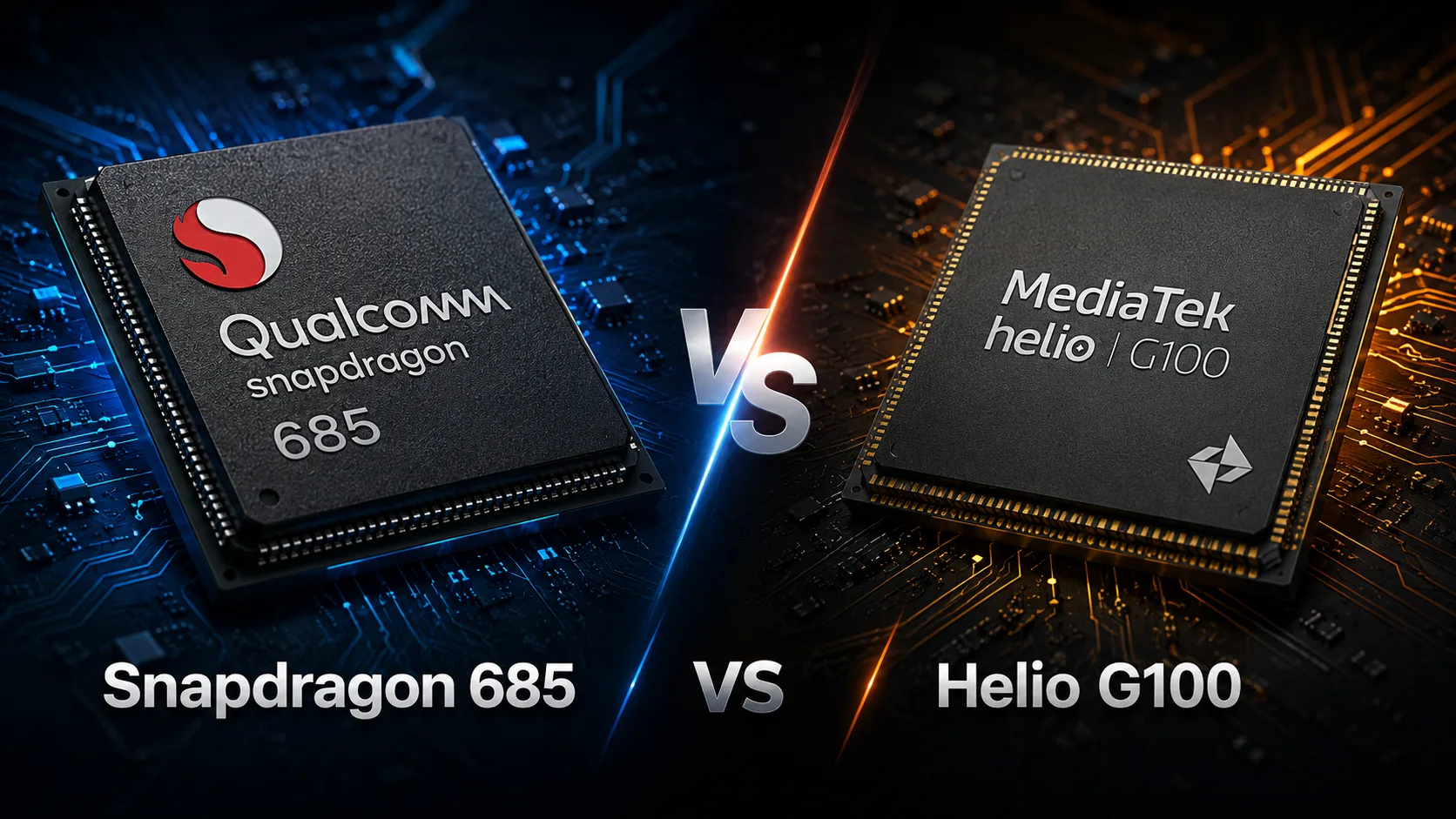
SoC Comparison Result
Snapdragon 685 vs Helio G100: Which 4G Chip is Better for Budget Smartphones
Qualcomm Snapdragon 685 and MediaTek Helio G100 are processors for affordable 4G smartphones. Both are designed for Full HD+ screens with high refresh rates and are found in budget and mid-range models. However, in terms of performance, these chips are not equal: the Helio G100 is noticeably snappier due to its more modern architecture.
Snapdragon 685 is commonly used in mass-market 4G smartphones from Xiaomi, Redmi, Honor, and Realme. The Helio G100 appears in newer 4G models from Xiaomi, Tecno, Infinix, and other brands. Therefore, the comparison is not only about specifications but also about how comfortably the smartphone will perform in everyday use.
The Main Difference - Architecture, Not Frequency
On paper, the Snapdragon 685 looks solid: 8 cores, 6nm manufacturing process, and frequencies up to 2.8 GHz. However, it employs the older Cortex-A73 and Cortex-A53 core configuration. The high frequency partially masks the age of its architecture.
The Helio G100 uses two high-performance Cortex-A76 cores and six energy-efficient Cortex-A55 cores. Its frequency is lower-up to 2.2 GHz-but the cores themselves are newer. As a result, in real-world tasks, the Helio G100 often proves to be faster, despite the less impressive frequency figure.
| Specification | Snapdragon 685 | Helio G100 |
|---|---|---|
| Manufacturing Process | 6 nm | 6 nm |
| CPU | 4x Cortex-A73 + 4x Cortex-A53 | 2x Cortex-A76 + 6x Cortex-A55 |
| Max Frequency | up to 2.8 GHz | up to 2.2 GHz |
| Graphics | Adreno 610 | Mali-G57 MC2 |
| Memory | LPDDR4X | LPDDR4X |
| Storage | depends on the smartphone | UFS 2.2 |
| 5G | no | no |
| Display | up to Full HD+ 120 Hz | up to Full HD+ 120 Hz |
The Helio G100 should not be viewed as a revolutionary chip. It is an evolution of MediaTek's 4G lineup, similar to the Helio G99/G9x. However, against the Snapdragon 685, it appears fresher and stronger.
Performance
In everyday tasks, the Snapdragon 685 still manages fine: messaging apps, YouTube, browsers, banking applications, navigation. But its headroom is limited. When multitasking heavily or dealing with complex web pages, a smartphone with Snapdragon 685 quickly starts to feel budget-level.
The Helio G100 performs more briskly. The Cortex-A76 cores help it handle application launches, web browsing, UI navigation, and switching between tasks more effectively.
| Benchmark | Snapdragon 685 | Helio G100 |
|---|---|---|
| AnTuTu 11 | around 460,000 | around 570,000 |
| Geekbench 6 Single-Core | around 460-470 | around 700-730 |
| Geekbench 6 Multi-Core | around 1400 | around 1900-2000 |
| Geekbench GPU Compute | around 380 | around 1400+ |
The difference is not cosmetic. The Helio G100 is faster in single-threaded tasks, which are critical for UI responsiveness, as well as in multi-core loads.
Gaming
The Snapdragon 685 with Adreno 610 is suitable for casual games and popular titles on moderate settings. Free Fire, Mobile Legends, simple arcade games, and less demanding online games will run fine. However, in more demanding games, the graphics limitations become apparent quickly.
The Helio G100 with Mali-G57 MC2 is not a full-fledged gaming processor either. It does not match the power of the Dimensity 7300 or Snapdragon 7s Gen 2. However, compared to the Snapdragon 685, it offers a better GPU margin and superior performance in graphical benchmarks.
If smartphones are priced similarly, choosing the Helio G100 for gaming in its class is more reasonable.
Cameras and Multimedia
The Snapdragon 685 supports cameras up to 108 MP, while the Helio G100 supports up to 200 MP. However, the mere pixel count does not guarantee quality.
Photo quality will depend on the specific smartphone: the sensor, optics, image processing algorithms, and camera firmware. Thus, it is not advisable to choose between these processors based solely on the support for 108 MP or 200 MP.
For regular shooting, social media videos, and everyday photos, both options are appropriate. The Helio G100 offers manufacturers a greater margin in overall performance, but ultimately, camera quality is determined not by the chip itself but by the specific model.
Connectivity, Battery Life, and Limitations
Both processors lack 5G support. For an affordable 4G smartphone, this is acceptable, but if the price approaches that of models with Dimensity 6100+, Dimensity 6300, Snapdragon 6 Gen 1, or other 5G chips, it’s worth reconsidering.
In terms of power consumption, both chips perform adequately: the 6nm manufacturing process aids in light tasks. Battery life largely depends on the battery itself, display, and smartphone optimization. However, under load, the Helio G100 shows greater preference: it handles tasks more efficiently and hits less on the older architecture.
Conclusion
The MediaTek Helio G100 is a more successful processor than the Snapdragon 685. It does not turn a smartphone into a flagship nor does it address the issue of lacking 5G, but within the realm of affordable 4G models, it is significantly stronger.
The Snapdragon 685 can be considered if the smartphone is considerably cheaper or excels in display, memory, battery, camera, build quality, or brand. The processor itself is already somewhat dated.
At equal prices, it's better to choose the Helio G100. It has a more modern CPU, stronger graphics, and better real-world performance. For a basic smartphone, the Snapdragon 685 is still acceptable, but for more comfortable usage, light gaming, and speed reserves, the Helio G100 is the wiser choice.
Advantages
- Higher Frequency: 2800 MHz (2800 MHz vs 2200 MHz)
- Newer Launch Date: August 2024 (March 2023 vs August 2024)
Basic
GPU Specifications
Connectivity
Memory Specifications
Miscellaneous
Benchmarks
Related SoC Comparisons




Share in social media
Or Link To Us
<a href="https://cputronic.com/soc/compare/qualcomm-snapdragon-685-vs-mediatek-helio-g100" target="_blank">Qualcomm Snapdragon 685 vs MediaTek Helio G100</a>