Qualcomm Snapdragon 6 Gen 3
vs
MediaTek Dimensity 7300
SoC Comparison Result
Snapdragon 6 Gen 3 vs Dimensity 7300: Which Chip is Better for Mid-Range Smartphones?
Qualcomm Snapdragon 6 Gen 3 and MediaTek Dimensity 7300 are two closely matched mid-range 5G chips. Both use an 8-core configuration with four performance-oriented Cortex-A78 and four power-efficient Cortex-A55 cores, both support modern memory, cameras up to 200 MP, and 4K 30 FPS video recording. However, they have different characteristics: the Dimensity 7300 focuses on efficiency and slightly higher clock speeds, while the Snapdragon 6 Gen 3 emphasizes Adreno graphics and well-known strong gaming compatibility.
Short Conclusion
If smartphones are priced similarly and otherwise look alike, the MediaTek Dimensity 7300 seems slightly more preferable. It has a higher CPU frequency, produced by TSMC, a slightly better overall score in AnTuTu, and a small edge in 3DMark Steel Nomad Light.
However, this is not a crushing defeat. The Snapdragon 6 Gen 3 is nearly equal in processor performance, with virtually no difference in Geekbench 6 CPU scores: both chips score around 1000 points in single-core and about 2930 points in multi-core. Thus, when purchasing, it's more critical to consider not just the SoC but the smartphone itself: display, battery, cameras, memory, cooling, and updates.
Main Differences
| Parameter | Snapdragon 6 Gen 3 | Dimensity 7300 |
|---|---|---|
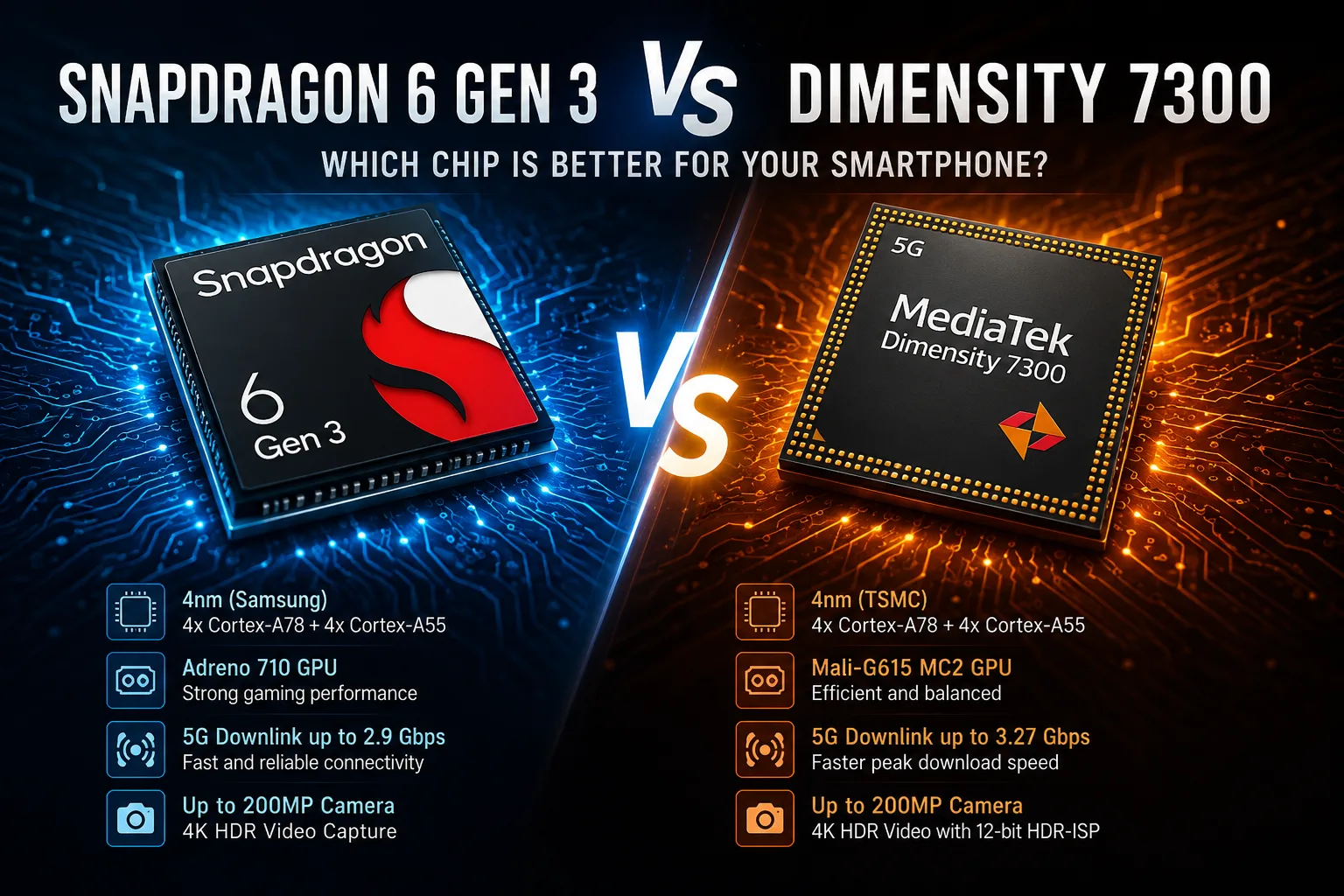
| CPU | 4x Cortex-A78 up to 2.4 GHz + 4x Cortex-A55 up to 1.8 GHz | 4x Cortex-A78 up to 2.5 GHz + 4x Cortex-A55 up to 2.0 GHz |
| GPU | Adreno 710 | Mali-G615 MC2 |
| Process Technology | 4 nm, Samsung | 4 nm, TSMC |
| Memory | LPDDR5 | LPDDR4x / LPDDR5 |
| Storage | UFS 3.1 | UFS 3.1 |
| 5G downlink | up to 2.9 Gbps | up to 3.27 Gbps |
| Camera | up to 200 MP, 4K 30 FPS | up to 200 MP, 4K 30 FPS, 4K HDR video |
| Example Smartphone | Motorola Moto G Stylus 5G 2025 | CMF Phone 1 |
When it comes to CPU, the difference is minimal. The Dimensity 7300 has slightly higher frequencies for both large and small cores, but architecturally, it is still the Cortex-A78 + Cortex-A55 configuration. Therefore, in regular tasks, both chips will feel very similar.
More importantly, the Dimensity 7300 is manufactured on TSMC's 4nm process, while the Snapdragon 6 Gen 3 is typically indicated as 4nm Samsung. In practice, this may give MediaTek an advantage in heat management and long-term stability under load, although much still depends on the specific casing, cooling, and manufacturer configurations.
Benchmark Performance
| Test | Snapdragon 6 Gen 3 | Dimensity 7300 | Who Leads |
|---|---|---|---|
| AnTuTu 11 | around 833,500 | around 877,300 | Dimensity 7300 |
| Geekbench 6 Single-Core | around 1009 | around 1009 | parity |
| Geekbench 6 Multi-Core | around 2933 | around 2936 | parity |
| 3DMark Steel Nomad Light | around 315 | around 346 | Dimensity 7300 |
| Geekbench GPU Compute | around 3366 | around 2501 | Snapdragon 6 Gen 3 |
In AnTuTu, the Dimensity 7300 is ahead by about 5%. This is a nice plus, but it's not a difference significant enough to automatically choose any smartphone with MediaTek. In real life, these 5% can easily be offset by memory quality, cooling, firmware, and power consumption limits.
In Geekbench 6, the CPU performances are nearly identical. This is an important point: browsing, messaging, UI, maps, YouTube, light photo editing, and everyday multitasking will depend more on smartphone optimization than on the choice between these two chips.
Gaming and Graphics
In gaming, the comparison is more complex than just "who scores higher." The Snapdragon 6 Gen 3 features Adreno 710, while the Dimensity 7300 uses Mali-G615 MC2. In 3DMark Steel Nomad Light, the Dimensity 7300 is slightly ahead, but in Geekbench GPU Compute, the Snapdragon 6 Gen 3 achieves a higher result.
For popular games like PUBG Mobile, Call of Duty Mobile, Mobile Legends, Asphalt, and similar projects, both chips perform adequately. However, this is still mid-range, so in heavy games, it's better to rely on medium or medium-high settings, rather than stable maximum graphics.
A practical advantage of Snapdragon is the Adreno graphics. It often performs well in games, emulators, and applications where driver compatibility is crucial. The Dimensity 7300 has a different strong point: it appears more balanced in efficiency and may maintain performance better under sustained load, provided the smartphone doesn't overheat.
Cameras, Video, and Connectivity
In terms of cameras, there is formal parity: both chips support sensors up to 200 MP and 4K 30 FPS recording. However, the Dimensity 7300 has a more noticeable emphasis on video capabilities: 4K HDR video, hardware noise reduction, EIS, and simultaneous recording from two cameras.
The Snapdragon 6 Gen 3 also does not seem weak in camera capabilities. However, in the mid-range, the quality of photos and videos often depends more on the smartphone itself: sensor, optics, stabilization, processing algorithms, and camera firmware.
In connectivity, the Dimensity 7300 appears slightly stronger on paper: it advertises peak download speeds of up to 3.27 Gbps, Wi-Fi 6E, and Bluetooth 5.4. The Snapdragon 6 Gen 3 typically indicates 5G downlink of up to 2.9 Gbps. In real networks, this is rarely a decisive factor, as speed largely depends on the operator, bands, region, and smartphone antennas.
Examples of Smartphones
The Snapdragon 6 Gen 3 is used, for example, in the Motorola Moto G Stylus 5G 2025. This is a good example of a smartphone where the chip combines with a large AMOLED screen, a stylus, and a 5000 mAh battery.
The Dimensity 7300 is found in the CMF Phone 1. This smartphone effectively showcases the chip's positioning: an affordable mid-range device focused on a fresh platform, energy efficiency, and decent everyday performance.
It's essential not to confuse the standard Dimensity 7300 with the Dimensity 7300 Ultra and other closely related versions. These are related solutions, but for a fair comparison, it's better to focus on the specific chip used in a given smartphone model.
Conclusion
MediaTek Dimensity 7300 appears slightly stronger overall. It has higher frequencies, TSMC's manufacturing process, a slightly better result in AnTuTu, a minor edge in 3DMark, and stronger communication capabilities on paper.
The Snapdragon 6 Gen 3, however, remains a very close competitor. It almost matches in CPU performance, looks good due to Adreno graphics, and may be more appealing for gaming, emulators, and scenarios where driver compatibility is critical.
If two smartphones are equal in price and specifications, it makes more sense to choose the model with the Dimensity 7300. But if the smartphone with Snapdragon 6 Gen 3 is better in terms of display, camera, battery, memory, or updates, it can be confidently chosen. The difference between these SoCs is not so significant that the processor should be prioritized above all else.
Advantages
- Newer Launch Date: September 2024 (September 2024 vs June 2024)
- Higher Frequency: 2500 MHz (2400 MHz vs 2500 MHz)
Basic
4x 1.8 GHz – Cortex-A55
GPU Specifications
Connectivity
Memory Specifications
Miscellaneous
Benchmarks
Comparison of Devices
Related SoC Comparisons




Share in social media
Or Link To Us
<a href="https://cputronic.com/soc/compare/qualcomm-snapdragon-6-gen-3-vs-mediatek-dimensity-7300" target="_blank">Qualcomm Snapdragon 6 Gen 3 vs MediaTek Dimensity 7300</a>