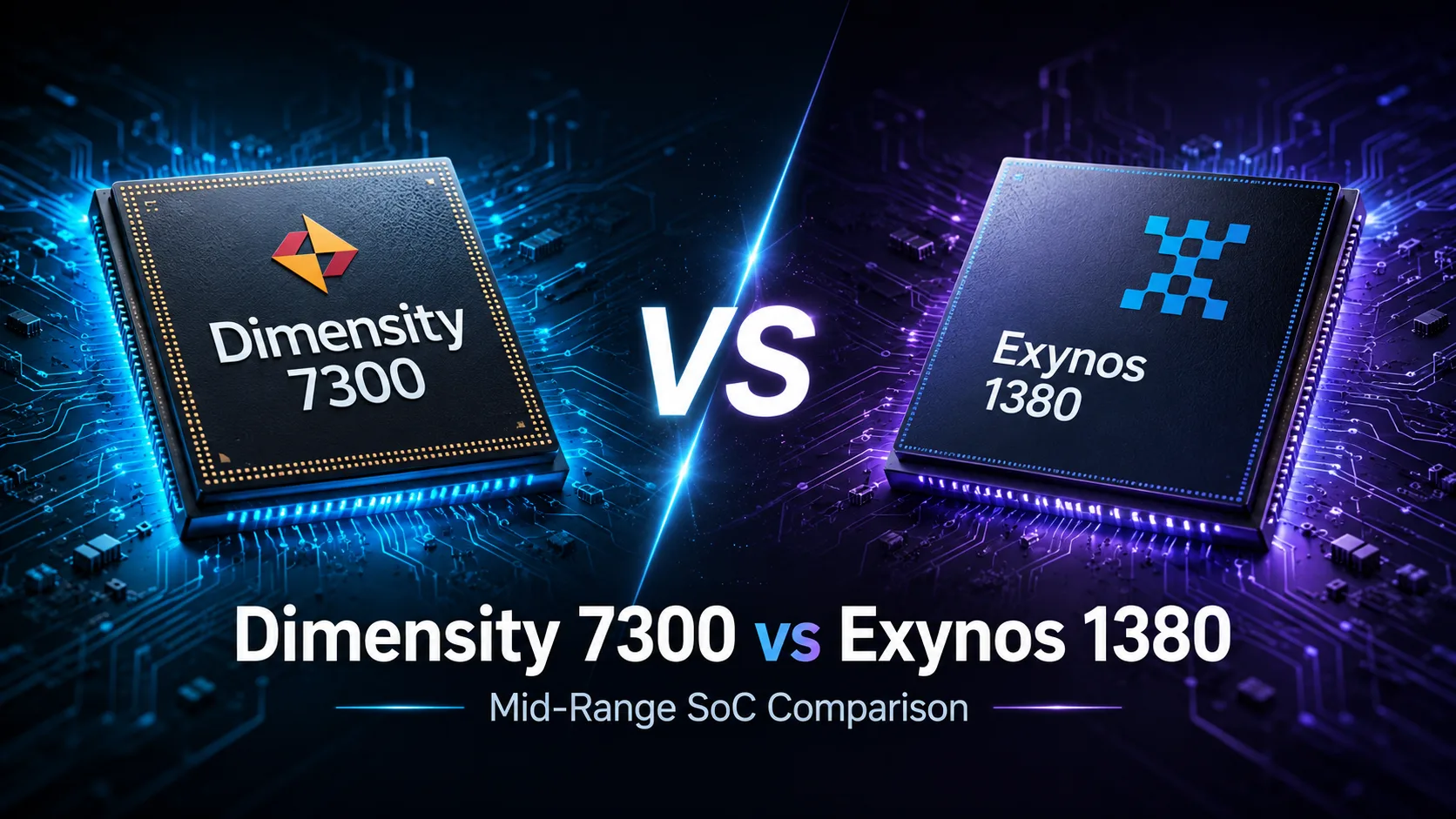
MediaTek Dimensity 7300
vs
Samsung Exynos 1380
SoC Comparison Result
MediaTek Dimensity 7300 vs Samsung Exynos 1380: nearly equal CPU, but a fresher platform with MediaTek
Dimensity 7300 and Exynos 1380 are closely matched mid-range chips. By its name, Dimensity 7300 appears noticeably newer, but in terms of CPU, it does not represent a class jump. Both utilize four powerful Cortex-A78 cores and four energy-efficient Cortex-A55 cores.
The main advantage of Dimensity 7300 lies not in the CPU cores themselves but in the platform surrounding them. It is newer, manufactured using a more advanced process node, offers better wireless interfaces, and performs noticeably better in overall synthetic benchmarks. Exynos 1380, while older, stays competitive with CPU performance: the four Cortex-A78 cores keep it close to the Dimensity 7300.
Key Differences
| Feature | MediaTek Dimensity 7300 | Samsung Exynos 1380 | What It Means |
|---|---|---|---|
| Process Node | 4 nm TSMC | 5 nm Samsung | Dimensity 7300 has better prospects for low power consumption |
| Big Core Frequency | up to 2.5 GHz | up to 2.4 GHz | Slight advantage for Dimensity 7300 in single-threaded and peak CPU loads |
| GPU | Mali-G615 MC2 | Mali-G68 MP5 | Dimensity features a newer architecture, Exynos has more GPU cores |
| Wi-Fi | Wi-Fi 6E | Wi-Fi 6 | Dimensity 7300 has a more modern Wi-Fi |
| Bluetooth | Bluetooth 5.4 | Bluetooth 5.3 | Slight advantage for Dimensity 7300 |
| Video Recording | 4K30, 4K HDR | 4K30 | Dimensity 7300 has a theoretical video advantage |
| Typical Devices | OPPO, Motorola, CMF, Redmi/Poco | Samsung Galaxy A/M, Galaxy Tab FE | Exynos 1380 is more commonly found in Samsung devices with One UI |
CPU and Benchmarks: Close in cores, Dimensity ahead overall
Both chips feature an identical 4+4 core configuration: four Cortex-A78 and four Cortex-A55. Dimensity 7300’s big cores operate at up to 2.5 GHz, while Exynos 1380 reaches up to 2.4 GHz. The advantage for MediaTek here is minimal.
This can be seen in Geekbench 6. Dimensity 7300 scores 1064 points in Single-Core and 2939 points in Multi-Core, while Exynos 1380 scores 1008 and 2773 points. The advantage for MediaTek is around 6% in both modes.
In everyday use such as interfaces, browsing, and regular applications, the difference should not be noticeable. Dimensity 7300 is faster, but not enough to classify its CPU as a whole class above. There is no shift to Cortex-A715, Cortex-A720, or any other newer architecture. It’s still based on the same architectural foundation of Cortex-A78/A55, just implemented in a fresher form.
Exynos 1380 is significant in that it employs a standard configuration with four performance cores rather than a cut-down 2+6 scheme. Thus, it remains close to the fresher Dimensity 7300 in CPU tests.
In AnTuTu 10, the disparity becomes more pronounced: 726,869 points for Dimensity 7300 compared to 578,941 for Exynos 1380. This is about +26% in favor of MediaTek. However, these numbers do not imply that the CPU of Dimensity is a quarter faster. The primary gap is due to graphics, memory, storage, UX scores, and the specific settings of the smartphones.
PCMark Work 3.0 shows a similar trend in everyday workloads: the device using Dimensity 7300 scores 16,352 points, while the smartphone with Exynos 1380 scores 13,227 points. This is not a pure CPU test, but it's closer to real-world scenarios than AnTuTu.
Conclusion from the tests: Dimensity 7300 is faster as an SoC, but the CPU gap remains small.
Graphics and Gaming: Dimensity often leads, but with a small margin
In graphics, the advantage is often with Dimensity 7300. It utilizes the Mali-G615 MC2, which is a newer architecture. Exynos 1380 has the Mali-G68 MP5: it has more blocks, but the architecture is older.
In 3DMark, Dimensity 7300 frequently comes out ahead. In Sling Shot, it scores 7198 points compared to 5860 for Exynos 1380. In Steel Nomad Light, it scores 361 versus 295, and in Steel Nomad Light Unlimited, it scores 350 against 280.
However, Exynos 1380 does not lose in all sub-tests. In Sling Shot Extreme Vulkan, it might take the lead: 4335 vs 3989. Thus, the more cautious conclusion is that Dimensity 7300 has a moderate advantage in graphical synthetic benchmarks, but it is not absolute.
Both chips handle light and medium games well. In heavy titles, both quickly hit the GPU limits, but Dimensity 7300 usually does so a bit later. For gaming, Dimensity 7300 is the more logical choice, but it does not reach the level of higher-end Snapdragon or Dimensity 8000/9000 series.
Process Node and Efficiency
Dimensity 7300 is manufactured on TSMC’s 4-nm process node. Exynos 1380 is made on Samsung’s 5-nm process node. With a similar CPU configuration, this gives MediaTek an advantage in potential energy efficiency.
In an actual smartphone, battery life depends not only on the chip. Important factors include the battery, display, modem, firmware, and cooling. However, under equal conditions, Dimensity 7300 should perform better in energy consumption and stability under load.
Exynos 1380 cannot be labeled inefficient, but Samsung's 5-nm process appears weaker compared to TSMC's 4-nm.
Camera, Connectivity, and Smartphones
In terms of camera capabilities, there is no strong advantage: both support sensors up to 200 MP and 4K30. Dimensity 7300 offers 4K HDR, while Exynos 1380 includes HDR, zero shutter lag, and Samsung’s processing. However, photo quality ultimately depends on the sensor, optics, and algorithms of the specific smartphone.
For wireless connectivity, Dimensity 7300 is more advanced: Wi-Fi 6E and Bluetooth 5.4 compared to Wi-Fi 6 and Bluetooth 5.3 in Exynos 1380. While this is not a primary selection criterion, it is another plus for MediaTek.
Exynos 1380 is more frequently found in Samsung smartphones: Galaxy A54, Galaxy A35, Galaxy M35, Galaxy M54, Galaxy A26, and Galaxy Tab S9 FE tablets. Its advantage lies not in the chip itself, but in the complete Samsung devices: One UI, updates, screens, and specific model cameras.
Dimensity 7300 is used by various brands: OPPO, Motorola, CMF, Redmi/Poco, and others. The choice is broader, but the variation in quality is also higher. Therefore, for models with Dimensity 7300, factors like price, display, memory, battery, and cooling are particularly important.
What to Choose Ultimately
At the same price, it is better to choose a smartphone with Dimensity 7300. It performs better in overall synthetic benchmarks, is more modern in connectivity, and benefits from a superior process node.
Exynos 1380 should be chosen not for the chip itself, but for the specific Samsung smartphone. If a device is significantly cheaper or offers a better display, camera, battery, and updates, Exynos 1380 remains a viable option. Since its CPU performance is close to Dimensity 7300, it may not always make sense to pay extra for the newer SoC name.
For gaming, Dimensity 7300 has the advantage, but it is not a substantial margin. In heavy projects, both chips are limited by graphics.
The main conclusion: at the same price, Dimensity 7300 is preferable. Exynos 1380 is worth considering when the Samsung smartphone is a better deal in terms of price, display, camera, battery, or updates.
Advantages
- Higher Technology: 4 nm (4 nm vs 5 nm)
- Higher Frequency: 2500 MHz (2500 MHz vs 2400 MHz)
- Newer Launch Date: June 2024 (June 2024 vs February 2023)
Basic
4x 2 GHz – Cortex-A55
GPU Specifications
Connectivity
Memory Specifications
Miscellaneous
Benchmarks
Comparison of Devices
Related SoC Comparisons




Share in social media
Or Link To Us
<a href="https://cputronic.com/soc/compare/mediatek-dimensity-7300-vs-samsung-exynos-1380" target="_blank">MediaTek Dimensity 7300 vs Samsung Exynos 1380</a>