MediaTek Helio G81
vs
MediaTek Helio G99

SoC Comparison Result
MediaTek Helio G81 vs Helio G99: the new G81 is noticeably weaker
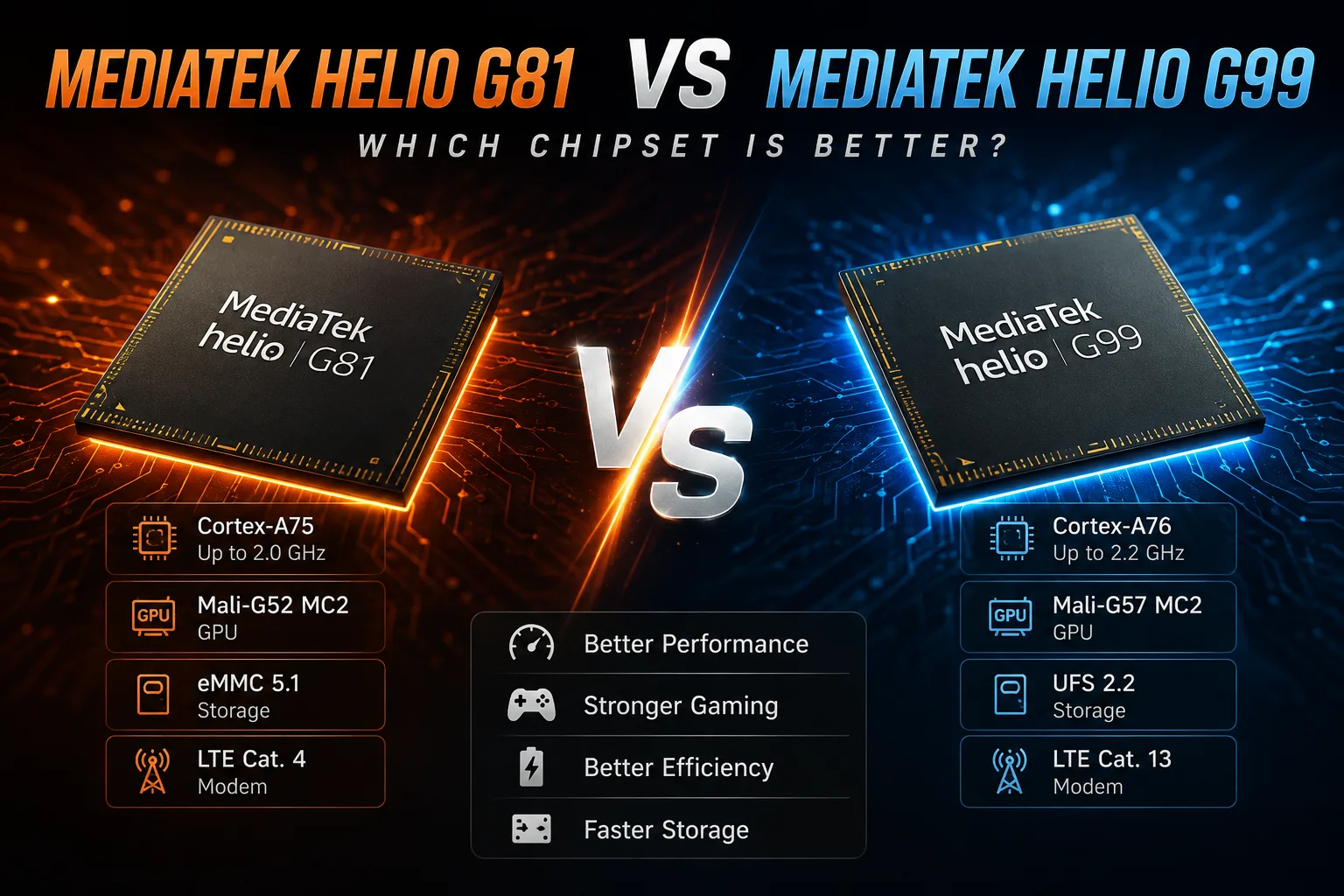
MediaTek Helio G81 appeared later than Helio G99, but in terms of performance, it turned out to be noticeably weaker. The G81 has Cortex-A75 and a 12nm process, while the G99 features Cortex-A76, faster graphics, and a 6nm process. In tests of specific smartphones, G99 proves to be approximately 40-60% faster.
| Specification | MediaTek Helio G81 | MediaTek Helio G99 |
|---|---|---|
| Process technology | 12 nm | 6 nm |
| Performance cores | 2 × Cortex-A75, 2.0 GHz | 2 × Cortex-A76, 2.2 GHz |
| Power-efficient cores | 6 × Cortex-A55, 1.7 GHz | 6 × Cortex-A55, 2.0 GHz |
| GPU | Mali-G52 MC2 | Mali-G57 MC2 |
| Storage | eMMC 5.1 | UFS 2.2 |
| Maximum camera | 48 MP | 108 MP |
| LTE | Cat. 4 | Cat. 13 |
| 5G | No | No |
CPU Performance
The main advantage of Helio G99 is its two Cortex-A76 cores instead of Cortex-A75 in G81. They are faster per clock cycle and operate at a higher frequency: 2.2 GHz versus 2.0 GHz. The small Cortex-A55 in G99 are also faster: 2.0 GHz versus 1.7 GHz.
The greatest difference is seen in single-threaded tests. In multi-threaded scenarios, G99 is also ahead, but the gap is smaller.
Benchmarks in Specific Smartphones
| Smartphone | Processor | Geekbench 6 Single | Geekbench 6 Multi | AnTuTu 11 |
|---|---|---|---|---|
| Infinix Hot 50i | Helio G81 | 443 | 1416 | 340 407 |
| Tecno Spark 40 | Helio G81 | 501 | 1410 | 388 287 |
| POCO M5 | Helio G99 | 729 | 1976 | 569 031 |
| Realme 10 | Helio G99 | 739 | 2021 | 557 994 |
Results are influenced by memory, firmware, and cooling, so assessments of the same SoC can vary from smartphone to smartphone. In these devices, G99 is approximately 40-60% faster depending on the test.
The most noticeable difference is in Geekbench 6 Single-Core.
Graphics and Gaming
Helio G81 uses Mali-G52 MC2, while G99 features the faster Mali-G57 MC2.
Helio G81 primarily handles less demanding games. For heavy projects, you'll need to lower the graphics settings, and even then, noticeable FPS drops can occur.
Helio G99 is also not a gaming chip, but it typically allows you to increase the settings higher and maintains better FPS in the same games.
UFS 2.2 vs eMMC 5.1
Helio G99 supports UFS 2.2, while G81 is limited to eMMC 5.1.
UFS 2.2 is faster than eMMC 5.1 when it comes to installing and launching applications, updating the system, and working with large files, so the difference between the platforms is noticeable not only in CPU tests.
Energy Efficiency
Helio G99 is manufactured using a 6nm process compared to 12nm for G81. The 6nm process gives G99 an advantage in energy efficiency and helps reduce heat under load.
The battery life of a specific smartphone depends not only on the SoC but also on the display, battery, and firmware.
Cameras and Connectivity
Helio G81 supports cameras up to 48 MP, while G99 supports up to 108 MP.
Both processors are limited to 4G, but G99 has a faster LTE modem: Cat. 13 versus Cat. 4 in G81.
What to Choose
If the price is the same or close, you should not buy Helio G81. G99 is significantly faster in CPU and graphics, supports UFS 2.2, and is manufactured using a more economical 6nm process.
Helio G81 is only justified in very cheap smartphones for calling, messaging, video, and browsing. Helio G99 is also far from new and does not support 5G, but in this comparison, the choice is clear - G99.
Advantages
- Newer Launch Date: August 2024 (August 2024 vs May 2022)
- Higher Technology: 6 nm (12 nm vs 6 nm)
- Higher Frequency: 2200 MHz (2000 MHz vs 2200 MHz)
Basic
6x 1.8 GHz – Cortex-A55
GPU Specifications
Connectivity
Memory Specifications
Miscellaneous
Benchmarks
Comparison of Devices
Related SoC Comparisons



Share in social media
Or Link To Us
<a href="https://cputronic.com/soc/compare/mediatek-helio-g81-vs-mediatek-helio-g99" target="_blank">MediaTek Helio G81 vs MediaTek Helio G99</a>