MediaTek Dimensity 8500
vs
MediaTek Dimensity 9500s
SoC Comparison Result
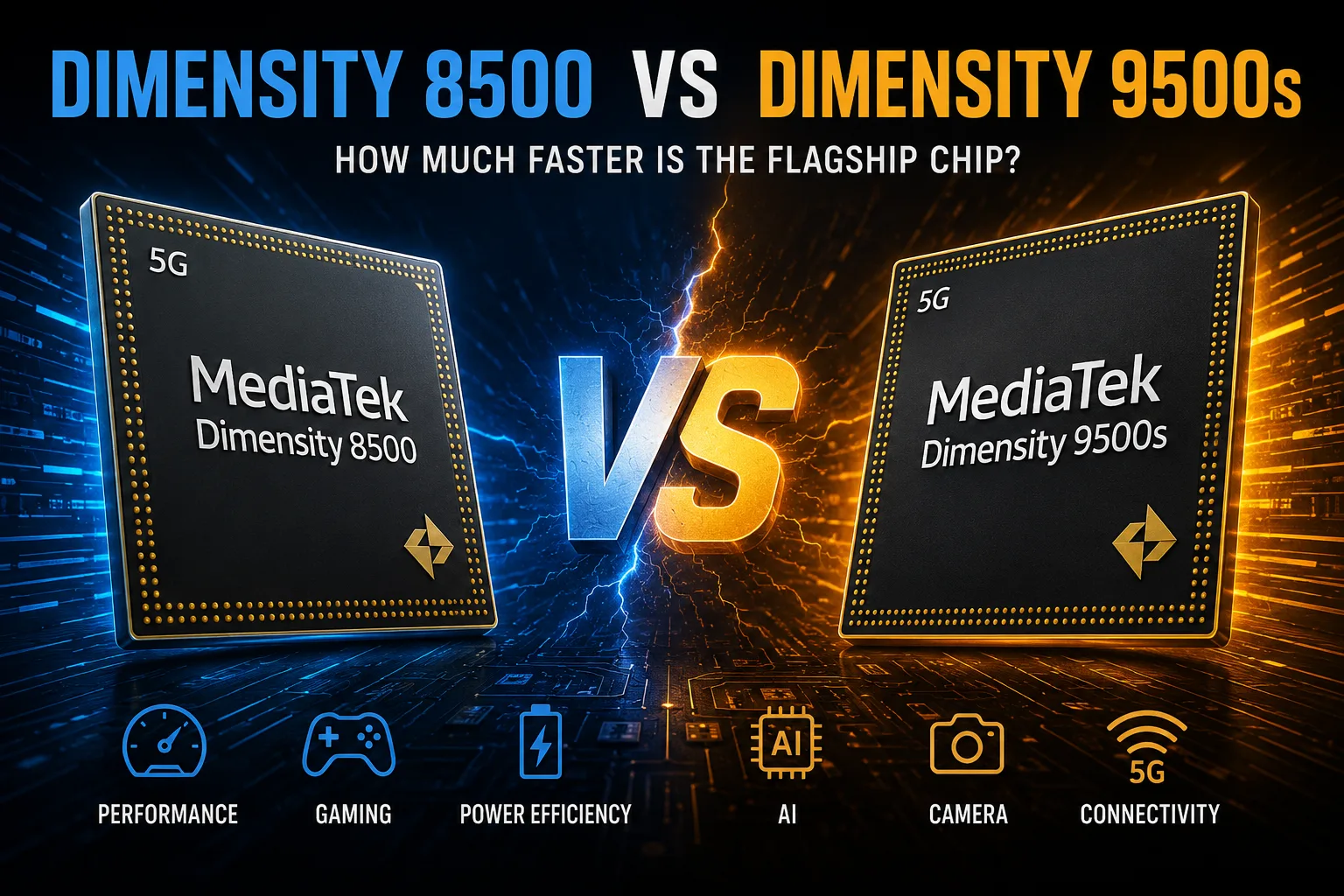
MediaTek Dimensity 8500 vs Dimensity 9500s: Is There a Significant Performance Difference?
The Dimensity 8500 belongs to the upper mid-range category but significantly lags behind the Dimensity 9500s in performance. In Geekbench 6, the flagship chip is nearly 50% faster in single-core tasks, and the performance gap in graphics workloads can be even larger. The purpose of the Dimensity 8500 is to cater to more affordable smartphones: it still offers plenty of performance, and not everyone needs to incur the premium for a flagship platform.
Dimensity 8500 and 9500s: Key Differences
| Characteristic | Dimensity 8500 | Dimensity 9500s |
|---|---|---|
| Process Technology | 4 nm | 3 nm |
| CPU | 1× Cortex-A725 3.4 GHz + 3× A725 3.2 GHz + 4× A725 2.2 GHz | 1× Cortex-X925 3.73 GHz + 3× Cortex-X4 + 4× Cortex-A720 |
| L3 Cache | 6 MB | 12 MB |
| System Cache | 5 MB | 10 MB |
| GPU | Mali-G720 MC8 | Immortalis-G925 |
| Memory | LPDDR5X up to 9600 Mbps | LPDDR5X up to 10,667 Mbps |
| Storage | UFS 4 + MCQ | UFS 4 + MCQ |
| Wi-Fi | Wi-Fi 6E | Wi-Fi 7 |
| 5G, Download | up to 5.17 Gbps | up to 7 Gbps |
| Video Recording | up to 4K 60 FPS | up to 8K 60 FPS |
The 9500s wins not only due to higher clock speeds. It has twice the L3 and system cache, higher memory speeds, a faster 5G modem, and a more powerful GPU.
Cortex-X925 Provides Nearly 50% in Single-Core
The Dimensity 8500 utilizes eight Cortex-A725 cores. The fastest core runs at 3.4 GHz, but this chip lacks a dedicated large Cortex-X core.
While this configuration works well in multi-threading, the absence of a Cortex-X is noticeable in single-core performance. The Dimensity 9500s features the Cortex-X925, clocked up to 3.73 GHz, along with three Cortex-X4 and four Cortex-A720 cores.
The advantage is particularly visible in scenarios where the speed of one or a few cores is crucial: in browsers, when launching heavy applications, in emulators, and in certain games.
In Geekbench 6, the Dimensity 8500 scores around 1690/6900 points, while the Dimensity 9500s scores approximately 2580/8500. The difference is about 50% in single-core and over 20% in multi-core.
Geekbench 6 in Real Smartphones
An average SoC result hides the differences between smartphones: cooling, power limits, and firmware influence the final outcome.
| Smartphone | Processor | RAM | Single-Core | Multi-Core |
|---|---|---|---|---|
| Motorola Edge 70 Pro | Dimensity 8500 | 12 GB | 1675 | 6642 |
| POCO X8 Pro | Dimensity 8500 | 12 GB | 1564 | 6478 |
| Honor Power 2* | Dimensity 8500 | 12 GB | 1728 | 6762 |
| POCO X8 Pro Max | Dimensity 9500s | 12 GB | 2673 | 8471 |
| Redmi Turbo 5 Max* | Dimensity 9500s | 16 GB | 2869 | 9130 |
*Results from Honor Power 2 and Redmi Turbo 5 Max are taken from earlier tests. After new firmware releases, retail device metrics may change.
Even the POCO X8 Pro Max-not the fastest smartphone with the 9500s in this selection-outperforms the Motorola Edge 70 Pro by around 60% in single-core and 28% in multi-core.
Such a gap can no longer be attributed to cooling or firmware: the main difference is made by the SoC itself.
In Gaming, the 9500s Pulls Ahead Even More
The Mali-G720 MC8 in the Dimensity 8500 is sufficient for most modern Android games at high settings, but the most demanding titles may require graphics settings to be lowered.
The Immortalis-G925 is faster and supports hardware ray tracing, making the 9500s better suited for demanding games and high graphical settings.
Early data on smartphones powered by the Dimensity 9500s show different configurations of the Immortalis-G925: for the Redmi Turbo 5 Max, a version MC12 was reported, while for the global POCO X8 Pro Max, it was MC11. MediaTek's official specs do not specify the number of GPU cores.
Therefore, MC11/MC12 should be indicated for a specific smartphone rather than for the Dimensity 9500s as a whole.
The peak performance of the 9500s also heavily relies on how well the smartphone manages heat dissipation. A device may excel in a short test but throttle after prolonged gaming loads.
The 9500s Features Faster Memory, Wi-Fi 7, and 5G up to 7 Gbps
The Dimensity 8500 supports LPDDR5X up to 9600 Mbps, Wi-Fi 6E, and 5G with download speeds up to 5.17 Gbps.
The Dimensity 9500s supports LPDDR5X up to 10,667 Mbps, Wi-Fi 7, and 5G with download speeds up to 7 Gbps. The video limits are also higher: 8K 60 FPS against 4K 60 FPS for the Dimensity 8500.
However, these figures alone do not indicate the quality of a specific smartphone. A more powerful ISP does not guarantee a better camera, and Wi-Fi 7 only makes sense if there’s a corresponding network available.
What to Choose: Dimensity 8500 or Dimensity 9500s
The main argument for the Dimensity 8500 is the lower price of the smartphone. Even this chip can handle demanding applications, multitasking, and modern games with ease. If a smartphone with the 8500 is significantly cheaper, not everyone needs to pay extra for the 9500s.
The Dimensity 9500s makes more sense primarily for performance. The largest gap is in single-core and GPU performance, making this chip more suitable for demanding applications and games intended for longer-term usage.
In terms of performance, the winner is clear: the Dimensity 9500s is significantly faster. The key question is how much the smartphone manufacturer will charge for this boost. If the price difference is small, it’s better to choose the model with the 9500s. However, if the premium is substantial, the Dimensity 8500 remains a reasonable compromise between price and speed.
Advantages
- Higher Technology: 3 nm (4 nm vs 3 nm)
- Higher Frequency: 3730 MHz (3400 MHz vs 3730 MHz)
Basic
3x 3.3 GHz – Cortex-X4
4x 2.4 GHz – Cortex-A720
GPU Specifications
Connectivity
Memory Specifications
Miscellaneous
- FLAC
- HE-AACv1
- HE-AACv2
- MP3
- H.265
- AV1
- VP9
Benchmarks
Comparison of Devices
Related SoC Comparisons




Share in social media
Or Link To Us
<a href="https://cputronic.com/soc/compare/mediatek-dimensity-8500-vs-mediatek-dimensity-9500s" target="_blank">MediaTek Dimensity 8500 vs MediaTek Dimensity 9500s</a>