MediaTek Dimensity 8500
vs
MediaTek Dimensity 7400
SoC Comparison Result
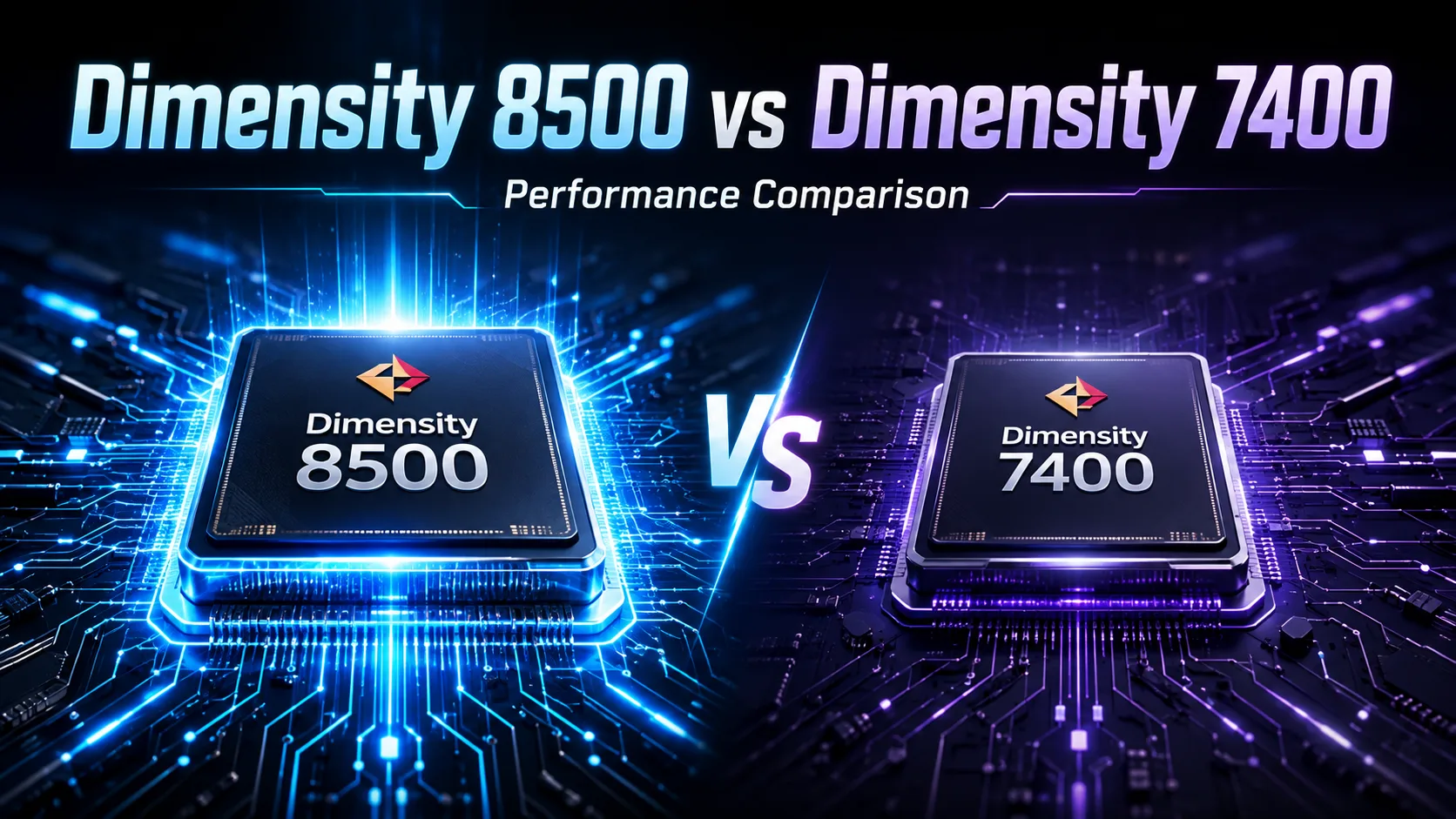
MediaTek Dimensity 8500 vs Dimensity 7400: How much faster is the 8500
Both processors are produced on a 4nm process, but there is a significant difference in performance between them. The Dimensity 8500 features eight Cortex-A725 cores, Mali-G720 MC8, LPDDR5X-9600 support, and UFS 4. The Dimensity 7400 utilizes older Cortex-A78 and Cortex-A55 cores. The 8500 especially outperforms the 7400 in multithreaded tasks and graphics.
| Specification | MediaTek Dimensity 8500 | MediaTek Dimensity 7400 |
|---|---|---|
| Process Technology | 4nm | 4nm |
| CPU | 1× Cortex-A725 3.4 GHz + 3× A725 3.2 GHz + 4× A725 2.2 GHz | 4× Cortex-A78 2.6 GHz + 4× Cortex-A55 2.0 GHz |
| GPU | Mali-G720 MC8 | Mali-G615 MC2 |
| RAM | LPDDR5X-9600 | LPDDR5 / LPDDR4X, up to 6400 Mbps |
| Storage | UFS 4 + MCQ | UFS 3.1 / UFS 2.2 |
| NPU | MediaTek NPU 880 | MediaTek NPU 655 |
| Maximum Camera | 320 MP | 200 MP |
| Video | 4K at 60 FPS | 4K at 30 FPS |
| Maximum 5G Speed | Up to 5.17 Gbps | Up to 3.27 Gbps |
| Display | WQHD+ up to 144 Hz | FHD+ up to 144 Hz |
CPU Performance
The main difference in the CPU section is the All Big Core configuration of the Dimensity 8500. All eight cores of the Dimensity 8500 are Cortex-A725, while the Dimensity 7400 combines four Cortex-A78 and four Cortex-A55.
In Geekbench 6, the Redmi Turbo 5 with Dimensity 8500 Ultra scores around 1698 points in the single-core test and 6527 in the multi-core test. The Motorola Edge 60 Fusion with Dimensity 7400 scores approximately 1092 and 3062 points.
In this comparison, the Dimensity 8500 is faster by about 55% in the single-core test and more than double in the multi-core test. The advantages of the 8500 will be more pronounced when processing photos and videos, unpacking large archives, emulation, and multitasking with several demanding applications.
The name Dimensity 8500 Ultra is found in the specifications of certain smartphones based on the Dimensity 8500. The chip's architecture remains unchanged; however, power limits and cooling depend on the specific smartphone.
Graphics and Gaming
The advantage of the Dimensity 8500 is even more noticeable regarding the GPU. It is equipped with Mali-G720 MC8 with eight graphics cores, while the Dimensity 7400 uses Mali-G615 MC2 with two cores.
In the Redmi Turbo 5, the graphics of the Dimensity 8500 Ultra score around 3980 points in 3DMark Wild Life Extreme, while smartphones with Dimensity 7400 score approximately around 1800 points in the same test. These results were obtained on different smartphones and do not provide an exact comparison of the SoCs themselves but illustrate the difference in graphical performance well.
For Mobile Legends, Call of Duty Mobile, and other less demanding games, the performance of Dimensity 7400 is sufficient. In heavier projects, graphics settings must be lowered. For instance, the Infinix GT 30 with this processor shows about 30-40 FPS on low settings in Wuthering Waves.
The Dimensity 8500 is better suited for heavy games and high frame rates, especially with an eye on several years of use.
Benchmarks in Specific Smartphones
Results depend on the cooling and power settings of specific smartphones; therefore, even models on the same SoC can show different values.
| Smartphone | Processor | AnTuTu 11 | Geekbench 6 Single | Geekbench 6 Multi |
|---|---|---|---|---|
| Redmi Turbo 5 | Dimensity 8500 Ultra | 1,880,823 | 1698 | 6527 |
| POCO X8 Pro | Dimensity 8500 Ultra | 2,283,558 | - | - |
| Motorola Edge 60 Fusion* | Dimensity 7400 | - | 1092 | 3062 |
| Infinix GT 30 | Dimensity 7400 | 982,451 | 949 | 2984 |
| realme Narzo 80 Pro | Dimensity 7400 | About 985,745 | 1037 | 2923 |
- Dimensity 7400 is installed, in particular, in the Indian version of the Motorola Edge 60 Fusion. In some other regions, the smartphone was released with a different processor.
In AnTuTu 11, models with Dimensity 8500 score about 1.9-2.3 million points, while devices with Dimensity 7400 are around the 1 million mark.
Heating and Stability
Under prolonged load, the Dimensity 8500's performance is more dependent on the smartphone's cooling system. In the Redmi Turbo 5, the Dimensity 8500 Ultra demonstrates about 64% stability in a long-duration graphics stress test, while the Motorola Edge 60 Fusion with Dimensity 7400 can maintain about 99% stability.
These numbers do not mean that the Dimensity 7400 handles prolonged loads better. The test compares smartphones with different cases, cooling systems, and power limits. Even two devices on the Dimensity 8500 can vary significantly in FPS after 15-20 minutes of gaming.
Therefore, when choosing a gaming smartphone, it is essential to consider not only the SoC but also results from extended gaming tests.
Memory and Multimedia
The Dimensity 8500 supports LPDDR5X-9600 and UFS 4, whereas the Dimensity 7400 is limited to slower memory and UFS 3.1. Faster memory and storage reduce loading times for games, application installations, and operations with large files.
The Dimensity 8500 also offers broader ISP capabilities: it supports cameras up to 320 MP and recording 4K at 60 FPS. Dimensity 7400 supports sensors up to 200 MP and 4K30. These limitations do not inherently indicate the quality of images; this depends on the sensors, optics, and image processing in the specific smartphone.
What to Choose
The Dimensity 8500 confidently outperforms the Dimensity 7400 in both CPU and graphics. The difference is especially pronounced in multithreaded tasks and gaming.
The performance of the Dimensity 7400 is sufficient for everyday apps, videos, web browsing, and less demanding games. The main limitation is the Mali-G615 MC2, which noticeably hits its performance ceiling in heavy games.
At a similar price point, it is advisable to choose a smartphone with Dimensity 8500, especially for gaming and heavy applications. The Dimensity 7400 is justified at a significantly lower price or if the smartphone itself offers better camera, display, or battery life.
Advantages
- Higher Frequency: 3400 MHz (3400 MHz vs 2600 MHz)
- Newer Launch Date: January 2026 (January 2026 vs February 2025)
Basic
GPU Specifications
Connectivity
Memory Specifications
Miscellaneous
Benchmarks
Comparison of Devices
Related SoC Comparisons





Share in social media
Or Link To Us
<a href="https://cputronic.com/soc/compare/mediatek-dimensity-8500-vs-mediatek-dimensity-7400" target="_blank">MediaTek Dimensity 8500 vs MediaTek Dimensity 7400</a>