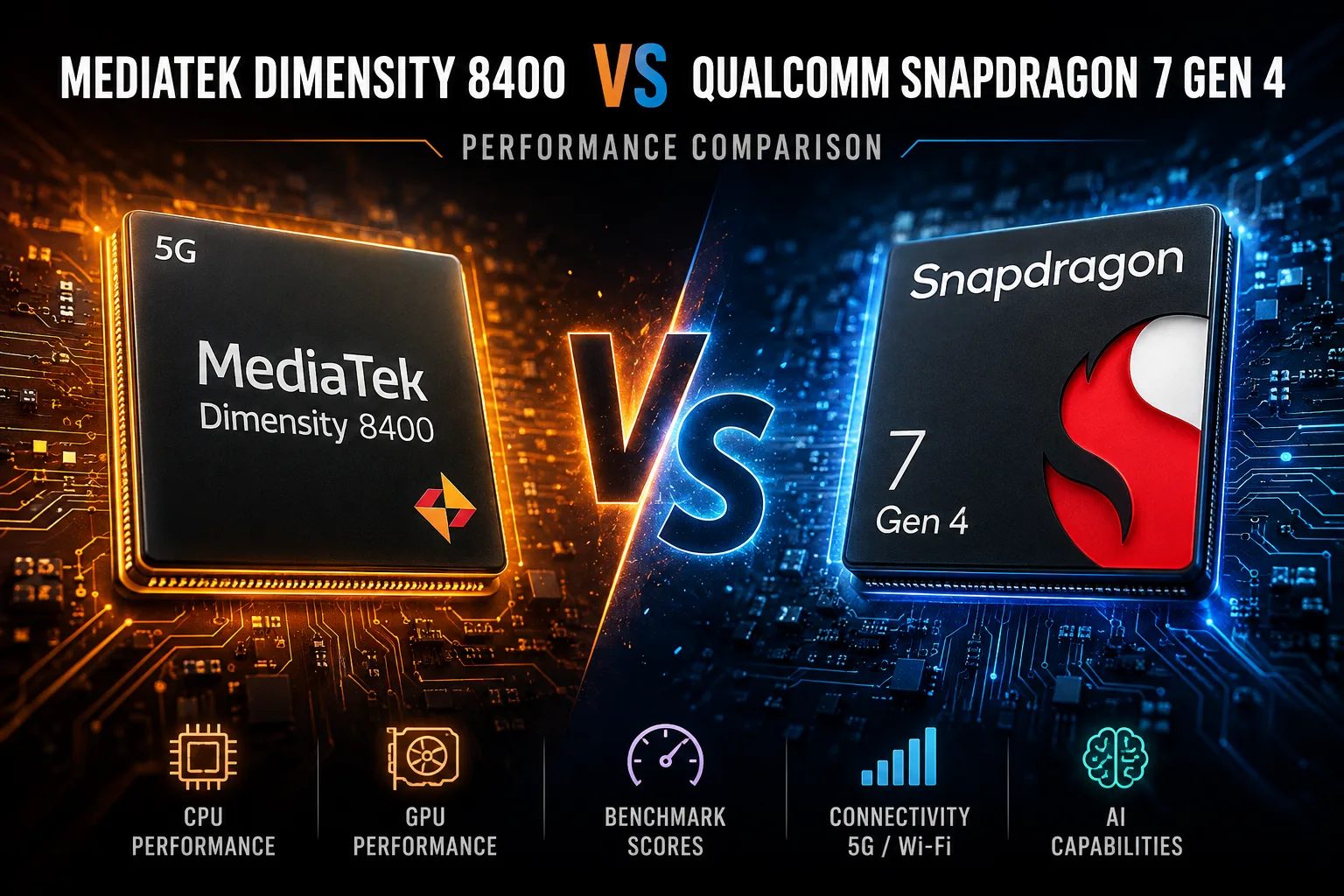
MediaTek Dimensity 8400
vs
Qualcomm Snapdragon 7 Gen 4

SoC Comparison Result
MediaTek Dimensity 8400 vs Snapdragon 7 Gen 4: How Big is the Performance Difference
The Dimensity 8400 and Snapdragon 7 Gen 4 are found in smartphones that are relatively close in price, but when it comes to computational capabilities, these platforms are far from equal. MediaTek significantly outperforms in multi-threaded tasks, and its graphical advantage in certain tests exceeds twofold. Snapdragon 7 Gen 4 supports more modern wireless connectivity, but it notably lags behind in CPU and GPU performance.
Key Differences
| Characteristic | Dimensity 8400 | Snapdragon 7 Gen 4 |
|---|---|---|
| Process Technology | 4 nm | 4 nm |
| CPU | 8× Cortex-A725 | 1× Cortex-A720 + 4× Cortex-A720 + 3× Cortex-A520 |
| Maximum Frequency | 3.25 GHz | 2.8 GHz |
| GPU | Mali-G720 MC7 | Adreno 722 |
| Memory | LPDDR5X up to 8533 Mbps | LPDDR5X |
| Storage | UFS 4.0 | up to UFS 4.0 |
| Wi-Fi | Wi-Fi 6E | Wi-Fi 7 |
| Bluetooth | 5.4 | 6.0 |
| Maximum 5G Speed | up to 5.17 Gbps | up to 4.2 Gbps |
The Dimensity 8400 is built with an All Big Core scheme: all eight cores belong to Cortex-A725, though they operate at different frequencies. The Snapdragon 7 Gen 4 uses a more familiar configuration with five Cortex-A720 and three Cortex-A520.
This configuration is generally weaker under full multi-threaded load, which causes the advantage of Dimensity 8400 to sharply increase when all cores are engaged.
CPU Performance
In Geekbench 6, the Dimensity 8400 scores about 1684 points in single-thread mode compared to 1325 for the Snapdragon 7 Gen 4. The difference is around 27%-notable, but much less than in multi-threaded scenarios.
When all cores are loaded, the result is 6970 versus 4081 points. Here, the Dimensity 8400 is approximately 71% faster.
The advantage is particularly pronounced in photo and video processing, decompression of large archives, rendering, and heavy multitasking. In the interface and simple applications, the difference will be much smaller.
Graphics and Gaming
In terms of GPU, the advantage of MediaTek is even greater. The Dimensity 8400 employs the Mali-G720 MC7, while the Snapdragon 7 Gen 4 comes with the Adreno 722.
In the 3DMark Steel Nomad Light benchmark, the iQOO Z10 Turbo with Dimensity 8400 scores around 1435 points, while the vivo S30 with Snapdragon 7 Gen 4 scores around 671. In this test, the difference exceeds two times.
| Smartphone | Processor | 3DMark Steel Nomad Light |
|---|---|---|
| iQOO Z10 Turbo | Dimensity 8400 | 1435 |
| vivo S30 | Snapdragon 7 Gen 4 | 671 |
The Snapdragon 7 Gen 4 remains sufficiently fast for most Android games, but the Dimensity 8400 provides much more headroom for high graphics settings and increased frame rates.
Benchmarks in Real Smartphones
The results of finished devices allow us to see how much the difference between SoCs remains after accounting for cooling, memory, and firmware settings.
| Smartphone | Processor | AnTuTu | Geekbench 6 Single | Geekbench 6 Multi |
|---|---|---|---|---|
| POCO X7 Pro | Dimensity 8400 Ultra | 1 577 069 | 1 590 | 6 257 |
| realme GT 7T | Dimensity 8400 Max | 1 761 804 | 1 651 | 5 998 |
| realme 15 Pro | Snapdragon 7 Gen 4 | 1 086 379 | 1 218 | 3 541 |
| vivo V60 | Snapdragon 7 Gen 4 | 1 006 885 | 1 244 | 3 585 |
Devices powered by Dimensity 8400 score around 1.6-1.8 million points in AnTuTu and about 6000 points in Geekbench 6 Multi. Smartphones with Snapdragon 7 Gen 4 hit around 1.0-1.1 million in AnTuTu and 3500-3600 points in multi-threaded Geekbench.
However, results can vary significantly even among devices using the same SoC. For example, the realme GT 7T is faster than the POCO X7 Pro in AnTuTu but lags behind in Geekbench Multi. Factors such as cooling, power limits, memory type, and manufacturer settings impact the outcome, so it is not advisable to evaluate a platform based on a single smartphone.
Connectivity and Additional Features
The Snapdragon 7 Gen 4 has an advantage in wireless interfaces. The platform supports Wi-Fi 7 and Bluetooth 6.0, while the Dimensity 8400 is limited to Wi-Fi 6E and Bluetooth 5.4.
In mobile networks, the situation is reversed: the Dimensity 8400 claims download speeds of up to 5.17 Gbps, while the Snapdragon 7 Gen 4 supports up to 4.2 Gbps. In practice, these maximums are rarely achievable and depend much more on the operator and network coverage than on the processor itself.
Both platforms have separate NPUs for local AI features, but the difference between them is currently significantly less substantial than the gap in CPU and GPU performance when choosing a smartphone.
What This Difference Means When Buying
The Dimensity 8400 is more commonly found in smartphones focused on performance-such as the POCO X7 Pro and realme GT 7T. The Snapdragon 7 Gen 4 is found in models where performance is just one of many components alongside camera quality, design, and battery life.
Therefore, the processor itself should not be the sole criterion for selection. A smartphone with Snapdragon 7 Gen 4 might be preferred due to its camera, display, software support, or price.
However, if two devices are priced similarly and comparable in other characteristics, the advantage of the Dimensity 8400 is too significant to overlook.
Conclusion
The Dimensity 8400 is significantly faster than the Snapdragon 7 Gen 4. In single-threaded Geekbench performance, the advantage is relatively moderate, but under full core load, it approaches 70%, and in graphical tests, it can exceed two times.
The Snapdragon 7 Gen 4 remains a decent platform for an everyday smartphone, but in terms of CPU and especially GPU, it lags noticeably behind the Dimensity 8400. If the priority is gaming, demanding applications, and future-proof performance, the advantage of MediaTek is clear.
Advantages
- Higher Frequency: 3250 MHz (3250 MHz vs 2800 MHz)
- Newer Launch Date: May 2025 (December 2024 vs May 2025)
Basic
3x 3.0 GHz – Cortex-A725
4x 2.1 GHz – Cortex-A725
GPU Specifications
Connectivity
Memory Specifications
Miscellaneous
Benchmarks
Comparison of Devices
Related SoC Comparisons


Share in social media
Or Link To Us
<a href="https://cputronic.com/soc/compare/mediatek-dimensity-8400-vs-qualcomm-snapdragon-7-gen-4" target="_blank">MediaTek Dimensity 8400 vs Qualcomm Snapdragon 7 Gen 4</a>