MediaTek Dimensity 7025
vs
Qualcomm Snapdragon 685
SoC Comparison Result
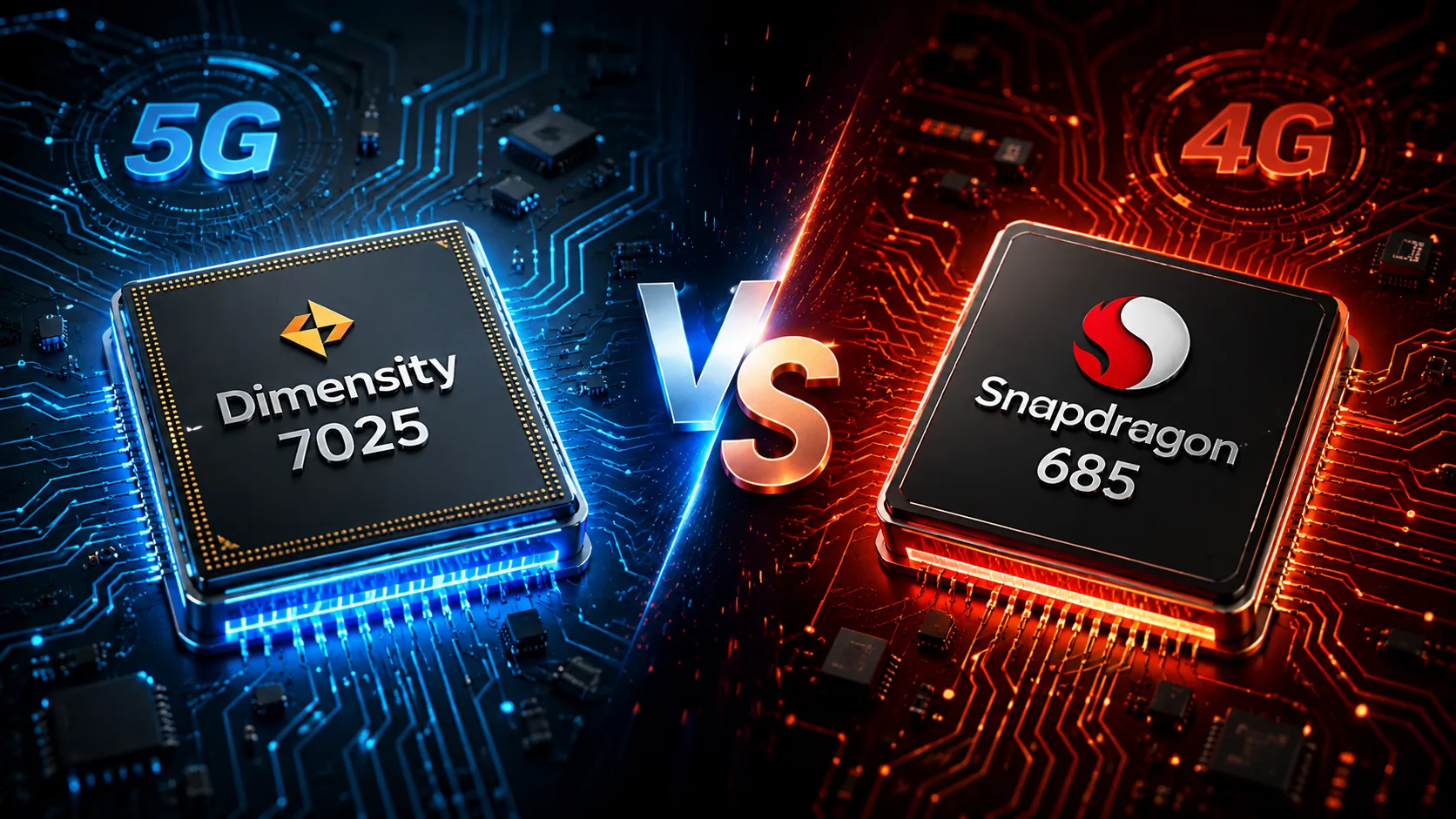
Dimensity 7025 vs Snapdragon 685: When Is It Worth Paying Extra for a 5G Chip and When Is 4G Enough
Snapdragon 685 is the foundation for budget 4G smartphones: messaging apps, YouTube, navigation, browsing, and simple games. Dimensity 7025 is a higher-tier chip: 5G, stronger cores, faster memory, and UFS 3.1. Therefore, the question is not only about network support but also about which smartphone will start lagging sooner.
This comparison is not about “one chip is new, the other is old.” Snapdragon 685 is still relevant in cheap devices without 5G. However, if the smartphone is purchased as a primary device and not just for one season, Dimensity 7025 appears more convincing.
Dimensity 7025 Is Faster Where It Matters Every Day
MediaTek Dimensity 7025 uses a combination of Cortex-A78 and Cortex-A55. For browsing, camera usage, and multitasking, these cores are more important than just high frequency. A78 cores handle heavy web pages, navigation, photography, banking applications, marketplaces, and frequent switching between them with ease.
The Snapdragon 685 has eight Kryo 265 cores at a frequency of up to 2.8 GHz, but the rest of the chip is weaker. High frequency looks good on paper but does not compensate for older memory, graphics, and storage. Dimensity 7025 supports LPDDR5 and UFS 3.1, while Snapdragon 685 is limited to LPDDR4X and UFS 2.2.
In practice, a smartphone with Dimensity 7025 opens heavy applications faster, manages multiple tasks more efficiently, and takes longer to turn into a typical “lagging budget device.” Snapdragon 685 is sufficient until the phone is loaded with heavy browsers, games, and constant app switching.
In Gaming, Dimensity 7025 Holds Up Better
These chips are not designed for gaming. High settings in heavy projects are not the goal here. However, there is a difference between them.
Dimensity 7025, paired with IMG BXM-8-256, performs better due to the CPU and fast memory. In popular games, this helps maintain a more stable FPS at low and medium settings. There is no headroom for heavy gaming, but frame drops will be less painful.
Snapdragon 685 uses Adreno 610. This is reliable graphics for casual games, simple projects, and less demanding online titles. In heavier games, Adreno 610 quickly hits its class limits: it doesn’t provide comfort and hovers at the lower end of acceptable FPS.
Regarding Connectivity, the Difference Is Simple: Dimensity 7025 Already Supports 5G, While Snapdragon 685 Is Only 4G
Dimensity 7025 supports 5G. Snapdragon 685 remains a 4G chip. This is fine if 5G is not available in the area, if rates are high, or if the phone is purchased as a cheap work model.
However, for a primary smartphone, 5G is becoming a part of the device's relevance. Even if it isn't needed today, the situation could change in a couple of years. Dimensity 7025 has less chance of quickly becoming obsolete regarding network capabilities.
Snapdragon 685 makes sense when the smartphone is significantly cheaper, and the user understands they are buying a standard 4G phone without any expectation of long-term usage.
Dimensity 7025 Offers More Camera Capabilities
Dimensity 7025 supports cameras up to 200 MP and video recording up to 2K at 30 FPS. Snapdragon 685 is designed for cameras up to 108 MP and video up to 1080p. This alone does not guarantee better photography: camera quality depends on the sensor, optics, and processing of the specific smartphone.
However, as a base for the device, Dimensity 7025 is stronger. It’s easier to create a smartphone with a higher-class camera, faster image processing, and less lag during shooting on its foundation.
Snapdragon 685’s camera can also be decent, especially in good lighting. But this chip is meant for budget models, where the camera is usually not the main reason for purchase.
Where the Difference Will Manifest in Real Use
The difference between these chips is not always apparent on the first day. Both smartphones will open Telegram, YouTube, and the browser. But after a year, the difference often shows not in benchmarks but in small details: the camera takes longer to start, the browser often reloads tabs, and games quickly drop to minimal settings.
The difference will be noticeable:
- with a large number of tabs and open applications;
- when taking photos and switching camera modes;
- in heavier games;
- during updates;
- in heavy applications;
- after a year or two, when the system and apps become more demanding.
Snapdragon 685 is suitable for a basic phone for calls, messaging, YouTube, and navigation. Dimensity 7025 is a better fit for a primary smartphone that should work longer without noticeable lag.
Key Differences
| Parameter | MediaTek Dimensity 7025 | Qualcomm Snapdragon 685 |
|---|---|---|
| Cellular | 5G + 4G | Only 4G LTE |
| CPU | Cortex-A78 + Cortex-A55 | Kryo 265 |
| Memory | LPDDR5 / LPDDR4X | LPDDR4X |
| Storage | UFS 3.1 | UFS 2.2 |
| Camera | Up to 200 MP | Up to 108 MP |
| Video | Up to 2K 30 FPS | Up to 1080p |
| Screen | FHD+ up to 120 Hz | FHD+ up to 120 Hz |
| Wi-Fi | Wi-Fi 5 | Wi-Fi 5 |
| Bluetooth | 5.2 | 5.2 |
What to Choose
Dimensity 7025 is better chosen if the smartphone is purchased as a primary device, not as a spare or temporary model. It is faster, supports 5G, works with faster memory and storage, and is better for browsing, camera, multitasking, and moderate gaming.
Snapdragon 685 makes sense if the smartphone’s price is significantly lower, 5G is not needed, and tasks are simple: calls, messaging, YouTube, navigation, banking apps, and light browsing. In such a scenario, it does not seem like a mistake. It is just aimed at a basic level, not for long-term relevance.
Conclusion
MediaTek Dimensity 7025 is a higher-class platform: stronger CPU, faster memory and storage, 5G support, and more camera capabilities.
Snapdragon 685 remains a reasonable choice for inexpensive 4G smartphones where price matters more than performance. It is suitable for calls, messaging, YouTube, and navigation but struggles to compete with Dimensity 7025 if a primary smartphone is needed for several years.
In short: Dimensity 7025 is a choice for longevity. Snapdragon 685 is a choice for price.
Advantages
- Newer Launch Date: April 2024 (April 2024 vs March 2023)
- Higher Frequency: 2800 MHz (2500 MHz vs 2800 MHz)
Basic
6x 2 GHz – Cortex-A55
GPU Specifications
Connectivity
Memory Specifications
Miscellaneous
Benchmarks
Related SoC Comparisons






Share in social media
Or Link To Us
<a href="https://cputronic.com/soc/compare/mediatek-dimensity-7025-vs-qualcomm-snapdragon-685" target="_blank">MediaTek Dimensity 7025 vs Qualcomm Snapdragon 685</a>