MediaTek Helio G37

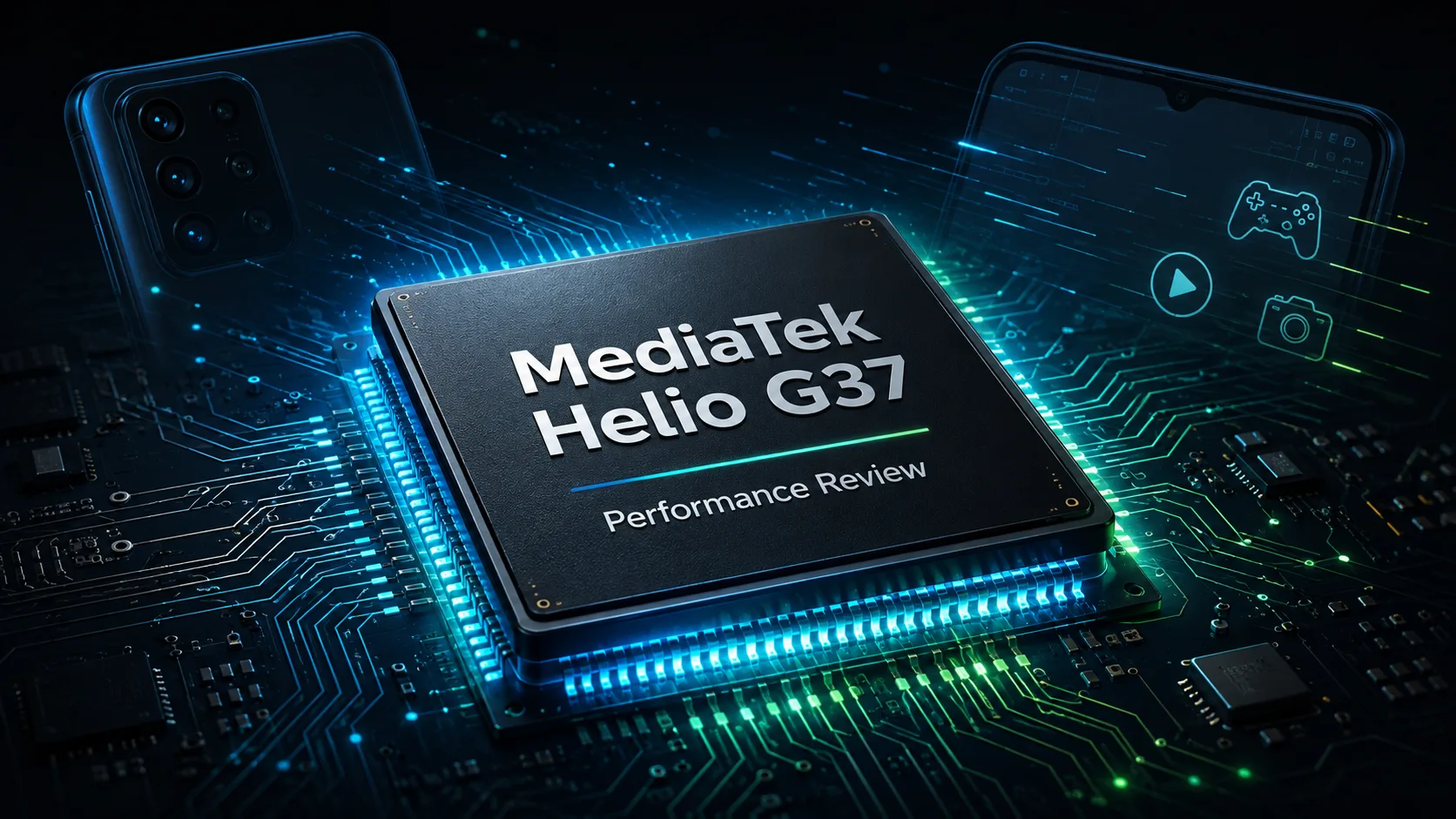
MediaTek Helio G37: Tests and Performance in Real Smartphones
MediaTek Helio G37 is an entry-level processor built solely on Cortex-A53 cores. Due to the lack of performant cores, the G37 slowly launches heavy applications and struggles more with complex web pages compared to newer budget SoCs.
In architecture, the Helio G37 is similar to the Helio G35 but has gained support for screens with a refresh rate of up to 90 Hz and more RAM. However, the support for 90 Hz does not compensate for the weak computational part: the smoothness of the interface depends not only on the screen's refresh rate.
Performance in Real Smartphones
The results from specific devices clearly demonstrate the real level of the Helio G37. The table uses the same versions of Geekbench, PCMark, and 3DMark, allowing for direct comparison of the models.
| Smartphone | RAM | Geekbench 5.5 Single | Geekbench 5.5 Multi | PCMark Work 3.x | 3DMark Sling Shot Unlimited |
|---|---|---|---|---|---|
| Motorola Moto G22 | 4 GB | 172 | 947 | 4,922 | 921 |
| Motorola Moto E32s | 3 GB | 160 | 656 | 5,815 | 919 |
| Motorola Moto E22i | 2 GB | 146 | 553 | 5,262 | 895 |
Single-core performance is low across all three smartphones-the best score is 172 points in Geekbench 5.5. The variance in the multi-core test is much more noticeable, ranging from 553 to 947 points.
Results are influenced by the amount of RAM, firmware, thermal limits, and specific smartphone settings, meaning the performance of a single device should not be considered a fixed performance level of the SoC itself.
Graphics results are much more stable: all three models score around 900 points in 3DMark Sling Shot Unlimited. The small variance indicates that performance in this test is primarily constrained by the PowerVR GE8320 itself.
Games and Graphics
The PowerVR GE8320 is primarily designed for simple mobile graphics. Casual games typically do not impose a significant load, but in more demanding 3D projects, low settings must be used.
In Call of Duty: Mobile, smartphones with the Helio G37 have access to low graphics settings, while in more demanding games, there's not enough performance headroom for stable frame rates.
Despite the G in the name, the Helio G37 cannot be considered a gaming processor. Software optimizations like HyperEngine do not compensate for the weak PowerVR GE8320 and the absence of performant CPU cores.
How Helio G37 Compares to Competitors
The difference from more modern budget platforms is already noticeable at the CPU level.
The Motorola Moto E32s with the Helio G37 scores around 160/656 points in Geekbench 5.5, while the Motorola Moto E32 with the Unisoc T606 shows approximately 312/1186 points. The difference is particularly large in the single-core test-almost double.
The Snapdragon 680 is also significantly faster. The Redmi 10C with this processor scores about 377/1644 points in Geekbench 5.5. For everyday tasks, such a difference is more important than the nominal CPU frequency or support for 90 Hz screens.
In practice, smartphones with the T606, T612, or Snapdragon 680 launch applications faster, handle browsers better, and provide a more responsive interface experience.
Conclusion
MediaTek Helio G37 is positioned at the lower end of the budget mobile processor segment. Its capabilities are sufficient for calls, messaging apps, video consumption, navigation, and simple applications, but the performance headroom is quite limited.
Choosing a smartphone with the Helio G37 is advisable only at a very low price. If a model with the Unisoc T606/T612 or Snapdragon 680 is available for a comparable price, it will be significantly faster, particularly in everyday CPU tasks.
SOC Comparison
Compare Helio G37 with other SOCs
Basic
4x 1.8 GHz – Cortex-A53
GPU Specifications
Connectivity
Memory Specifications
Miscellaneous
Benchmarks
Compared to Other SoC
Related SoC Comparisons



Share in social media
Or Link To Us
<a href="https://cputronic.com/index.php/soc/mediatek-helio-g37" target="_blank">MediaTek Helio G37</a>