Qualcomm Snapdragon 8s Gen 4
vs
MediaTek Dimensity 8300 Ultra

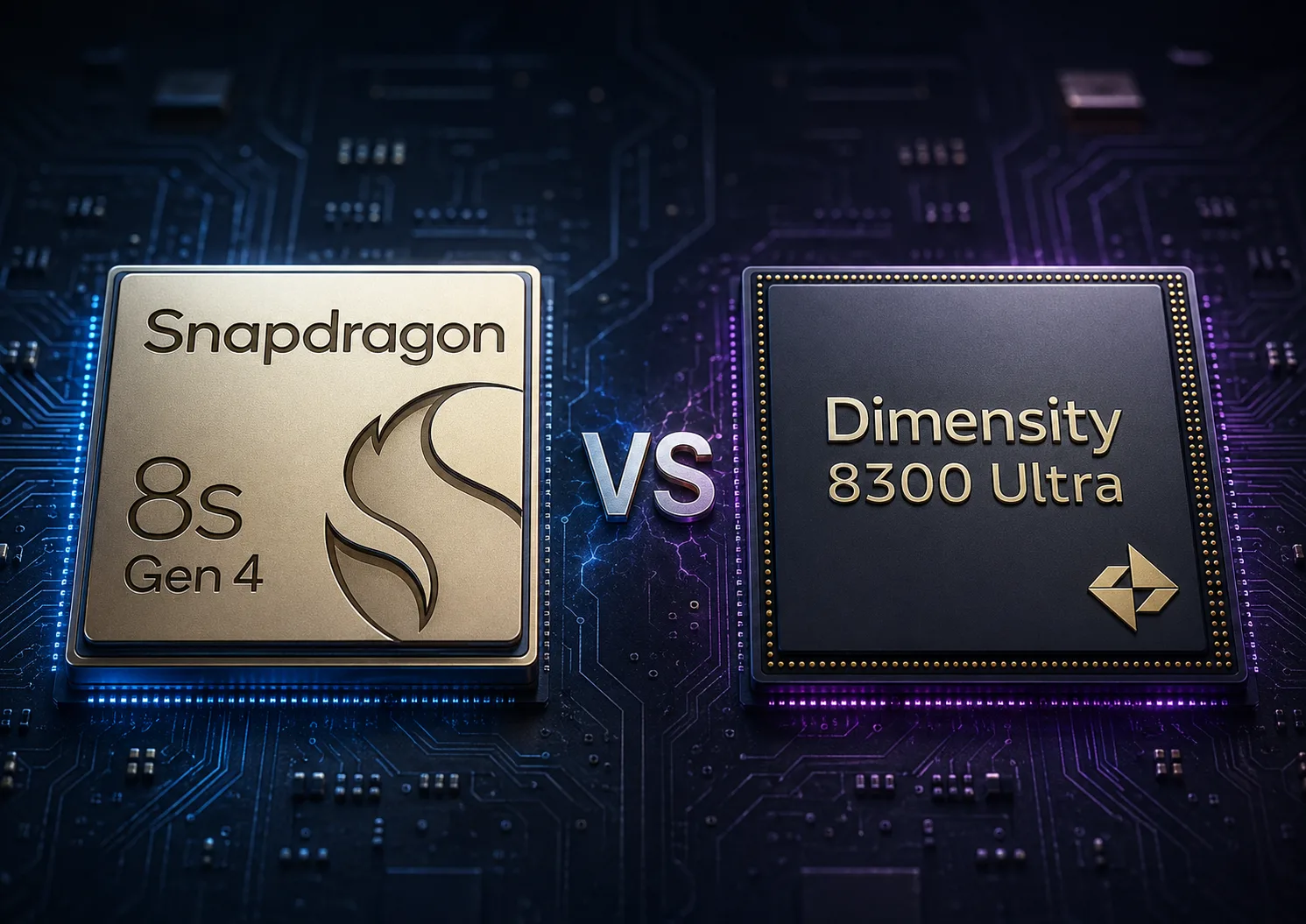
SoC Comparison Result
Snapdragon 8s Gen 4 vs Dimensity 8300 Ultra: How Well Does the Old "Flagship Killer" Hold Up?
Introduction: New Sub-flagship vs Old Hit
Snapdragon 8s Gen 4 and Dimensity 8300 Ultra are not direct competitors from the same generation. Qualcomm has released a newer chip for higher-class devices, while the Dimensity 8300 Ultra has become one of the most successful solutions in the upper mid-range segment for 2023-2024. Thus, the comparison is interesting not only in terms of speed but also in how well the old hit from MediaTek holds up against the new sub-flagship.
On paper, the Snapdragon 8s Gen 4 is stronger in almost every aspect: CPU, GPU, wireless standards, ISP, and headroom for AI functions. However, the Dimensity 8300 Ultra shouldn't be written off just yet. It brought relatively affordable smartphones features like LPDDR5X, UFS 4.0, and performance that recently appeared almost flagship-level.
The main question is not which chip is faster. Snapdragon is faster. The question is: how important is this difference when making a purchase, and at what discount does the Dimensity 8300 Ultra remain a reasonable choice?
Positioning: Different Classes and Different Prices
Snapdragon 8s Gen 4 is a chip for smartphones that do not reach true flagship status with Snapdragon 8 Elite, but want to feel close to them. It uses standard ARM Cortex-X4 and Cortex-A720 cores instead of the custom Oryon cores of the higher-end platform, but in terms of CPU and GPU levels, it is already noticeably above the typical mid-range.
The Dimensity 8300 Ultra is a different case. It is not a new flagship chip but a strong platform for devices like the POCO X6 Pro. The Ultra version is more commonly found in smartphones from Xiaomi, Redmi, and POCO, and is publicly close in specifications to the regular Dimensity 8300.
Hence, comparing them "head-to-head" can only be done with the caveat that the Snapdragon 8s Gen 4 should be faster. It is more interesting to understand how outdated Dimensity 8300 Ultra has become and whether it has transformed from a "people's flagship" into just a good mid-range chip.
CPU: Why Frequency Doesn’t Save Dimensity
At first glance, the Dimensity 8300 Ultra looks confident: peak frequency up to 3.35 GHz against 3.2 GHz for Snapdragon 8s Gen 4. However, not only the frequency matters but also the class of cores and overall layout.
| Parameter | Snapdragon 8s Gen 4 | Dimensity 8300 Ultra | What's Better |
|---|---|---|---|
| Main Core | 1x Cortex-X4 up to 3.2 GHz | 1x Cortex-A715 up to 3.35 GHz | Snapdragon - higher class core |
| Performance Cores | 7x Cortex-A720 | 3x Cortex-A715 | Snapdragon |
| Small Cores | None | 4x Cortex-A510 | Dimensity may be more energy efficient in light tasks |
| Overall Character | All-performance design | Classic big/little scheme | Snapdragon faster under load |
The main advantage of the Snapdragon 8s Gen 4 is not only the Cortex-X4 but also the lack of weak small cores. All eight cores belong to the performance class. This provides a high multi-threaded ceiling and helps in heavy tasks such as gaming, photo processing, file unpacking, multitasking, and camera work.
The Dimensity 8300 Ultra is not weak either. Its Cortex-A715 cores still perform well in everyday tasks, while the Cortex-A510 cores help save energy in simple scenarios. However, in terms of CPU headroom, they are no longer on the same level: Snapdragon is faster per core and significantly better suited for heavy tasks.
Performance: About a 50% Gap, Not Uniformly Visible
In benchmarks, the Snapdragon 8s Gen 4 leads by about half. This is not a small difference and not "a margin of error." However, the final figures depend on the specific smartphone, cooling, version of the test, and power limits.
| Test | Snapdragon 8s Gen 4 | Dimensity 8300 Ultra | Approximate Difference |
|---|---|---|---|
| Geekbench 6 Single | ~2100-2250 | ~1400-1500 | +45-55% |
| Geekbench 6 Multi | ~7000-7400 | ~4500-4700 | +50-60% |
| AnTuTu | ~2.1-2.2 million | ~1.45-1.55 million | +40-50% |
| 3DMark Wild Life Extreme | ~4600 | ~3000 | about +50% |
These figures clearly illustrate the class of devices. The Snapdragon 8s Gen 4 is closer to previous flagships, while the Dimensity 8300 Ultra today looks like a very strong but no longer top chip in the upper mid-range segment.
In regular tasks like messaging, browsing, YouTube, and navigation, the Dimensity will still not seem slow. The difference will become more pronounced in heavy games, emulators, prolonged multitasking, photo and video processing, and in 2-3 years when applications become heavier.
GPU and Gaming: Adreno 825 Provides Greater Headroom
In gaming, the advantage of Snapdragon is noticeable not only in peak scores. The Adreno 825 is faster than Mali-G615 MC6 and is generally stronger in terms of compatibility, drivers, and emulators. For heavy games and a longer lifespan, this is more important than the difference in one specific test.
The Snapdragon 8s Gen 4 also has a newer set of gaming technologies: hardware ray tracing, Game Super Resolution, Frame Motion Engine, and other features from Snapdragon Elite Gaming. Not every game will fully utilize them, but the platform's headroom is higher.
The Dimensity 8300 Ultra is still good in games. It can maintain high FPS in popular competitive titles and handles heavy games reasonably well at appropriate settings. However, in Genshin Impact, Honkai: Star Rail, emulators, and extended gaming sessions, the Snapdragon 8s Gen 4 will be preferable.
The conclusion is simple: if gaming is one of the main scenarios, the Snapdragon 8s Gen 4 is worth the significant extra cost. If gaming is secondary, the Dimensity 8300 Ultra is still powerful enough.
AI, Camera, and Connectivity: Snapdragon is Newer, but the Smartphone Matters More Than the Chip
Both chips support modern AI scenarios, but the Snapdragon 8s Gen 4 looks more promising: it has a newer Hexagon NPU, support for INT4/INT8, and a greater emphasis on local Gen AI functions. The Dimensity 8300 Ultra with APU 780 is also capable of handling AI tasks, including photo processing, noise reduction, and scene recognition. However, for the average consumer, the NPU should not be the main argument just yet: the user will feel the difference in CPU, GPU, cameras, cooling, and price much faster.
In terms of camera, the Snapdragon 8s Gen 4 appears stronger. Its 18-bit Triple AI ISP offers more capabilities for HDR, night video, multi-camera processing, and intelligent scene segmentation. The Dimensity 8300 Ultra uses a 14-bit HDR ISP Imagiq 980 - a good level but not as fresh.
| Parameter | Snapdragon 8s Gen 4 | Dimensity 8300 Ultra |
|---|---|---|
| ISP | 18-bit Triple AI ISP | 14-bit HDR ISP Imagiq 980 |
| Maximum Sensor | up to 320 MP | up to 320 MP |
| Video Recording | 4K HDR up to 60 FPS | 4K HDR up to 60 FPS |
| 8K Playback | claimed | not claimed |
| AI Scene Processing | up to 250 layers | no comparable public statement |
However, the ISP is only part of the camera. The actual photo quality depends on the sensor, optics, stabilization, the manufacturer's algorithms, and firmware. A smartphone on the Dimensity 8300 Ultra with a well-tuned camera may take better photos than a weak model on Snapdragon.
In terms of memory and storage, the difference is smaller: both platforms support LPDDR5X and UFS 4.0. Connectivity is more interesting: the Dimensity 8300 Ultra may boast a higher claimed peak 5G download speed, but the Snapdragon 8s Gen 4 has a more modern wireless set - Wi-Fi 7 and Bluetooth 6.0 against Wi-Fi 6E and Bluetooth 5.4. In reality, much depends on the antennas, region, firmware, and network quality, but in terms of standard headroom, the Snapdragon is ahead.
Which Chip to Choose in 2026
Choose Snapdragon 8s Gen 4 if:
- You need performance headroom for the next 2-3 years;
- Heavy gaming, emulators, and stable FPS are important;
- You want the more modern Wi-Fi 7 and Bluetooth 6.0;
- The smartphone is intended for long-term use rather than just "for a year or a year and a half."
The Dimensity 8300 Ultra still makes sense if:
- The smartphone is significantly cheaper;
- Gaming is not the main scenario;
- Price, display, battery, and memory size are more important;
- Maximum settings in heavy projects are not needed;
- The device is taken as a cost-effective option in the upper mid-range.
Conclusion
The Snapdragon 8s Gen 4 is a significantly stronger platform. It is faster in CPU, more powerful in graphics, richer in ISP capabilities, and more modern in wireless standards. This is no longer a mere "slightly faster" situation; it represents a shift to another level of performance.
The Dimensity 8300 Ultra, however, has not turned bad. It is still fast enough for everyday use, performs well in mid and high-level games, and remains a successful chip if the smartphone is sold at a good discount.
The practical takeaway is this: if the price difference between smartphones on Snapdragon 8s Gen 4 and Dimensity 8300 Ultra is up to 20-25%, it is better to choose Snapdragon. If the Dimensity 8300 Ultra model is cheaper by 30-40%, it is still a reasonable purchase. Just understand that it is no longer "almost flagship" but a strong upper mid-range chip from the last generation.
Advantages
- Newer Launch Date: April 2025 (April 2025 vs November 2023)
- Higher Frequency: 3350 MHz (3200 MHz vs 3350 MHz)
Basic
3x 3 GHz – Cortex-A720
2x 2.8 GHz – Cortex-A720
2x 2.02 GHz – Cortex-A720
GPU Specifications
Connectivity
Memory Specifications
Miscellaneous
- AIFF
- CAF
- MP3
- MP4
- WAV
- H.265
- AV1
- VP9
Benchmarks
Comparison of Devices
Related SoC Comparisons


Share in social media
Or Link To Us
<a href="https://cputronic.com/index.php/soc/compare/qualcomm-snapdragon-8s-gen-4-vs-mediatek-dimensity-8300-ultra" target="_blank">Qualcomm Snapdragon 8s Gen 4 vs MediaTek Dimensity 8300 Ultra</a>