Qualcomm Snapdragon 8 Gen 3
vs
Qualcomm Snapdragon 7 Gen 4

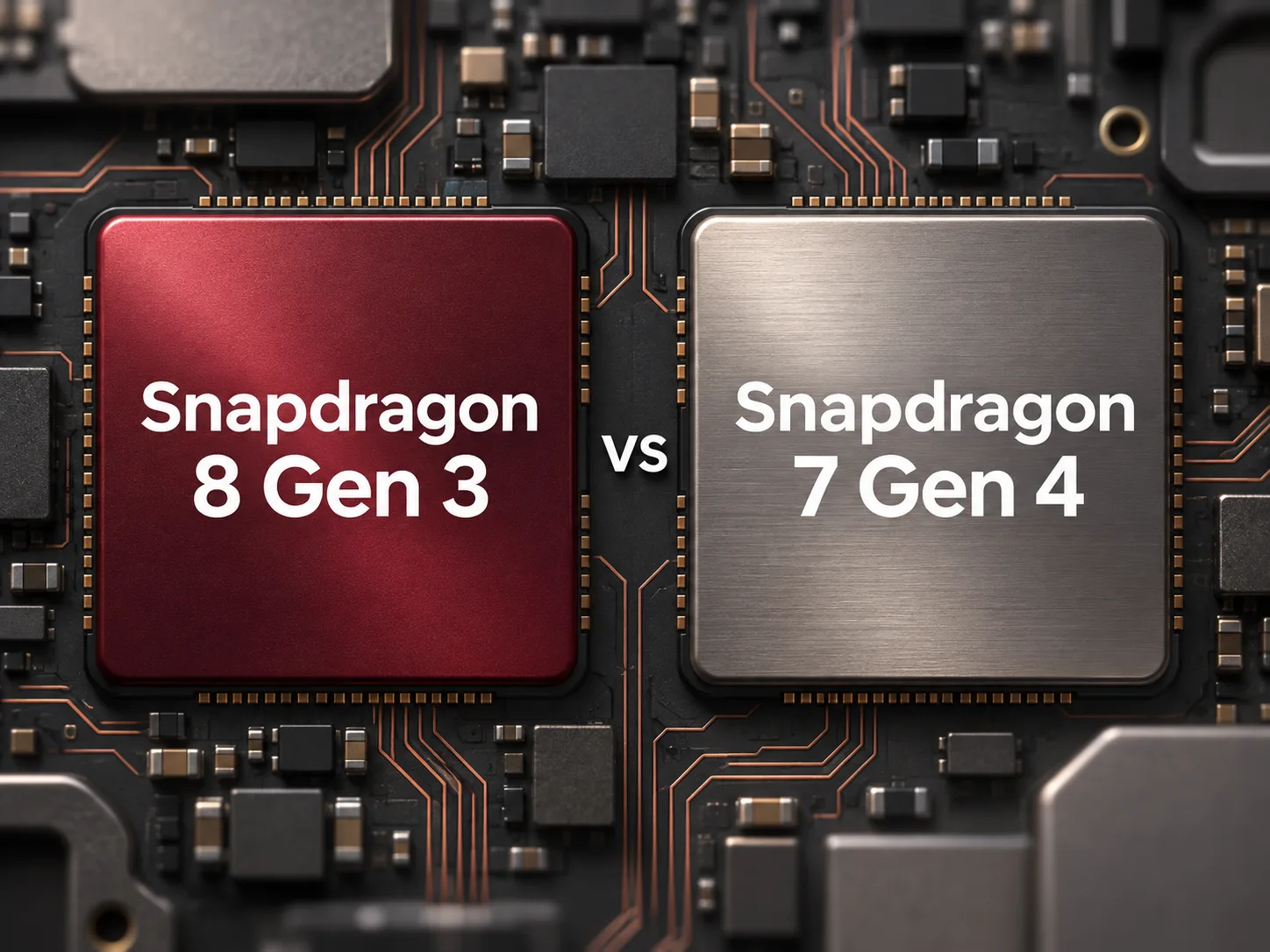
SoC Comparison Result
Snapdragon 8 Gen 3 and Snapdragon 7 Gen 4 Tested in Four Smartphones
Snapdragon 8 Gen 3 was released in 2023 for flagship smartphones. In 2025, Qualcomm introduced Snapdragon 7 Gen 4 for mid-range models. The biggest difference between them appears in the 3DMark Wild Life Extreme graphics test. The Xiaomi 14 with Snapdragon 8 Gen 3 scores approximately 2.5 times higher than the Realme 15 Pro and Vivo V60 with Snapdragon 7 Gen 4.
Key differences
| Specification | Snapdragon 8 Gen 3 | Snapdragon 7 Gen 4 |
|---|---|---|
| CPU cores | 1 Cortex-X4 + 5 Cortex-A720 + 2 Cortex-A520 | 5 Cortex-A720 + 3 Cortex-A520 |
| Maximum CPU frequency | 3.3 GHz for the SM8650-AB version | 2.8 GHz |
| Graphics | Adreno 750 | Adreno 722 |
| Image signal processors (ISPs) | 3 × 18-bit | 3 × 12-bit |
| Video recording | Up to 8K at 30 FPS or 4K at 120 FPS | Up to 4K at 60 FPS |
| Peak 5G download speed | 10 Gb/s | 4.2 Gb/s |
| Bluetooth | 5.4 | 6.0 |
CPU and graphics performance
Both chips have eight cores. In Snapdragon 8 Gen 3, the fastest Cortex-X4 core reaches 3.3 GHz. Of the five Cortex-A720 cores, three run at up to 3.2 GHz, while the other two reach up to 3.0 GHz. In Snapdragon 7 Gen 4, the highest-clocked Cortex-A720 core reaches 2.8 GHz, while the other four cores of the same type run at 2.4 GHz.
The table combines results from several reviews. The Geekbench 6 columns show single-core and multi-core scores, while the last column shows the result of a single 3DMark Wild Life Extreme run. Scores are affected by the memory configuration, firmware, and power mode.
| Smartphone | Chip | Geekbench 6 Single-Core | Geekbench 6 Multi-Core | AnTuTu 10 | 3DMark Wild Life Extreme |
|---|---|---|---|---|---|
| Xiaomi 14 | Snapdragon 8 Gen 3 | 2,204 | 6,698 | 2,003,429 | 4,567 |
| OnePlus 13R | Snapdragon 8 Gen 3 | 2,218 | 6,714 | 2,109,299 | 4,979 |
| Realme 15 Pro | Snapdragon 7 Gen 4 | 1,218 | 3,541 | 1,095,837 | 1,816 |
| Vivo V60 | Snapdragon 7 Gen 4 | 1,247 | 3,539 | 1,009,011 | 1,795 |
In Geekbench 6, the Xiaomi 14 is 77% ahead of the Vivo V60 in the single-core test and 89% ahead in the multi-core test. The Realme 15 Pro and Vivo V60 are separated by just two points in the multi-core test. In AnTuTu 10, the Realme’s lead reaches 9%. The overall AnTuTu score also includes the results of graphics, memory, and storage tests.
Graphics performance under sustained load
In the 3DMark Wild Life Extreme stress test, a smartphone renders the same scene several times in succession. The difference between the best and worst runs indicates how much performance drops under sustained load.
The OnePlus 13R scored 4,748 points in its best run and 2,721 in its worst, retaining 57% of its maximum performance. The Vivo V60 scored 1,819 and 1,436 points, respectively, meaning it retained 79%. The Vivo’s performance drop is smaller, but even the OnePlus’s worst result is 50% higher than the Vivo’s best result. Assessing frame rates in a game requires measurements at the same resolution and graphics settings.
Video recording, memory, and on-device neural networks
Snapdragon 8 Gen 3 supports 8K recording at 30 FPS, but the available modes depend on the smartphone. The Xiaomi 14’s main camera records 8K video at 24 FPS. On the OnePlus 13R with the same chip, the maximum recording mode for the main camera is 4K at 60 FPS.
Snapdragon 7 Gen 4 supports LPDDR5X RAM and UFS 4.0 storage. The Vivo V60 is equipped with LPDDR4X RAM and UFS 2.2 storage. When copying large files, speed also depends on the storage solution installed by the manufacturer.
Both chips are equipped with a Hexagon neural processor. For Snapdragon 7 Gen 4, Qualcomm states that it can run Stable Diffusion 1.5 directly on the smartphone. Generating images requires an app capable of running this model on Hexagon.
Which tasks each chip is suited for
- Games and emulators. At a comparable price, the advantage goes to a smartphone with Snapdragon 8 Gen 3. The Adreno 750 is faster in the graphics test, while 8 Gen 3 also offers higher single-threaded performance for emulators that depend heavily on single-core speed.
- Browsing, messaging, and video. Snapdragon 7 Gen 4 is sufficient for these tasks. When choosing between specific models, display quality and battery life are more important.
- Replacing a smartphone with 8 Gen 3. Switching to 7 Gen 4 makes sense if the new device, for example, lasts longer on a charge or will receive updates for longer. In games and applications with a heavy CPU load, the previous flagship chip is faster.
Advantages
- Higher Frequency: 3300 MHz (3300 MHz vs 2800 MHz)
- Newer Launch Date: May 2025 (October 2023 vs May 2025)
Basic
5x (3x3.2 GHz/2x3.0GHz) – Cortex-A720
2x 2.3 GHz – Cortex-A520
GPU Specifications
Connectivity
Memory Specifications
Miscellaneous
Benchmarks
Comparison of Devices
Related SoC Comparisons




Share in social media
Or Link To Us
<a href="https://cputronic.com/index.php/soc/compare/qualcomm-snapdragon-8-gen-3-vs-qualcomm-snapdragon-7-gen-4" target="_blank">Qualcomm Snapdragon 8 Gen 3 vs Qualcomm Snapdragon 7 Gen 4</a>