Qualcomm Snapdragon 7s Gen 4
vs
MediaTek Helio G200
SoC Comparison Result
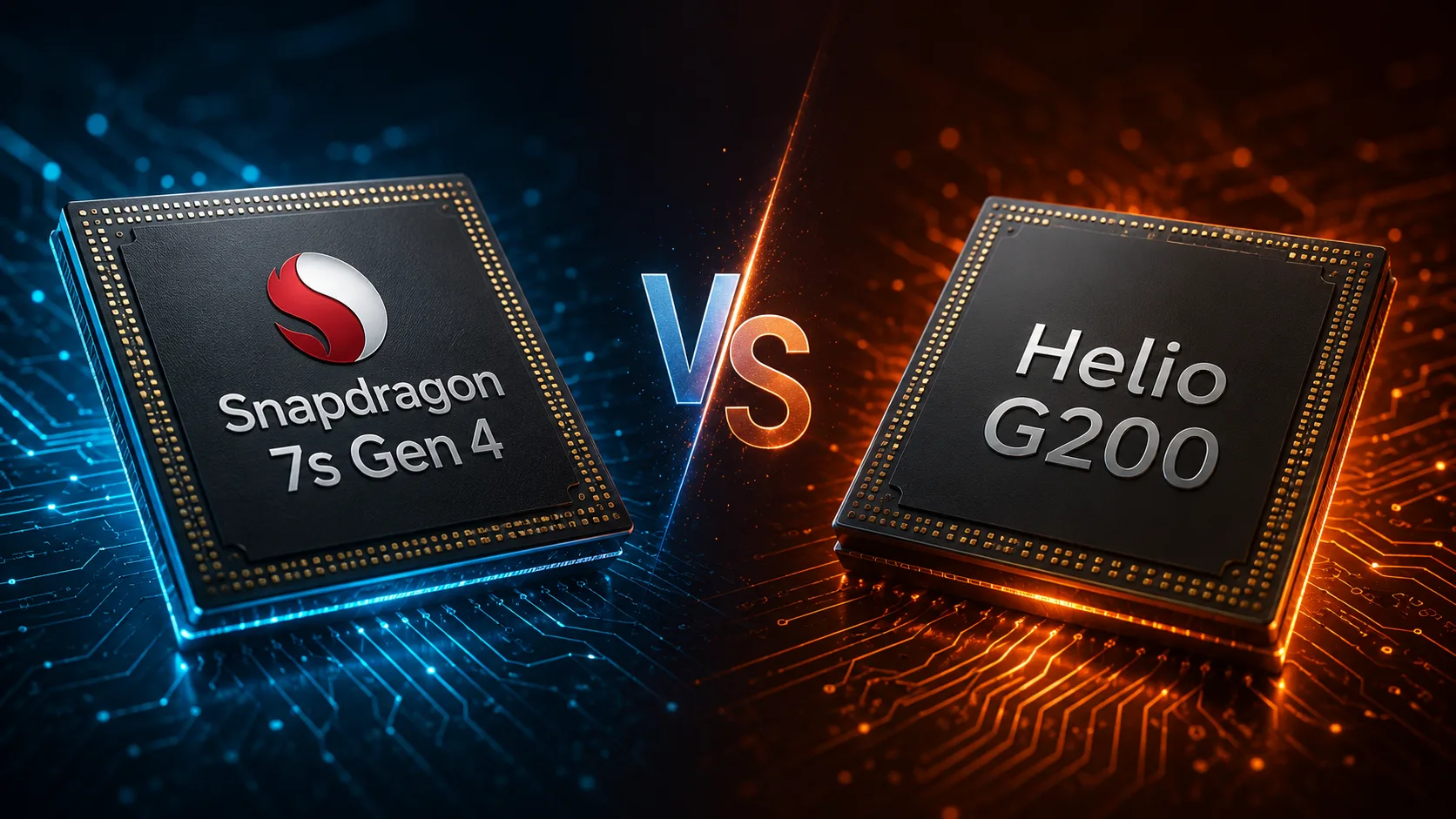
Snapdragon 7s Gen 4 vs Helio G200: The 5G Mid-Range vs the Fast 4G Budget Chip
Qualcomm Snapdragon 7s Gen 4 and MediaTek Helio G200 may appear to be chips from the same mid-range segment, but in practice, they operate in different leagues. The Snapdragon 7s Gen 4 is a more modern 5G platform with a 4nm process, a fresh CPU architecture, fast LPDDR5 memory, and UFS 3.1 storage. Helio G200 is an evolution of the popular 4G line of MediaTek Helio G99/G100, aimed at budget smartphones with good basic performance but not aspiring to the level of new 5G chips.
In short, the Snapdragon 7s Gen 4 is stronger in almost every aspect. The Helio G200 is only interesting when the smartphone featuring it is notably cheaper.
Key Differences
| Feature | Snapdragon 7s Gen 4 | Helio G200 |
|---|---|---|
| Class | mid-range 5G | affordable 4G |
| Process | 4 nm | 6 nm |
| CPU | 1+3+4, up to 2.7 GHz | 2+6, up to 2.2 GHz |
| GPU | Adreno | Mali-G57 MC2 up to 1.1 GHz |
| Memory | LPDDR5 / LPDDR4X | LPDDR4X |
| Storage | UFS 3.1 | UFS 2.2 |
| Connectivity | 5G, Wi-Fi 6E, Bluetooth 5.4 | 4G LTE, Wi-Fi 5, Bluetooth 5.2 |
| Display | up to WFHD+ 144 Hz | up to Full HD+ 120 Hz |
| Video | up to 4K HDR 30 FPS | up to 2K 30 FPS / FHD 60 FPS |
Performance
The main advantage of the Snapdragon 7s Gen 4 lies not only in its frequencies. It has a more advanced CPU structure: one fast core for short heavy tasks, three performance cores for stable loads, and four efficiency cores. Helio G200 uses the classic 2x Cortex-A76 + 6x Cortex-A55 configuration. For messengers, browsers, YouTube, navigation, and simple games, this is sufficient, but the performance reserve is lower.
In Geekbench 6, the Snapdragon 7s Gen 4 usually appears about 50-60% faster in both single-core and multi-core tests. The gap in AnTuTu is significant as well, but it's important not to get caught up on a single number: the outcome depends on the version of the test, the specific smartphone, memory, cooling, and manufacturer settings.
| Benchmark | Snapdragon 7s Gen 4 | Helio G200 | Comment |
|---|---|---|---|
| Geekbench 6 Single-Core | around 1150-1200 | around 730-780 | Snapdragon is significantly faster in responsiveness |
| Geekbench 6 Multi-Core | around 3100-3300 | around 1950-2100 | Better suited for heavy multitasking |
| AnTuTu | around 850000-1000000 | around 450000-600000 | The result heavily depends on the version of the test, memory, and cooling |
In regular use, this translates to faster app installations, fewer delays in heavy interfaces, better camera performance, and a longer buffer for several years.
Graphics and Gaming
In gaming, Snapdragon 7s Gen 4 also looks stronger. The Adreno graphics in this chip belong to a more modern class than the Mali-G57 MC2 in the Helio G200. The difference is particularly noticeable in demanding projects, where not only peak FPS but also stability under long loads matter.
The Helio G200 can only be considered a gaming chip within the budget 4G segment. For PUBG Mobile, Mobile Legends, Asphalt, and similar titles, its capabilities are sufficient, especially at medium or moderate settings. However, for Genshin Impact, Wuthering Waves, and other heavy games, the Snapdragon 7s Gen 4 will be noticeably more comfortable: higher FPS, better graphical settings, and a reduced risk of hitting performance ceilings.
Memory and Storage
Here, the Snapdragon 7s Gen 4 has another crucial advantage: support for LPDDR5 and UFS 3.1. This impacts not just the numbers on the table but also the sensation of speed. The smartphone launches heavy apps faster, holds multiple programs in memory more confidently, and works with files more quickly.
The Helio G200 is limited to LPDDR4X and UFS 2.2. This is an acceptable level for a budget smartphone but nothing more. With good optimization, the system will run smoothly, but in demanding scenarios and over a couple of years, the reserve of the Snapdragon will be significantly higher.
Connectivity, Camera, and Multimedia
Snapdragon 7s Gen 4 supports 5G, Wi-Fi 6E, and Bluetooth 5.4. The Helio G200 remains a 4G chip with Wi-Fi 5 and Bluetooth 5.2. If the smartphone is intended for long-term use, this is an important argument in favor of Qualcomm: 5G is not yet necessary for everyone, but the platform itself is noticeably fresher.
For cameras, both chips can work with high-resolution sensors, but Snapdragon excels in image and video processing. Support for 4K HDR 30 FPS, a more advanced ISP, and modern multimedia capabilities make it a more suitable option for smartphones focused on photography and videography. The Helio G200 can also be used in devices with cameras up to 200 MP, but it is simpler in video recording and processing.
An Important Nuance About Helio G200
The Helio G200 is not a bad processor. Its issue arises only in comparison. Against the backdrop of the Snapdragon 7s Gen 4, it appears simpler in nearly every aspect, but it can be quite suitable in a budget smartphone. This chip is designed for instances when a manufacturer needs to create an affordable device with decent everyday speed, good battery life, and a large display, but without 5G and an expensive platform.
Essentially, the Helio G200 continues the idea of the Helio G99/G100: to maximize output from the 4G segment and keep the smartphone's price lower. Therefore, comparing it directly to the Snapdragon 7s Gen 4 as equal competitors is not entirely accurate. It is not a one-to-one alternative but rather a cheaper class of devices.
Conclusion
The Snapdragon 7s Gen 4 is clearly the stronger chip. It is faster in CPU, more powerful in graphics, supports more modern memory and storage, offers 5G, and is better suited for gaming, cameras, and longevity.
The Helio G200 should only be chosen when the price difference is significant. If the smartphone featuring it is cheaper, has a good display, a decent battery, and sufficient memory, it can be a reasonable choice for everyday tasks. However, at a similar price point, the Snapdragon 7s Gen 4 is much more interesting: it is not only faster but also a more modern and promising processor.
Advantages
- Higher Technology: 4 nm (4 nm vs 6 nm)
- Higher Frequency: 2700 MHz (2700 MHz vs 2200 MHz)
- Newer Launch Date: August 2025 (August 2025 vs May 2025)
Basic
GPU Specifications
Connectivity
Memory Specifications
Miscellaneous
- AIFF
- CAF
- MP3
- MP4
- WAV
- AIFF
- CAF
- MP3
- MP4
- WAV
- H.265
- VP9
- H.265
- VP9
Benchmarks
Comparison of Devices
Related SoC Comparisons




Share in social media
Or Link To Us
<a href="https://cputronic.com/index.php/soc/compare/qualcomm-snapdragon-7s-gen-4-vs-mediatek-helio-g200" target="_blank">Qualcomm Snapdragon 7s Gen 4 vs MediaTek Helio G200</a>