Qualcomm Snapdragon 6 Gen 5
vs
MediaTek Dimensity 8300 Ultra

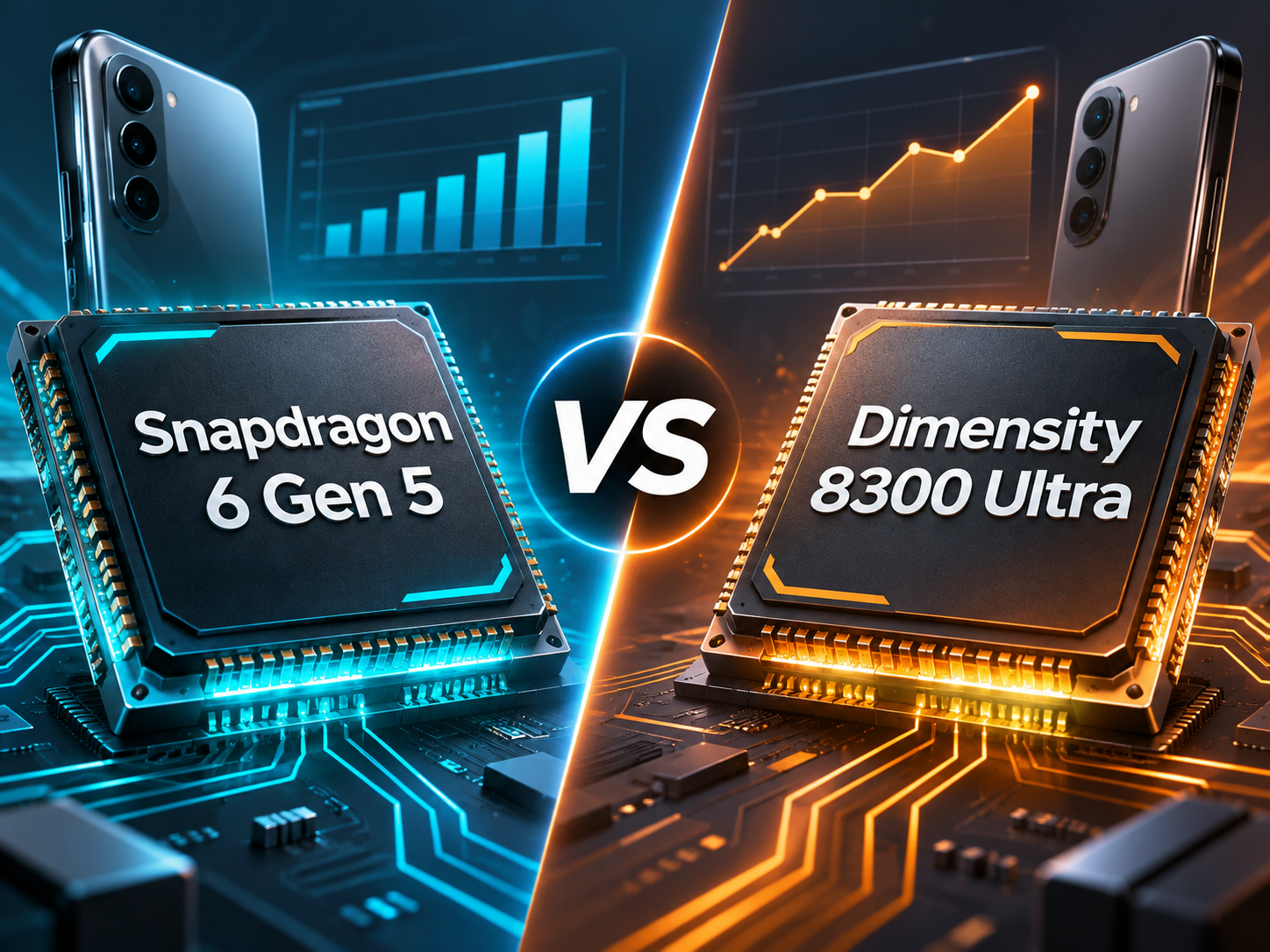
SoC Comparison Result
Snapdragon 6 Gen 5 vs. Dimensity 8300 Ultra: Smartphone Benchmarks and Prices
The Snapdragon 6 Gen 5 was released in May 2026-two and a half years after the Dimensity 8300 Ultra. At the same time, smartphones with the MediaTek chip score around 1.6 million points in AnTuTu 11, compared with 1 million for Qualcomm-powered models, while the gap in 3DMark Steel Nomad Light approaches twofold. The chips belong to different segments: the Snapdragon 6 Gen 5 is designed for the mid-range segment, while the Dimensity 8300 Ultra targets more powerful smartphones.
Key Differences
Both chips are manufactured using TSMC’s 4 nm process and have eight CPU cores each. However, the Dimensity 8300 Ultra has a newer core architecture and a significantly more powerful GPU.
| Specification | Snapdragon 6 Gen 5 | Dimensity 8300 Ultra |
|---|---|---|
| Release date | May 2026 | November 2023 |
| Performance cores | 4× Cortex-A78, 2.6 GHz | 1× Cortex-A715, 3.35 GHz + 3× Cortex-A715, 3.2 GHz |
| Efficiency cores | 4× Cortex-A55, 2.0 GHz | 4× Cortex-A510, 2.2 GHz |
| CPU architecture | Armv8.2-A | Armv9-A |
| GPU | Adreno 812 | Mali-G615 MC6 |
| Memory (specification) | LPDDR5 | LPDDR5X-8533 |
| Storage interface (specification) | UFS 3.1 | UFS 4.0 |
| Wi-Fi | Wi-Fi 7 | Wi-Fi 6E |
| Bluetooth | 6.0 | 5.4 |
| Peak 5G download speed | 2.8 Gb/s | 5.17 Gb/s |
| Video recording | Up to 4K at 30 FPS | Up to 4K at 60 FPS |
The Dimensity 8300 Ultra has four Cortex-A715 performance cores clocked at up to 3.35 GHz. The Snapdragon uses Cortex-A78 cores clocked at up to 2.6 GHz. The newer architecture and higher clock speeds help MediaTek outperform Qualcomm in computing benchmarks.
The Snapdragon supports newer Wi-Fi and Bluetooth versions. However, the smartphone manufacturer may not use all of the chip’s capabilities.
Benchmarks: Real Smartphones and Prices
The table lists Geekbench 6, AnTuTu 11, and 3DMark Steel Nomad Light results for four smartphones.
| Smartphone | Geekbench 6 Single / Multi | AnTuTu 11 | 3DMark Steel Nomad Light | Launch price |
|---|---|---|---|---|
| Snapdragon 6 Gen 5 | ||||
| HONOR X9e Pro | 1,174 / 3,487 | 1,008,325 | 431 | ~$408 |
| POCO X8 Power | 1,083 / 3,469 | 1,010,104 | 413 | ~$380 |
| Dimensity 8300 Ultra | ||||
| POCO X6 Pro | 1,370 / 4,509 | 1,604,305 | 852 | $299 |
| Xiaomi 14T | 1,335 / 4,107 | 1,598,339 | 836 | ~$724 |
These are results from individual tests; other units may produce different figures. Scores depend on the firmware, cooling, and testing conditions. Prices refer to the base versions at launch: HONOR X9e Pro-in the UAE, POCO X8 Power-in India, POCO X6 Pro-on the global market, and Xiaomi 14T-in Europe. Regional prices have been approximately converted to USD without accounting for discounts.
In the tests, the POCO X6 Pro outperforms the HONOR X9e Pro by:
- 17% in Geekbench 6 Single-Core.
- 29% in Geekbench 6 Multi-Core.
- 59% in AnTuTu 11.
- 98% in 3DMark Steel Nomad Light.
The largest gap appears in 3DMark: nearly 100%, compared with 17-29% in Geekbench 6.
Even smartphones with the same chip can achieve different scores. For example, lower Geekbench 6 results than those shown in the table have also been published for the POCO X8 Power. In addition, a single short test does not show how significantly a smartphone’s performance declines under sustained load.
Gaming: How Much Faster Is the Dimensity 8300 Ultra?
In Steel Nomad Light, smartphones with the Dimensity 8300 Ultra score approximately twice as many points as models with the Snapdragon 6 Gen 5.
The more powerful Mali-G615 MC6 provides greater scope for increasing graphics settings and FPS in demanding games. The Adreno 812 is suitable for less demanding games, but graphics settings will more often need to be lowered in demanding titles.
The difference in 3DMark cannot be directly translated into FPS: games may limit the frame rate, and performance depends not only on the GPU but also on the CPU. During extended gaming sessions, cooling and the specific smartphone’s power-consumption limits also affect performance.
Memory and Everyday Performance
The POCO X6 Pro and Xiaomi 14T use LPDDR5X and UFS 4.0-the standards supported by the Dimensity 8300 Ultra.
In the Snapdragon 6 Gen 5 specifications, Qualcomm lists LPDDR5 and UFS 3.1. However, the specifications of some smartphones with this chip list newer memory and storage standards. This does not mean that those standards are listed in the processor’s own specifications.
Both chips provide enough performance for browsing, messaging, video, and navigation. The difference becomes more noticeable under heavy computational loads, where the Dimensity 8300 Ultra remains ahead.
App installation and file-copying speeds depend not only on the CPU but also on the storage. Therefore, when choosing a smartphone, it is worth checking not only the processor model but also the specifications of the installed memory.
Smartphone Battery Life
The core architecture and manufacturing process cannot determine which chip consumes less power. The benchmarks presented here also cannot be used to compare their power consumption under the same load.
At the same time, smartphones with these processors differ significantly in battery capacity:
- HONOR X9e Pro-11,000 mAh.
- POCO X8 Power-10,000 mAh.
- POCO X6 Pro-5,000 mAh.
With such a difference in battery capacity, the smartphones’ runtime will not show which chip is more efficient. Separate power-consumption measurements under comparable conditions are needed for that.
Smartphone Prices and Relevance
At launch, the POCO X6 Pro cost from $299. That was less than the launch prices of the POCO X8 Power and HONOR X9e Pro, even though the POCO X6 Pro was noticeably faster than both models in the tests.
At the same time, the POCO X6 Pro was released in January 2024, while smartphones with the Snapdragon 6 Gen 5 were released in 2026. Launch prices do not show how much these devices cost today.
Newer smartphones generally have more time remaining before the end of software support. For example, the POCO X8 Power is promised four major Android updates and six years of security updates.
The Xiaomi 14T and POCO X6 Pro use the same chip, but their launch prices were approximately $724 and $299, respectively. The price difference is related in part to the cameras, display, and body design, rather than computing performance.
Conclusion: Which Chip Should You Choose?
Based on the Geekbench 6, AnTuTu 11, and 3DMark results, the Dimensity 8300 Ultra remains ahead. The gap is especially large in graphics: in Steel Nomad Light, it approaches twofold.
For gaming and demanding applications, smartphones with the Dimensity 8300 Ultra are preferable. The Snapdragon 6 Gen 5 supports newer Wi-Fi and Bluetooth versions, and some models with this chip have batteries with capacities of up to 11,000 mAh.
If battery life and the length of software support are more important, compare specific smartphones rather than processors alone.
Advantages
- Newer Launch Date: May 2026 (May 2026 vs November 2023)
- Higher Frequency: 3350 MHz (2.6 GHz vs 3350 MHz)
Basic
GPU Specifications
Connectivity
Memory Specifications
Miscellaneous
Benchmarks
Comparison of Devices
Related SoC Comparisons



Share in social media
Or Link To Us
<a href="https://cputronic.com/index.php/soc/compare/qualcomm-snapdragon-6-gen-5-vs-mediatek-dimensity-8300-ultra" target="_blank">Qualcomm Snapdragon 6 Gen 5 vs MediaTek Dimensity 8300 Ultra</a>