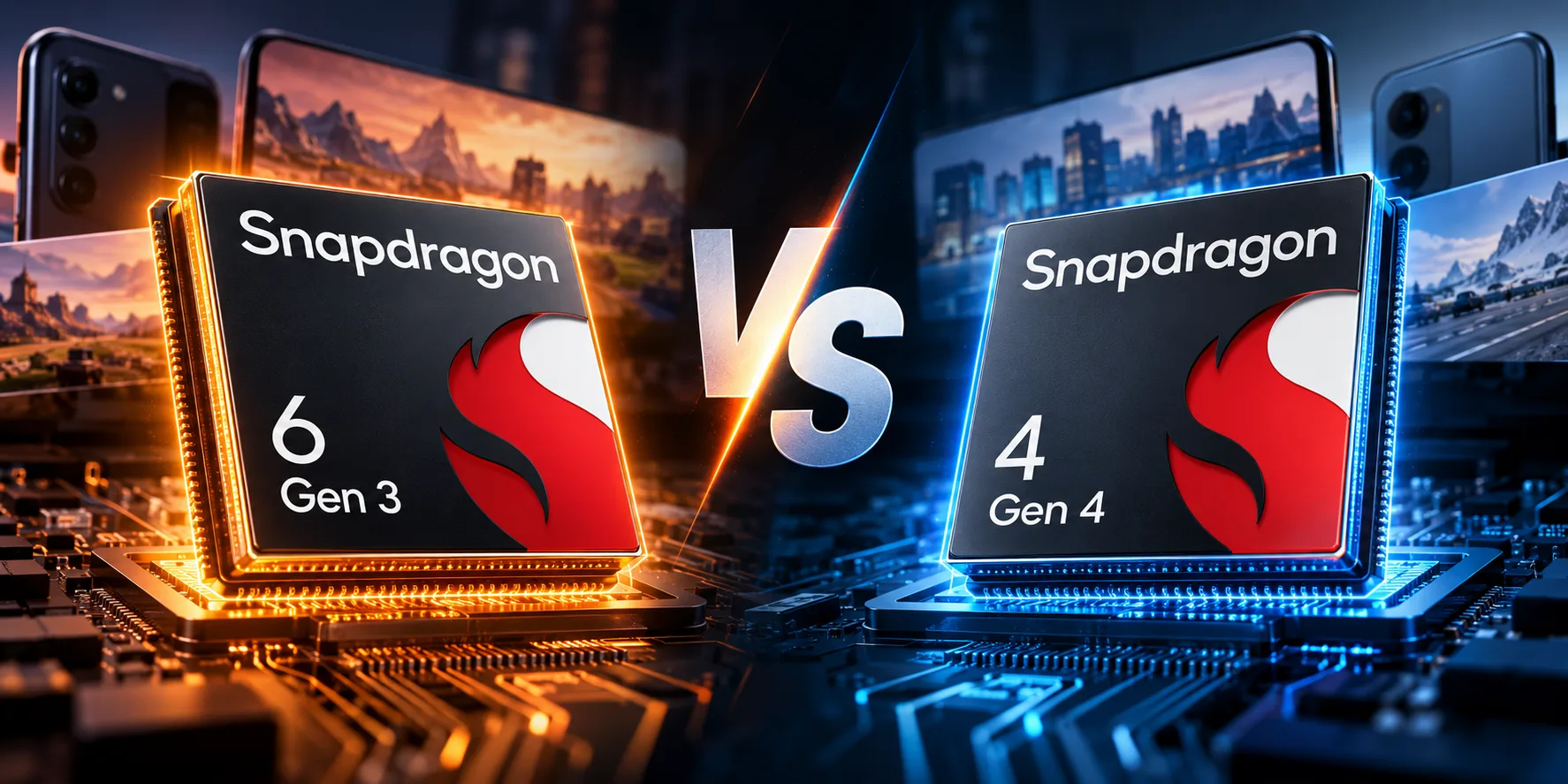
Qualcomm Snapdragon 6 Gen 3
vs
Qualcomm Snapdragon 4 Gen 4

SoC Comparison Result
Snapdragon 6 Gen 3 vs. Snapdragon 4 Gen 4: Performance and Benchmark Comparison
The Snapdragon 4 Gen 4 was released after the Snapdragon 6 Gen 3, but it belongs to a lower tier and is noticeably slower. The difference is small in single-threaded Geekbench 6, but increases to roughly one-third in Multi-Core. The Snapdragon 6 Gen 3 has an even greater advantage in graphics tests.
Both processors are manufactured using Samsung’s 4 nm process and support 5G, LPDDR5, and UFS 3.1. The main differences are the CPU configuration and GPU performance.
Key Differences
| Specification | Snapdragon 6 Gen 3 | Snapdragon 4 Gen 4 |
|---|---|---|
| Release year | 2024 | 2025 |
| CPU | 4x Cortex-A78 up to 2.4 GHz + 4x Cortex-A55 up to 1.8 GHz | 2x Cortex-A78 up to 2.3 GHz + 6x Cortex-A55 up to 2.0 GHz |
| Cores | 8 | 8 |
| Process | 4 nm Samsung | 4 nm Samsung |
| GPU | Adreno 710* | Adreno 613* |
| Memory | LPDDR5 up to 3200 MHz, LPDDR4X | LPDDR5 up to 3200 MHz, LPDDR4X |
| Storage | UFS 3.1 | UFS 3.1 |
| Wi-Fi | Wi-Fi 6 / 6E | Wi-Fi 5 |
| Maximum 5G speed | up to 2.9 Gbps | up to 2.5 Gbps |
* On its official pages, Qualcomm lists only the Adreno name without a numerical index. The Adreno 710 and Adreno 613 designations are used in data from production devices and diagnostic databases.
The Snapdragon 6 Gen 3 has four high-performance Cortex-A78 cores, while the Snapdragon 4 Gen 4 has two. The maximum clock speed differs by only 100 MHz, so the difference in single-threaded workloads is small.
Performance in Real Smartphones
| Smartphone | Processor | Geekbench 6 Single | Geekbench 6 Multi | AnTuTu 11 |
|---|---|---|---|---|
| POCO M8 5G | Snapdragon 6 Gen 3 | 1015 | 2981 | 859 658 |
| Samsung Galaxy A36 5G | Snapdragon 6 Gen 3 | 1004 | 2919 | 844 447 |
| Redmi Note 15 5G | Snapdragon 6 Gen 3 | 991 | 2972 | 830 765 |
| POCO M8 Power 5G | Snapdragon 4 Gen 4 | 952 | 2269 | 625 331 |
| Honor 600 Smart | Snapdragon 4 Gen 4 | 927 | 2205 | 570 353 |
| Redmi Note 17 | Snapdragon 4 Gen 4 | 900 | 2178 | 593 849 |
Across the three selected smartphones with the Snapdragon 6 Gen 3, the average score is about 1003 points in Geekbench 6 Single-Core and 2957 points in Multi-Core. The three models with the Snapdragon 4 Gen 4 average approximately 926 and 2217 points, respectively.
The difference in single-threaded performance is about 8%. In Multi-Core, the Snapdragon 6 Gen 3’s advantage increases to approximately 33%.
The average AnTuTu 11 score is about 845,000 versus 597,000 points, meaning the difference reaches approximately 42%. AnTuTu is more heavily influenced by memory, storage, and the smartphone’s software settings, so the variation between devices is greater here than in Geekbench.
GPU: The Biggest Difference Between the Processors
The largest gap is visible in graphics tests.
Production devices with the Snapdragon 6 Gen 3 use the Adreno 710, while the Snapdragon 4 Gen 4 is identified with the Adreno 613.
| Smartphone | Processor | 3DMark Wild Life Extreme |
|---|---|---|
| Samsung Galaxy A36 5G | Snapdragon 6 Gen 3 | 912 |
| POCO M8 5G | Snapdragon 6 Gen 3 | 862 |
| Sony Xperia 10 VII | Snapdragon 6 Gen 3 | 865 |
| POCO M8 Power 5G | Snapdragon 4 Gen 4 | 188-191 |
| Redmi Note 17 | Snapdragon 4 Gen 4 | 183 |
The average score of the three Snapdragon 6 Gen 3 models is about 880 points. Smartphones with the Snapdragon 4 Gen 4 score approximately 185-190 points.
The gap is about 4.7 times.
The Adreno 613 is designed for games with a low graphics workload. More demanding titles generally require low settings. The Adreno 710 is noticeably faster and better suited to more demanding games.
Why the Snapdragon 4 Gen 4 Is Slower Despite Being Newer
The Snapdragon 4 Gen 4 was released later, but it belongs to Qualcomm’s lower-tier series. Both chips use Cortex-A78 and Cortex-A55 cores, but the Snapdragon 6 Gen 3 has four high-performance cores instead of two and a significantly faster GPU.
Memory and Storage
Both platforms support LPDDR5 and UFS 3.1, but manufacturers may use slower memory and storage in specific smartphones.
For example, some Snapdragon 4 Gen 4 devices come with LPDDR4X and UFS 2.2. Therefore, an AnTuTu result depends not only on the SoC, but also on the memory, storage, and software of the specific device.
Geekbench 6 more accurately reflects the difference in CPU performance, while AnTuTu evaluates the smartphone as a whole.
Snapdragon 6 Gen 3 or Snapdragon 4 Gen 4
The Snapdragon 6 Gen 3 is faster in all major tests. Based on the selected production smartphones, the difference is about 8% in Geekbench 6 Single-Core, approximately 33% in Multi-Core, and around 42% in AnTuTu 11.
The GPUs differ particularly significantly. In 3DMark Wild Life Extreme, Snapdragon 6 Gen 3 devices score approximately 860-910 points, while the Snapdragon 4 Gen 4 scores roughly 180-190 points.
The Snapdragon 4 Gen 4 is aimed at budget 5G smartphones. The Snapdragon 6 Gen 3 is noticeably faster in multithreaded tasks and almost five times faster in Wild Life Extreme.
At a similar price, a Snapdragon 6 Gen 3 smartphone offers substantially higher performance, especially in games. The Snapdragon 4 Gen 4 should primarily be considered in significantly cheaper smartphones.
Advantages
- Higher Frequency: 2400 MHz (2400 MHz vs 2300 MHz)
- Newer Launch Date: December 2025 (September 2024 vs December 2025)
Basic
4x 1.8 GHz – Cortex-A55
6x 2 GHz – Cortex-A55
GPU Specifications
Connectivity
Memory Specifications
Miscellaneous
- AIFF
- CAF
- MP3
- MP4
- WAV
- H.265
- VP9
Benchmarks
Related SoC Comparisons


Share in social media
Or Link To Us
<a href="https://cputronic.com/index.php/soc/compare/qualcomm-snapdragon-6-gen-3-vs-qualcomm-snapdragon-4-gen-4" target="_blank">Qualcomm Snapdragon 6 Gen 3 vs Qualcomm Snapdragon 4 Gen 4</a>