MediaTek Helio G99
vs
Qualcomm Snapdragon 680

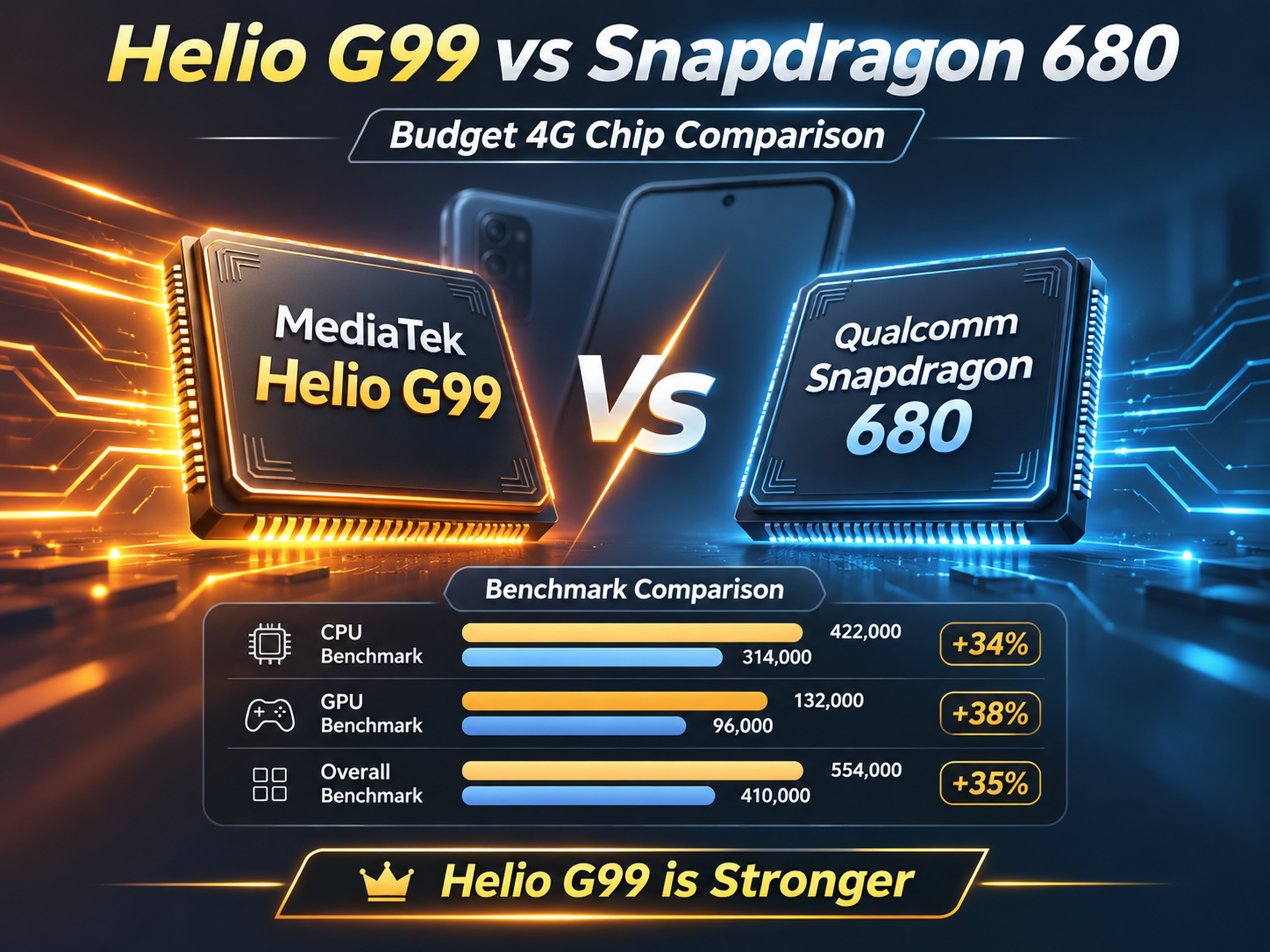
SoC Comparison Result
Helio G99 vs. Snapdragon 680: How Much Faster Is the MediaTek Processor?
The MediaTek Helio G99 and Qualcomm Snapdragon 680 are used in budget smartphones with 4G support. Both chips are manufactured using a 6 nm process, but the Helio G99 features newer CPU cores and graphics. In Geekbench 6, it scores approximately 76% higher in the single-core test and 44% higher in the multi-core test. In games, the difference depends on the graphics workload and the specific smartphone.
Key Differences Between the Helio G99 and Snapdragon 680
Both processors have eight cores, but they use different architectures. The Helio G99 has two high-performance Cortex-A76 cores, while the Snapdragon 680 is equipped with four older Cortex-A73 cores.
| Specification | MediaTek Helio G99 | Snapdragon 680 |
|---|---|---|
| Release date | May 2022 | October 2021 |
| Performance cores | 2 × Cortex-A76, 2.2 GHz | 4 × Cortex-A73, 2.4 GHz |
| Efficiency cores | 6 × Cortex-A55, 2.0 GHz | 4 × Cortex-A53, 1.9 GHz |
| GPU | Mali-G57 MC2 | Adreno 610 |
| Display refresh rate | Up to 120 Hz at Full HD+ | Up to 90 Hz at Full HD+ |
| Maximum camera resolution | 108 MP | 64 MP |
| Bluetooth | 5.2 | 5.1 |
Despite the Cortex-A73’s higher clock speed, the Snapdragon 680 trails the Helio G99 in single-core performance. Cortex-A76 cores execute more instructions per clock, giving the Helio G99 an advantage even with fewer performance cores.
Another difference is the number and generation of the efficiency cores. The Helio G99 has six of them, and its Cortex-A55 cores are newer than the Cortex-A53 cores used in the Snapdragon 680. These cores handle background processes and lightly loaded applications.
Both chips support LPDDR4X RAM and UFS 2.2 storage. Application launch speed is also affected by the amount of memory and the storage specifications.
Performance in Geekbench 6 and AnTuTu
The table lists results from five smartphones with the Helio G99 and Snapdragon 680.
| Smartphone | Processor | Geekbench 6 Single | Geekbench 6 Multi | AnTuTu 11 |
|---|---|---|---|---|
| Tecno Pova 5 | Helio G99 | 734 | 1,984 | 555,991 |
| Samsung Galaxy A15 4G | Helio G99 | 708 | 1,862 | 522,075 |
| Xiaomi Redmi Note 11 | Snapdragon 680 | 415 | 1,435 | 427,429 |
| Xiaomi Redmi 10C | Snapdragon 680 | 413 | 1,173 | 421,228 |
| Samsung Galaxy A23 4G | Snapdragon 680 | 405 | 1,361 | 398,643 |
Geekbench 6 results are from individual runs on the specified devices. AnTuTu 11 figures are aggregated model results. Values may vary depending on the firmware, memory capacity, temperature, and testing conditions.
Aggregate platform results make it possible to assess the difference without tying it to a single smartphone.
| Benchmark | Helio G99 | Snapdragon 680 | G99 Advantage |
|---|---|---|---|
| Geekbench 6 Single | 727 | 412 | +76% |
| Geekbench 6 Multi | 2,047 | 1,423 | +44% |
| AnTuTu 11 | 554,590 | 424,216 | +31% |
| 3DMark Wild Life Extreme | 346 | 172 | +101% |
The Helio G99’s biggest lead over the Snapdragon 680 comes in the Geekbench 6 single-core test. The main reason is the higher per-clock performance of the Cortex-A76.
The gap narrows in the multi-core test. The Snapdragon 680 benefits from having four Cortex-A73 performance cores, but they cannot fully offset the advantage of the newer architecture.
The difference in AnTuTu 11 is approximately 31%. In addition to the CPU, this test takes graphics, RAM, and storage into account.
Graphics and Gaming Performance
The Helio G99 is equipped with Mali-G57 MC2 graphics, while the Snapdragon 680 uses the Adreno 610.
In 3DMark Wild Life Extreme, the Helio G99 scores approximately 346 points compared with 172 for the Snapdragon 680. MediaTek’s result is about twice as high, but the difference in games may be considerably smaller.
Results from two games on specific smartphones:
| Game and settings | Helio G99 | Snapdragon 680 |
|---|---|---|
| Shadowgun Legends, Low | 91 FPS | 65 FPS |
| Mobile Legends: Bang Bang, Ultra | 55 FPS | 54 FPS |
The results apply to the Cubot X70 with the Helio G99 and the Xiaomi Redmi Note 11 with the Snapdragon 680. The tests were conducted on different devices, and the measurement conditions may have varied.
In Shadowgun Legends, the Helio G99 delivers approximately 40% more frames per second. In Mobile Legends, the difference is practically nonexistent. Thus, a twofold advantage in 3DMark does not guarantee the same increase in FPS.
In demanding games, including Genshin Impact, graphics settings must be reduced on both chips. The Helio G99 provides more performance headroom, while the Snapdragon 680 places greater limits on the available settings.
During extended gaming sessions, smartphone heat may cause the processor clock speeds and FPS to drop. Sustained performance therefore also depends on the cooling system.
Power Consumption and Battery Life
Both processors are manufactured by TSMC using a 6 nm process. The Helio G99’s newer cores give it a performance advantage, but they do not guarantee better battery life.
Battery life depends on battery capacity, the display, firmware, and the type of workload. Without directly comparing smartphones under identical conditions, it is impossible to determine which chip is more power-efficient.
Cameras, Video Recording, and Connectivity
The Helio G99 supports cameras with resolutions of up to 108 MP, while the Snapdragon 680 supports up to 64 MP. These are the chips’ stated capabilities, not the specifications of the cameras in specific smartphones. Photo quality depends on the sensor, optics, and image-processing algorithms.
The Snapdragon 680 features a triple Spectra 346 ISP capable of processing images from multiple cameras simultaneously.
The Helio G99 also has three image-processing blocks (ISPs) and supports hardware noise reduction, electronic stabilization, and depth-processing functions.
Video-recording capabilities differ:
- Helio G99: hardware video encoding of up to 2K at 30 FPS or Full HD at 60 FPS.
- Snapdragon 680: video recording of up to Full HD at 60 FPS.
The Helio G99 supports video recording at a higher resolution, although the smartphone manufacturer may not include the corresponding mode in the camera app.
Both chips operate on 4G LTE networks and do not support 5G. The Helio G99 has an LTE Cat.13 modem, while the Snapdragon 680 uses the Snapdragon X11 LTE modem. Actual data-transfer speeds depend on the supported bands and the carrier’s network.
Which Processor Should You Choose?
The Helio G99 is faster than the Snapdragon 680 in CPU and graphics tests. The advantage is especially noticeable under high CPU loads, although the difference in games depends on the specific title and settings.
The Snapdragon 680 provides sufficient performance for browsing, messaging, video, and simple games. The Helio G99 is better suited to demanding applications and games, but both processors are too weak for modern titles at high graphics settings.
Several factors should be considered when choosing a smartphone:
- Performance. At a comparable price, the Helio G99 is preferable.
- Price. The Snapdragon 680 makes sense if the smartphone is noticeably cheaper.
- Display and memory. A higher-quality display or larger memory capacity may matter more than the difference in speed.
- Software support. When buying in 2026, consider the smartphone’s age and the availability of Android updates.
Bottom line: The MediaTek Helio G99 wins the performance comparison in both CPU and GPU performance. At the same price and with similar smartphone specifications, it is the better choice. The Snapdragon 680 is worth considering primarily in inexpensive devices with a good display, sufficient memory, and an appropriate period of software support.
Advantages
- Newer Launch Date: May 2022 (May 2022 vs October 2021)
- Higher Frequency: 2400 MHz (2200 MHz vs 2400 MHz)
Basic
4x 1.9 GHz – Kryo 265 Silver (Cortex-A53)
GPU Specifications
Connectivity
Memory Specifications
Miscellaneous
Benchmarks
Related SoC Comparisons



Share in social media
Or Link To Us
<a href="https://cputronic.com/index.php/soc/compare/mediatek-helio-g99-vs-qualcomm-snapdragon-680" target="_blank">MediaTek Helio G99 vs Qualcomm Snapdragon 680</a>