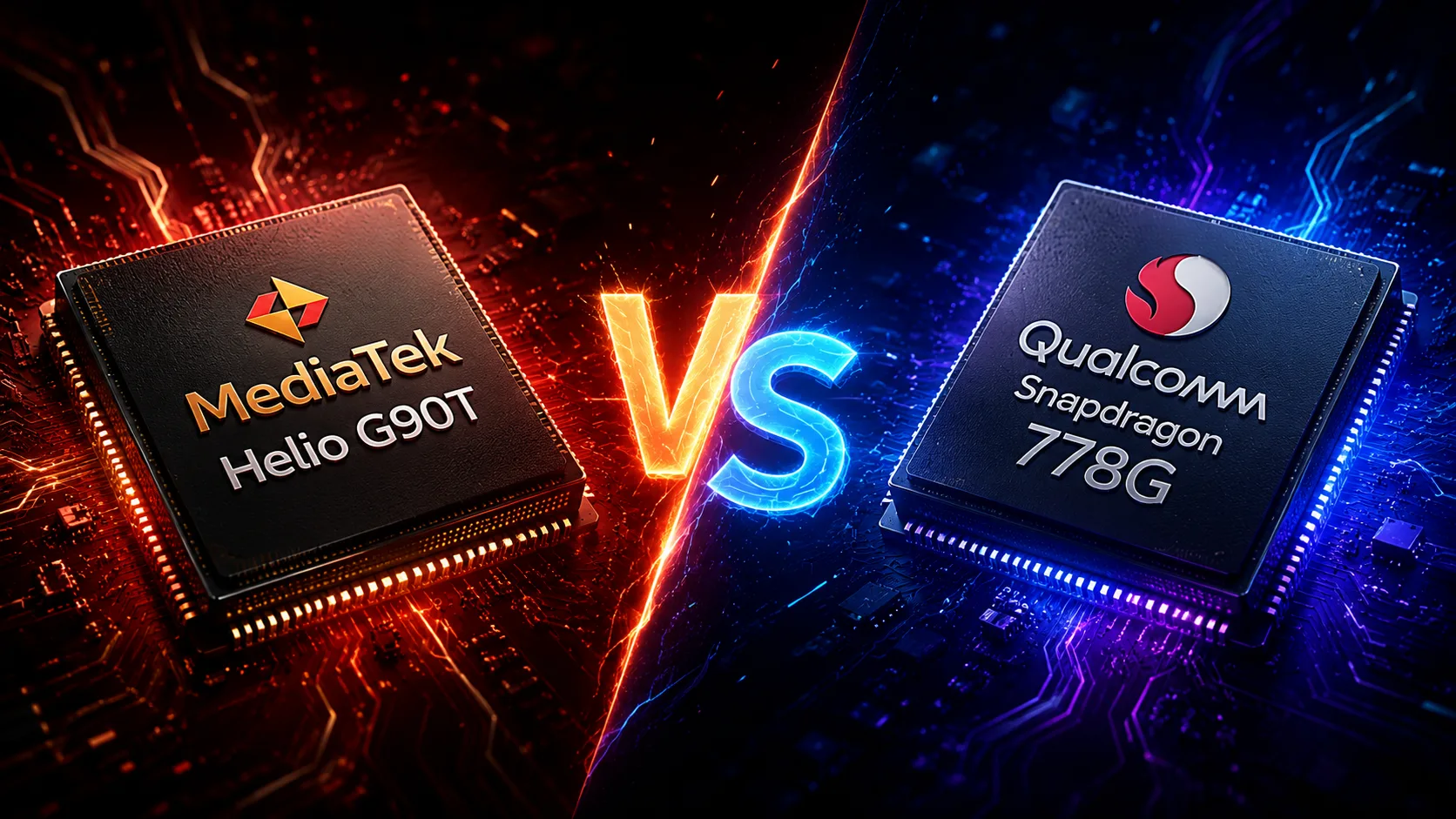
MediaTek Helio G90T
vs
Qualcomm Snapdragon 778G

SoC Comparison Result
MediaTek Helio G90T vs Snapdragon 778G: Is It Worth Comparing Them Today?
The Helio G90T once made budget smartphones significantly faster, but the Snapdragon 778G was released almost two years later and belongs to a different generation. It features a 6nm manufacturing process, more powerful graphics, 5G support, and modern wireless interfaces. Therefore, the question is not which chip will win, but rather how significant the gap is and whether the low price of older smartphones using the G90T justifies it.
CPU Performance
The MediaTek Helio G90T uses two high-performance Cortex-A76 cores clocked up to 2.05 GHz and six Cortex-A55 cores. For 2019, this was a strong configuration: smartphones using this chip significantly outperformed many budget models in applications, browsers, and multitasking.
The Snapdragon 778G is built on the newer Kryo 670 architecture and operates at frequencies up to 2.4 GHz. It is faster in both single-core and multi-core workloads. The difference is especially noticeable when processing photos, installing apps, unpacking files, and navigating heavy web pages.
The Helio G90T still handles messaging apps, video playback, navigation, and common applications. However, its performance headroom is noticeably less, and smartphones on this platform are showing signs of age, both technically and physically.
Gaming and Stability Under Load
The main advantage of the Helio G90T at its launch was its Mali-G76 MC4 graphics. MediaTek promoted the chip as a gaming solution for affordable smartphones, with support for displays up to 90 Hz appearing as a strong selling point back then.
The Snapdragon 778G uses the Adreno 642L and is significantly better suited for modern games. It more often allows for higher settings, maintains stable frame rates for longer periods, and handles demanding graphical scenes more confidently.
The difference is not only due to the GPU's power. The Helio G90T is manufactured using a 12nm process, while the Snapdragon 778G is built on a 6nm process. The newer chip is more energy-efficient and relies less on aggressive frequency scaling during prolonged loads.
The specific results are still determined by the smartphone's casing and cooling system. A poorly cooled device on the Snapdragon 778G can lose to a well-optimized model in a short test, but on average, Qualcomm's platform is significantly more stable.
Connectivity and Wireless Interfaces
The Helio G90T is limited to 4G networks. For calls, messaging, and streaming video, this is still sufficient, especially in areas where 5G has yet to become widespread.
The Snapdragon 778G is equipped with the Snapdragon X53 modem, supporting 5G. It also features Wi-Fi 6E and Bluetooth 5.2, while the Helio G90T is limited to Wi-Fi 5 and Bluetooth 5.0.
In practice, Wi-Fi 6E is more important for the consistent operation in congested wireless networks than for maximum speed specifications. However, both the smartphone and router must support the corresponding standard.
Cameras and Image Processing
The Helio G90T supports cameras with resolutions of up to 64 MP and can record 4K video at 30 frames per second. For its time, this was adequate for manufacturers to release budget models with multiple cameras and acceptable video quality.
The Snapdragon 778G features a more powerful triple ISP, the Spectra 570L. It can process data from multiple cameras simultaneously, supports sensors with resolutions up to 200 MP, and records 4K HDR videos as well as HDR10+.
A higher megapixel count does not guarantee a good camera by itself. However, the new ISP combines multiple frames faster, processes HDR more efficiently, and gives manufacturers greater capabilities for night shooting and switching between lenses.
The more modern AI block in the Snapdragon 778G is also utilized for scene recognition, portrait processing, and background camera functions. Directly comparing the advertised TMAC and TOPS is not fair; MediaTek and Qualcomm use different methods for counting.
What Matters More in Practice
| Scenario | Stronger Chip |
|---|---|
| Modern gaming | Snapdragon 778G |
| Stability under prolonged load | Snapdragon 778G |
| Battery life with comparable capacity | Snapdragon 778G |
| Cameras and video processing | Snapdragon 778G |
| 5G and modern wireless networks | Snapdragon 778G |
| Minimum price of old smartphone | Helio G90T |
Should You Buy a Smartphone with Helio G90T?
Currently, the Helio G90T makes sense only at a very low device price. Such smartphones can still be used for calls, social media, videos, and less demanding games, but you shouldn't expect a high performance margin.
When purchasing a used model, it's essential to check the condition of the battery, display, and body. A worn-out battery and poor cooling can significantly diminish the user experience more than differences in synthetic benchmark results.
The Snapdragon 778G cannot be labeled as a new chip either, but smartphones based on it typically handle modern applications and games better. Additionally, they are more often equipped with faster storage, higher-quality displays, and current wireless interfaces.
Conclusion
The Snapdragon 778G outperforms in almost all scenarios. It is faster, more energy-efficient, better suited for gaming, supports 5G, and features a more powerful image processing system.
The Helio G90T remains an essential chip in MediaTek's history: it helped the company establish itself in the affordable gaming smartphone segment. However, today, its only significant advantage is the low price of the devices.
Choosing a smartphone with the Helio G90T is worthwhile only if substantial savings are evident. With only a slight price difference, the Snapdragon 778G would be a significantly more sensible purchase.
Advantages
- Higher Technology: 6 nm (12 nm vs 6 nm)
- Higher Frequency: 2400 MHz (2050 MHz vs 2400 MHz)
- Newer Launch Date: May 2021 (July 2019 vs May 2021)
Basic
6x 2 GHz – Cortex-A55
3x 2.2 GHz – Kryo 670 Gold (Cortex-A78)
4x 1.9 GHz – Kryo 670 Silver (Cortex-A55)
GPU Specifications
Connectivity
Memory Specifications
Miscellaneous
Benchmarks
Related SoC Comparisons


Share in social media
Or Link To Us
<a href="https://cputronic.com/index.php/soc/compare/mediatek-helio-g90t-vs-qualcomm-snapdragon-778g" target="_blank">MediaTek Helio G90T vs Qualcomm Snapdragon 778G</a>