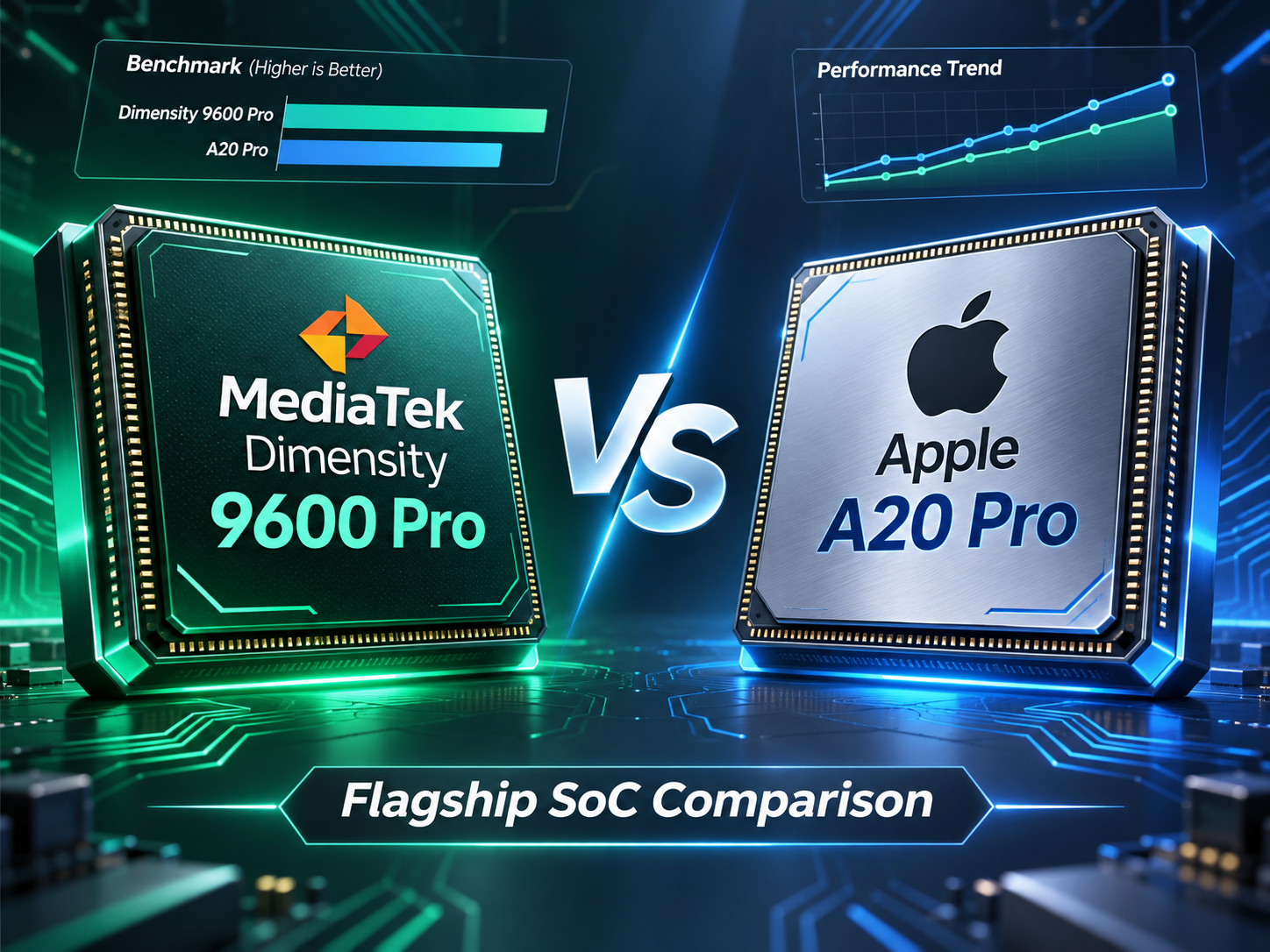
MediaTek Dimensity 9600 Pro
vs
Apple A20 Pro

SoC Comparison Result
MediaTek Dimensity 9600 Pro vs Apple A20 Pro: Specifications and Performance Comparison
Apple A20 Pro is faster than MediaTek Dimensity 9600 Pro in the single-threaded Geekbench 6 test, but the difference between them is considerably smaller in multithreaded workloads. Both processors are manufactured using TSMC’s 2nm process. Apple uses six in-house CPU cores, while MediaTek uses eight Arm cores. Graphics tests do not identify a clear leader: the results depend on the workload and the specific smartphone.
Differences in Specifications
| Specification | Dimensity 9600 Pro | Apple A20 Pro |
|---|---|---|
| CPU | 8 Arm C2 cores | 6 Apple cores |
| Configuration | 2 + 3 + 3 | 2 + 4 |
| Maximum frequency | 4.55 GHz | 4.93 GHz |
| Graphics | Mali-G2 Ultra NX | Apple GPU, 7 cores |
| RAM | LPDDR6, LPDDR5X | LPDDR5X |
| Storage interface | UFS 5.0 | NVMe |
| Neural processor | NPU 1090 + NPU 2.0 | Dual 16-core Neural Engine |
| Smartphones | Vivo X500 Pro Max, OPPO Find X10 Pro Max | iPhone 18 Pro, iPhone 18 Pro Max |
Both processors were introduced in September 2026. The Dimensity 9600 Pro is designed for flagship Android smartphones, while the A20 Pro is used in the iPhone 18 Pro and Pro Max.
CPU Architecture
The Dimensity 9600 Pro has two Arm C2-Ultra cores clocked at up to 4.55 GHz, three C2-Pro cores reaching up to 4.35 GHz, and another three C2-Pro cores reaching up to 3.10 GHz. It has 16 MB of L3 cache and 10 MB of system cache.
The A20 Pro has two high-performance Apple architecture cores clocked at up to 4.93 GHz and four efficiency cores.
The A20 Pro delivers higher single-core performance. In multithreaded workloads, the Dimensity 9600 Pro achieves similar results thanks to its eight-core configuration. However, comparing only the number of cores and clock speeds does not provide a reliable assessment of the performance difference because the processor architectures are substantially different.
Geekbench 6: Comparing Specific Smartphones
The table shows Geekbench 6 results for four smartphones. The Vivo result was obtained by testing a retail device, while the OPPO was tested at a temperature of approximately 25°C. The iPhone figures were taken from separate Geekbench Browser entries.
| Smartphone | Processor | Single-Core | Multi-Core |
|---|---|---|---|
| Vivo X500 Pro Max | Dimensity 9600 Pro | 3,755 | 11,227 |
| OPPO Find X10 Pro Max | Dimensity 9600 Pro | 3,975 | 12,191 |
| iPhone 18 Pro | Apple A20 Pro | 4,608 | 12,266 |
| iPhone 18 Pro Max | Apple A20 Pro | 4,711 | 12,789 |
In Single-Core, the iPhone 18 Pro is approximately 16% faster than the OPPO and 23% faster than the Vivo. The difference is most significant in tasks that use one or two cores.
In Multi-Core, the gap narrows. The iPhone 18 Pro is only 0.6% faster than the OPPO, although its advantage over the Vivo reaches 9.3%.
The aggregate processor scores differ from the results of the listed smartphones:
| Processor | Single-Core | Multi-Core |
|---|---|---|
| Dimensity 9600 Pro | 4,346 | 13,052 |
| Apple A20 Pro | 4,713 | 12,599 |
According to these figures, the A20 Pro is 8.4% faster in Single-Core, while the Dimensity 9600 Pro leads it by 3.6% in Multi-Core.
Geekbench 6 results are affected by firmware, power settings, and device temperature. Therefore, the scores of individual smartphones do not always match the aggregate processor figures.
In AnTuTu 12, the Vivo X500 Pro Max scored 4,264,941 points in one published review. Another run of version 12.0.1 produced a score of 4,460,761 points-4.6% higher. Comparing these results directly with the A20 Pro would be incorrect because of the differences between Android and iOS.
Graphics Performance: 3DMark
The Dimensity 9600 Pro is equipped with the Arm Mali-G2 Ultra NX graphics accelerator with hardware ray tracing. The A20 Pro uses a seven-core Apple GPU that also supports ray tracing.
The table lists median scores from the UL Benchmarks database.
| Smartphone | Steel Nomad Light | Wild Life Extreme |
|---|---|---|
| OPPO Find X10 Pro Max | 3,809 | 6,716 |
| iPhone 18 Pro | 3,708 | 7,916 |
| iPhone 18 Pro Max | 3,775 | 8,059 |
In Steel Nomad Light, the OPPO leads the iPhone 18 Pro by 2.7% and the Pro Max by less than 1%. This gap is too small to conclude that the OPPO has an advantage in games.
Apple’s smartphones lead in Wild Life Extreme. The iPhone 18 Pro scores approximately 18% higher than the OPPO, while the Pro Max leads by 20%.
The advantage depends on the graphics workload: Steel Nomad Light does not reveal a significant difference, while Apple is faster in Wild Life Extreme.
Gaming Performance
In published tests, smartphones with the Dimensity 9600 Pro achieved the following results:
| Smartphone | Game | Average FPS | Duration |
|---|---|---|---|
| Vivo X500 Pro Max | Genshin Impact | 60.09 | 30 min |
| OPPO Find X10 Pro Max | Genshin Impact | 59.0 | 15 min |
| Vivo X500 Pro Max | Honor of Kings | 120.11 | 30 min |
The Vivo X500 Pro Max delivered 60.09 FPS in Genshin Impact at maximum settings with a 60 FPS limit. Its 1% Low result was 59.4 FPS. No noticeable frame-rate drops were observed in this test.
The OPPO Find X10 Pro Max achieved 59.0 FPS in Genshin Impact over 15 minutes at maximum settings. The test was conducted in high-performance mode.
In Honor of Kings, the Vivo averaged 120.11 FPS over 30 minutes, with a 1% Low result of 109.2 FPS.
The tests were conducted under different conditions, so the small difference between the Vivo and OPPO does not prove that one smartphone is superior to the other. There are not enough comparable gaming measurements for the iPhone 18 Pro using the same settings and scenes.
Power Consumption and Cooling
In tests of the OPPO Find X10 Pro Max at room temperature, Geekbench 6 produced scores of 3,975 in Single-Core and 12,191 in Multi-Core. With additional cooling, the scores increased to 4,273 and 12,754.
With additional cooling, the OPPO scored 3,938 points in Steel Nomad Light, compared with 3,584 points without cooling-almost 10% higher.
The Vivo X500 Pro Max also reduced its performance under a sustained synthetic workload. During the 30-minute Genshin Impact test, however, the smartphone maintained approximately 60 FPS.
These figures cannot determine which processor is more energy-efficient. Such a comparison requires measurements of power consumption under the same workload, not just Geekbench and 3DMark scores.
Memory and Artificial Intelligence
The Dimensity 9600 Pro supports LPDDR6 and UFS 5.0, although smartphone manufacturers may use earlier standards. For example, the Vivo X500 Pro Max is equipped with LPDDR5X RAM and UFS 4.1 storage.
The A20 Pro supports LPDDR5X and uses an NVMe storage interface. Apple claims a 50% increase in memory bandwidth compared with the A19 Pro. This is a comparison within Apple’s lineup, not with a MediaTek processor.
AI computations on the Dimensity 9600 Pro are handled by the NPU 1090 and a separate energy-efficient NPU 2.0. MediaTek claims support for MoE models with more than 30 billion parameters through hardware compression mechanisms.
The A20 Pro is equipped with a Dual 16-core Neural Engine. According to Apple, its computing power for AI tasks is twice that of the previous generation.
The stated AI figures do not provide a direct comparison of neural processor speeds. Such a comparison requires testing the same models on both chips.
Advantages of Each Processor
- Apple A20 Pro: Higher single-threaded performance and an advantage in 3DMark Wild Life Extreme. It is suitable for users who prefer iOS and want a smartphone with high CPU performance.
- MediaTek Dimensity 9600 Pro: Similar multithreaded performance, competitive graphics, and support for LPDDR6 and UFS 5.0. It is used in high-performance Android smartphones.
- For gaming: The difference between the processors does not always determine the result. Cooling, power settings, and the specific device’s FPS stability are important.
Conclusion
The Apple A20 Pro outperforms the Dimensity 9600 Pro in Geekbench 6 Single-Core. The difference is considerably smaller in Multi-Core: aggregate scores give MediaTek a slight advantage, but Apple is faster in the listed smartphone tests.
The graphics test results are mixed. The OPPO Find X10 Pro Max is slightly faster than the iPhone 18 Pro in Steel Nomad Light, but it trails it by approximately 18% in Wild Life Extreme. When choosing a smartphone, it is worth considering the specific model’s performance under sustained load, rather than only the maximum benchmark scores.
Advantages
- Newer Launch Date: September 2026 (September 2026 vs September 2026)
- Higher Frequency: 4.93 GHz (4.55 GHz vs 4.93 GHz)
Basic
GPU Specifications
Connectivity
Memory Specifications
Miscellaneous
Benchmarks
Comparison of Devices
Related SoC Comparisons




Share in social media
Or Link To Us
<a href="https://cputronic.com/index.php/soc/compare/mediatek-dimensity-9600-pro-vs-apple-a20-pro" target="_blank">MediaTek Dimensity 9600 Pro vs Apple A20 Pro</a>