MediaTek Dimensity 8500
vs
Qualcomm Snapdragon 8 Gen 2

SoC Comparison Result
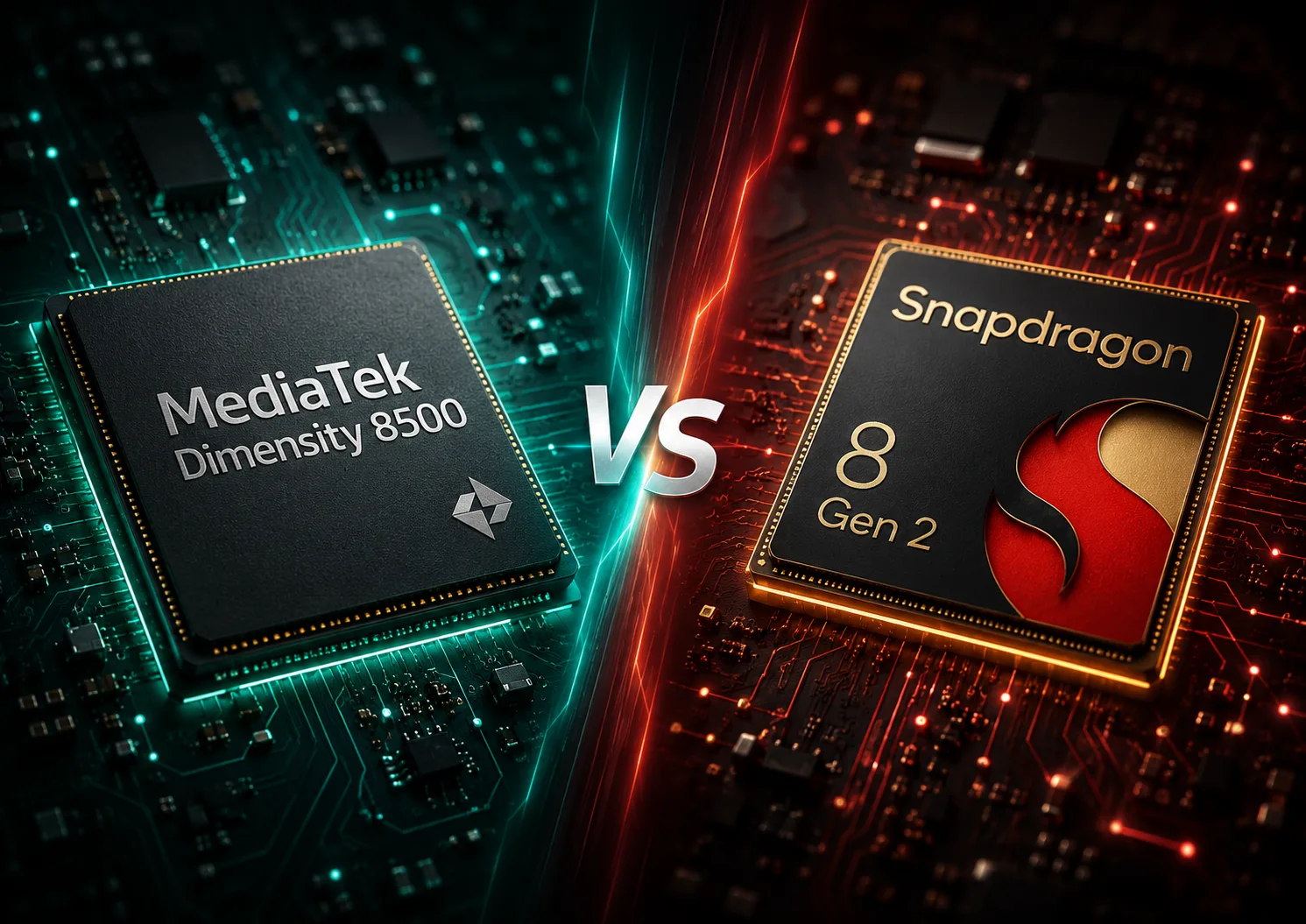
MediaTek Dimensity 8500 vs Qualcomm Snapdragon 8 Gen 2: New Sub-Flagship vs Old Flagship
MediaTek Dimensity 8500 and Qualcomm Snapdragon 8 Gen 2 are chips from different eras. The Snapdragon 8 Gen 2 was launched as a flagship platform for high-end Android smartphones. The Dimensity 8500 is a newer premium chip that encroaches on the territory of former flagships.
The intrigue is not about which SoC is newer. The more practical question is: what is more beneficial in a real smartphone - the fresh performance of the Dimensity 8500 or the older, but full-fledged flagship package of the Snapdragon 8 Gen 2?
CPU: Many Strong Cores vs One Main Core
The Dimensity 8500 is built on an all-big-core scheme: one Cortex-A725 up to 3.4 GHz, three Cortex-A725 up to 3.2 GHz, and four Cortex-A725 up to 2.2 GHz. There are no small Cortex-A5xx cores here - all eight cores belong to the performance class.
The Snapdragon 8 Gen 2 is arranged differently: one Cortex-X3, two Cortex-A715, two Cortex-A710, and three Cortex-A510. This is the classic flagship scheme of its time: a powerful main core for short heavy tasks, performance cores for multi-threading, and small cores for background load.
This leads to a difference in behavior. The Dimensity 8500 performs better in multi-core tasks: heavy applications, photo processing, multitasking. The Snapdragon 8 Gen 2 is stronger in single-core performance, so in user interface, browser, and short bursts, it doesn’t seem outdated.
Benchmarks: Dimensity is Faster in Overall Score, Snapdragon in Single-Core
According to available aggregated tests, the Dimensity 8500 significantly outperforms the Snapdragon 8 Gen 2 in AnTuTu and Geekbench Multi-Core. However, in Geekbench Single-Core, the Snapdragon 8 Gen 2 remains ahead.
| Test | MediaTek Dimensity 8500 | Qualcomm Snapdragon 8 Gen 2 | Who's Ahead |
|---|---|---|---|
| AnTuTu 11 | 2,153,969 | 1,752,044 | Dimensity 8500 |
| Geekbench 6 Single-Core | 1,721 | 2,033 | Snapdragon 8 Gen 2 |
| Geekbench 6 Multi-Core | 6,716 | 5,558 | Dimensity 8500 |
The numbers effectively illustrate the character of the chips: MediaTek delivers overall multi-threaded power, while Qualcomm relies on a strong main core. However, this is not guaranteed for every smartphone. Cooling, build quality, memory, firmware, and power limits all affect the final speed.
What’s most telling here is not just that the Dimensity 8500 scores higher in AnTuTu. More importantly, the level that was recently considered flagship is gradually moving into the upper mid-range. The Snapdragon 8 Gen 2 hasn't become weak; the market has simply caught up from below.
Gaming and Graphics: Mali vs Adreno
The Dimensity 8500 features the Mali-G720 MC8. This is modern graphics for heavy Android games, high FPS, and screens with increased refresh rates. In synthetic benchmarks, this combination looks very confident.
The Snapdragon 8 Gen 2 uses the Adreno 740. It's older, but still a powerful graphics chip with a good gaming reputation. Qualcomm’s strengths lie not only in performance but also in drivers, optimizations for popular games, and the large number of smartphones using this chip.
Thus, in games, it won’t be the SoC's name that determines the victor, but the specific smartphone: cooling, power limits, screen frequency, and FPS stability. The Dimensity 8500 may look faster on paper, but a good flagship on the Snapdragon 8 Gen 2 can still provide a more predictable gaming experience.
Where Snapdragon 8 Gen 2 Still Looks Like a Flagship
The power of the Snapdragon 8 Gen 2 lies not only in the CPU and GPU. It’s an overall platform: 18-bit triple ISP, Cognitive ISP, Snapdragon X70 modem, Wi-Fi 7, and a strong multimedia component. Such features may not always be visible in AnTuTu, but they impact the camera, connectivity, video, and overall device class.
The Dimensity 8500 is also well-equipped: cameras up to 320 MP, 4K60 recording, LPDDR5X up to 9600 Mbps, UFS 4 + MCQ, 5G-Advanced Sub-6, Wi-Fi 6E, and Bluetooth 5.4. This is sufficient for a premium smartphone. However, in terms of flagship features, the Snapdragon 8 Gen 2 appears richer.
This is especially noticeable in two scenarios:
- If the camera is important: smartphones with Snapdragon 8 Gen 2 often come with expensive sensors, optics, and more serious processing;
- If connectivity is important: the Snapdragon X70 and Wi-Fi 7 are stronger than the 5G-A Sub-6 and Wi-Fi 6E in the Dimensity 8500.
Key Differences
| Parameter | MediaTek Dimensity 8500 | Qualcomm Snapdragon 8 Gen 2 | Which is Better |
|---|---|---|---|
| Class | Fresh premium / upper mid-range | Former flagship | Depends on the smartphone’s price |
| CPU | 8x Cortex-A725 | Cortex-X3 + A715/A710/A510 | Dimensity - multi-core, Snapdragon - single-core |
| GPU | Mali-G720 MC8 | Adreno 740 | Dimensity - synthetic, Snapdragon - optimization |
| Memory | LPDDR5X up to 9600 Mbps | LPDDR5X | Dimensity |
| Storage | UFS 4 + MCQ | Varies by smartphone | Dimensity at the platform level |
| Camera | Up to 320 MP, 4K60 | 18-bit triple ISP | Snapdragon |
| Modem | 5G-A Sub-6, up to 5.17 Gbps | Snapdragon X70, up to 10 Gbps | Snapdragon |
| Wi-Fi | Wi-Fi 6E | Wi-Fi 7 | Snapdragon |
What to Choose
Dimensity 8500 is better suited if you need a new smartphone with high performance, a modern platform, and a reasonable price. It’s a choice for those who want near-flagship speed without paying extra for a top SoC.
Snapdragon 8 Gen 2 is more interesting if we are talking about a discounted flagship or a good sub-flagship from the previous generation. Especially if the camera, game stability, quality connectivity, Wi-Fi 7, and overall device quality are important.
It’s important not to fall into the name trap. A new smartphone with Dimensity 8500 won't always be better than an older flagship with Snapdragon 8 Gen 2. Conversely, an old Snapdragon doesn't become weak just because the Dimensity 8500 scores higher in AnTuTu.
Conclusion
The MediaTek Dimensity 8500 shows how much the upper mid-range has grown. In terms of overall performance and multi-core tests, it is already capable of surpassing the Snapdragon 8 Gen 2. For a new premium smartphone, this is a very serious platform.
The Snapdragon 8 Gen 2 is older, but it's not just an outdated SoC; it’s a former top-of-the-line platform with strong single-core performance, Adreno 740, good ISP, Snapdragon X70, and Wi-Fi 7.
If judged solely on freshness and overall performance, the advantage goes to the Dimensity 8500. If looking at the smartphone as a whole, the Snapdragon 8 Gen 2 can still be more appealing, especially in an older flagship with a good camera, effective cooling, and reasonable pricing.
Advantages
- Higher Frequency: 3400 MHz (3400 MHz vs 3200 MHz)
- Newer Launch Date: January 2026 (January 2026 vs November 2022)
Basic
2x 2.8 GHz – Cortex-A715
2x 2.8 GHz – Cortex-A710
3x 2 GHz – Cortex-A510
GPU Specifications
Connectivity
Memory Specifications
Miscellaneous
Benchmarks
Comparison of Devices
Related SoC Comparisons



Share in social media
Or Link To Us
<a href="https://cputronic.com/index.php/soc/compare/mediatek-dimensity-8500-vs-qualcomm-snapdragon-8-gen-2" target="_blank">MediaTek Dimensity 8500 vs Qualcomm Snapdragon 8 Gen 2</a>