MediaTek Dimensity 7500
vs
Qualcomm Snapdragon 6 Gen 4
SoC Comparison Result
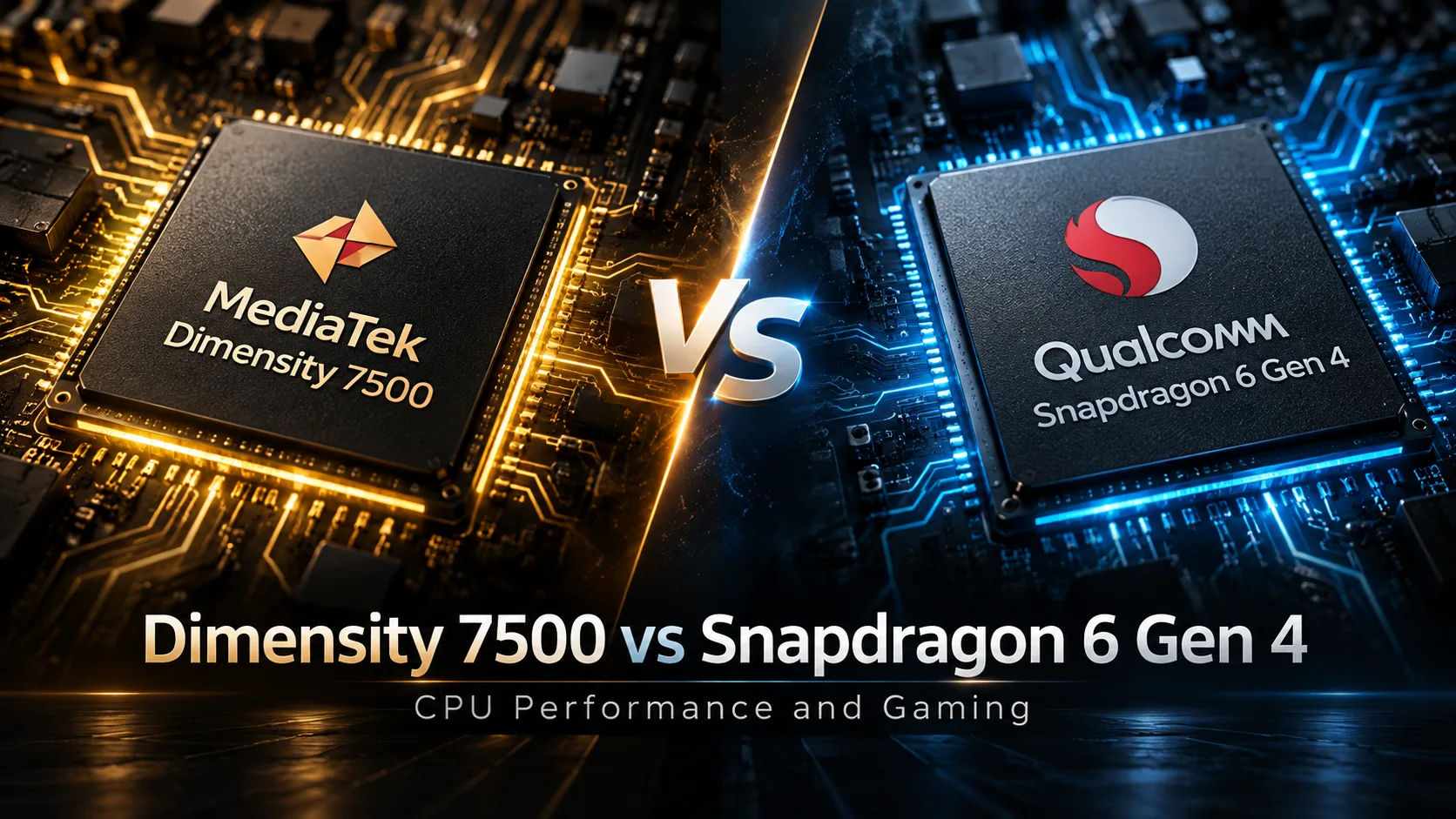
Dimensity 7500 vs Snapdragon 6 Gen 4: Which Chip Is Faster?
The MediaTek Dimensity 7500 is faster in CPU tests, while the Snapdragon 6 Gen 4 performs better in graphics. The Dimensity features new Arm C1 Pro and C1 Nano cores, whereas the Snapdragon 6 Gen 4 uses the Adreno 810 and is already found in significantly more smartphones. In Geekbench 6, the difference between the chips reaches 25%, but the picture changes in games.
Main Differences
| Specification | MediaTek Dimensity 7500 | Qualcomm Snapdragon 6 Gen 4 |
|---|---|---|
| Release year | 2026 | 2025 |
| Process technology | 4 nm | 4 nm |
| CPU | 4x Arm C1 Pro up to 2.6 GHz + 4x Arm C1 Nano up to 2.0 GHz | 1x Cortex-A720 up to 2.3 GHz + 3x Cortex-A720 up to 2.2 GHz + 4x Cortex-A520 up to 1.8 GHz |
| Instruction set | Armv9.3-A | Armv9-A |
| GPU | Mali-G625 MC2 | Adreno 810 |
| Memory | LPDDR5 | LPDDR5 / LPDDR4X |
| Storage | UFS 3.1 2-lane | UFS 3.1 |
| Maximum camera resolution | 200 MP | 200 MP |
| Video | 4K 30 FPS, 10-bit | 4K 30 FPS |
| Wi-Fi | Wi-Fi 6E | Wi-Fi 6E |
| Bluetooth | 5.4 | 5.4 |
| Maximum 5G speed | up to 5.2 Gbps | up to 2.9 Gbps |
| NPU | MediaTek NPU 850 | Qualcomm Hexagon |
The Dimensity 7500 uses four Arm C1 Pro cores and four C1 Nano cores clocked at up to 2.6 GHz.
The Snapdragon 6 Gen 4 features one Cortex-A720 core clocked at up to 2.3 GHz, three Cortex-A720 cores at up to 2.2 GHz, and four Cortex-A520 cores at up to 1.8 GHz.
Tests on Real Smartphones
There are still few smartphones with the Dimensity 7500. For example, this chip is used in the vivo S60 Vitality Edition.
The Snapdragon 6 Gen 4 is found much more often-for example, in the Realme P3 5G, Realme 14 5G, OPPO K13 5G, and other models.
| Smartphone | Processor | AnTuTu 11 | Geekbench 6 Single | Geekbench 6 Multi | Launch price |
|---|---|---|---|---|---|
| vivo S60 Vitality Edition | Dimensity 7500 | ~1,169,000 | 1243 | 3569 | ~$430 |
| Realme P3 5G | Snapdragon 6 Gen 4 | ~983,000 | 1071 | 3057 | ~$200 |
| Realme 14 5G | Snapdragon 6 Gen 4 | ~981,000 | 1107 | 3072 | ~$410 |
| OPPO K13 5G | Snapdragon 6 Gen 4 | ~904,000 | 996 | 2977 | ~$210 |
The prices apply to different markets and configurations, so they cannot be compared directly. The table shows the price segments in which these processors are already available.
In Geekbench 6, the vivo S60 Vitality Edition scores 1243 points in Single-Core and 3569 in Multi-Core. The smartphones with the Snapdragon 6 Gen 4 in this sample score 996-1107 and 2977-3072 points, respectively.
Depending on the device, the Dimensity 7500 is approximately 12-25% faster in Single-Core and 16-20% faster in Multi-Core.
In AnTuTu 11, the smartphone with the Dimensity 7500 also scores higher. However, AnTuTu takes into account not only the CPU and GPU, but also memory, storage, and system performance. Therefore, a result of 1.17 million points does not mean the same level of advantage in games.
Graphics and Gaming
The Dimensity 7500 is equipped with the Mali-G625 MC2, which has two graphics cores. The Snapdragon 6 Gen 4 uses the Adreno 810.
In the available graphics tests, the Snapdragon 6 Gen 4 is faster, but there are still too few results for the Dimensity 7500 to draw a confident conclusion.
The following settings can be used as a guide for these processors:
- PUBG Mobile - medium and high settings;
- Call of Duty Mobile - high settings;
- Mobile Legends - high settings;
- Genshin Impact - medium settings;
- Honkai: Star Rail - low or medium settings.
The availability of 90 and 120 FPS depends on the smartphone, display, cooling, and the limitations of the game itself.
In Genshin Impact and Honkai: Star Rail, you should not expect stable 60 FPS at maximum graphics settings with either of these chips.
For gaming, the Snapdragon 6 Gen 4 is currently preferable: its GPU is faster in the available tests. However, tests on other smartphones with the Dimensity 7500 are needed for an accurate assessment.
Everyday Performance
In CPU-dependent tasks, the Dimensity 7500 is faster. This is confirmed by the Geekbench 6 results, where its advantage reaches 25% in Single-Core and 20% in Multi-Core.
Both chips have dedicated blocks for machine-learning tasks. The Dimensity 7500 features the MediaTek NPU 850, while the Snapdragon 6 Gen 4 uses the Qualcomm Hexagon.
The feature set depends on the smartphone manufacturer and firmware, so there is no point in comparing the chips based solely on their NPUs.
Connectivity, Memory, and Cameras
Both processors support Wi-Fi 6E, Bluetooth 5.4, and UFS 3.1 storage.
The Dimensity 7500 supports download speeds over 5G of up to 5.2 Gbps, compared with 2.9 Gbps for the Snapdragon 6 Gen 4. Actual speeds depend on the carrier, frequency band, and coverage quality.
Both platforms support cameras of up to 200 MP and 4K video recording at 30 FPS. The Dimensity 7500 also claims support for 10-bit 4K30 video.
Which One to Choose
At the same price, the Dimensity 7500 is better for CPU performance, while the Snapdragon 6 Gen 4 is better for gaming.
The Dimensity 7500 is faster in CPU tasks. Its advantage is clearly visible in Geekbench 6, especially in the single-threaded test.
The Snapdragon 6 Gen 4 wins in the available graphics tests. The Adreno 810 is faster, and there are already significantly more smartphones with this processor.
The Snapdragon 6 Gen 4 is also found in models priced at around $200-300. The vivo S60 Vitality Edition with the Dimensity 7500 launched at approximately $430.
It is not worth paying $100 or more extra solely for the Dimensity 7500. The additional cost is justified only if the more expensive model offers a better display, cameras, memory, battery life, or other advantages.
Conclusion
In Geekbench 6, the vivo S60 Vitality Edition with the Dimensity 7500 scores 1243/3569 points and outperforms models with the Snapdragon 6 Gen 4 by 12-25% in Single-Core and 16-20% in Multi-Core.
The Snapdragon 6 Gen 4 lags behind in CPU performance but is faster in the available graphics tests. There are more smartphones with this chip, and some models cost around $200-300.
At the same price, choose the Dimensity 7500 for its faster CPU, while the Snapdragon 6 Gen 4 is the better choice if gaming is more important.
Advantages
- Newer Launch Date: May 2026 (May 2026 vs February 2025)
- Higher Frequency: 2300 MHz (Up to 2.6GHz vs 2300 MHz)
Basic
3x 2.2 GHz – Kryo Gold (Cortex-A720)
4x 1.8 GHz – Kryo Silver (Cortex-A520)
GPU Specifications
Connectivity
Memory Specifications
Miscellaneous
- AIFF
- CAF
- MP3
- MP4
- WAV
- H.265
- VP9
Benchmarks
Related SoC Comparisons



Share in social media
Or Link To Us
<a href="https://cputronic.com/index.php/soc/compare/mediatek-dimensity-7500-vs-qualcomm-snapdragon-6-gen-4" target="_blank">MediaTek Dimensity 7500 vs Qualcomm Snapdragon 6 Gen 4</a>