Qualcomm Snapdragon 7 Gen 4
vs
MediaTek Dimensity 7500

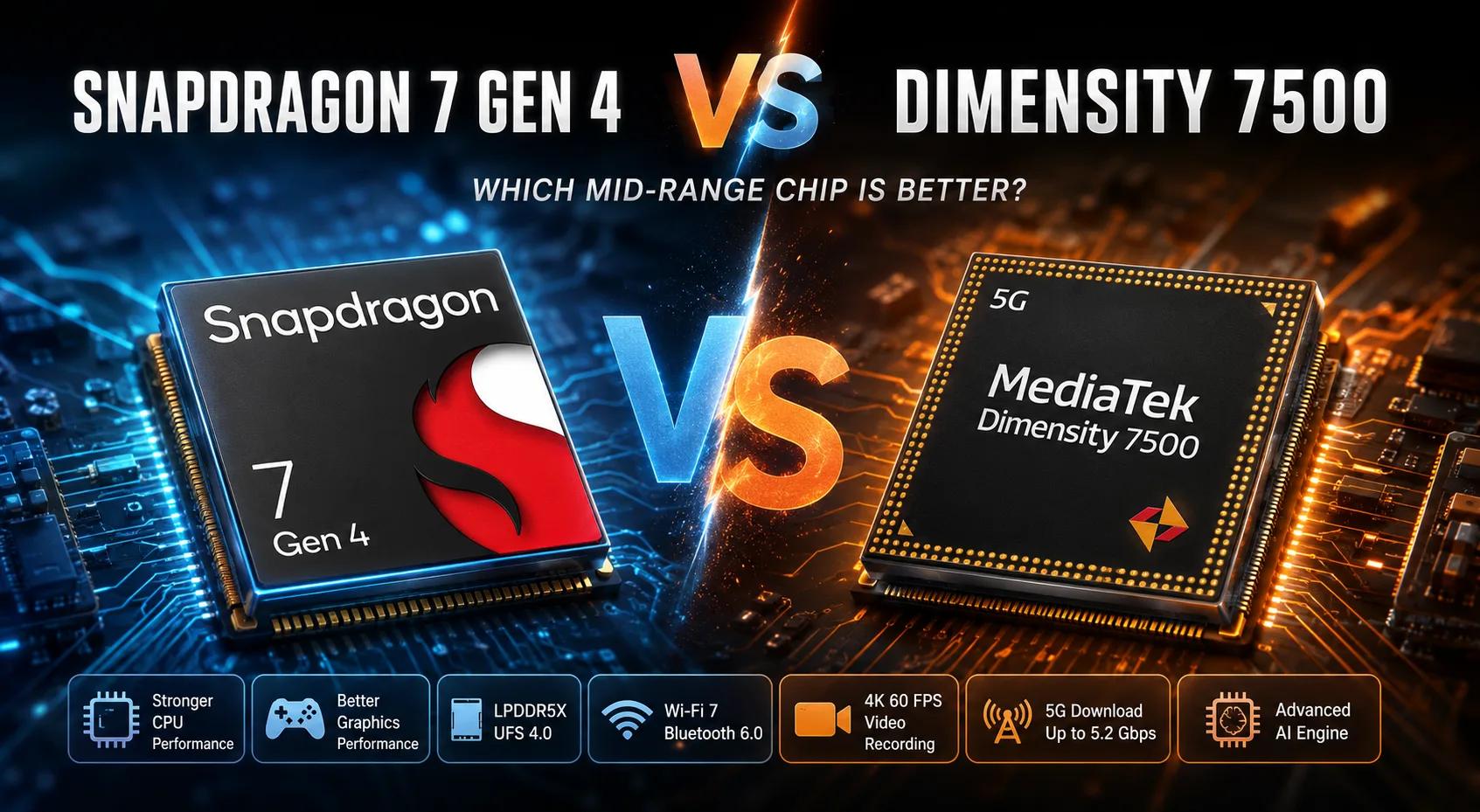
SoC Comparison Result
Snapdragon 7 Gen 4 vs Dimensity 7500: A Notable Advantage for Qualcomm in Graphics
The Dimensity 7500 is newer, but the Snapdragon 7 Gen 4 is faster. In terms of processing performance, Qualcomm has a moderate edge, but the gap in graphics performance is already noticeable. Snapdragon also supports faster memory, UFS 4.0, Wi-Fi 7, and 4K60 recording. Therefore, at similar price points, it’s difficult to justify choosing the Dimensity 7500.
Benchmarks in Smartphones
Benchmark results depend on cooling, firmware, memory, and power settings, so it's best to look at several devices.
| Smartphone | Processor | Geekbench 6 Single | Geekbench 6 Multi | AnTuTu | 3DMark Wild Life Extreme |
|---|---|---|---|---|---|
| Nothing Phone (4a) Pro | Snapdragon 7 Gen 4 | 1332 | 4189 | 1 403 850 | 2088 |
| Honor 600 | Snapdragon 7 Gen 4 | 1325 | 4066 | 1 343 336 | 1800 |
| vivo V60 | Snapdragon 7 Gen 4 | 1247 | 3539 | - | - |
| vivo S60 Vitality Edition | Dimensity 7500 | 1243 | 3569 | - | - |
| iQOO Z11* | Dimensity 7500 Turbo | 1194 | 3271 | 1 107 516 | 1161 |
- Dimensity 7500 Turbo - a customized version of Dimensity 7500 with the same core CPU and GPU characteristics. Such MediaTek versions usually differ in platform settings rather than significantly higher peak performance. Therefore, the result of the iQOO Z11 can serve as an additional reference point, but not as a direct result for the standard Dimensity 7500.
For the regular Dimensity 7500, the sample size of independent tests is currently small; thus, more results are available for Snapdragon across various smartphones.
CPU and GPU
In Geekbench 6, the Snapdragon 7 Gen 4 scores about 1325 points in single-core mode and 4080 in multi-core mode. The Dimensity 7500 typically scores around 1240 and 3570 points, respectively.
This results in an approximate 7% advantage for Qualcomm in Single-Core and around 14% in Multi-Core. In everyday tasks, the difference is minor, but in heavy workloads and multitasking, Snapdragon is faster.
The Dimensity 7500 has shown noticeable improvement compared to the Dimensity 7400. The shift to Arm C1 Pro and C1 Nano has boosted processing performance, but it still trails behind the Snapdragon 7 Gen 4.
The gap in graphics is wider. The Adreno 722 in smartphones with Snapdragon 7 Gen 4 achieves about 1800-2100 points in 3DMark Wild Life Extreme. The iQOO Z11 with Dimensity 7500 Turbo scores around 1160 points.
It’s not possible to calculate the exact percentage advantage based solely on these results: the devices are different, and cooling and power settings influence the final scores. However, the difference is too significant to attribute solely to the characteristics of specific devices.
The history of customized MediaTek MAX, Ultra, and other DORA versions shows that at identical CPU and GPU frequencies, their peak performance generally remains close to that of the base chip. Therefore, the result of the Dimensity 7500 Turbo provides a good indication of the potential graphics performance of the 7500, although it cannot replace a comprehensive test of the standard version.
For gaming, the Snapdragon 7 Gen 4 is clearly stronger. In demanding projects, the Dimensity 7500 will need to lower settings or resolution sooner.
Platform Capabilities
In terms of features, the Snapdragon 7 Gen 4 is significantly stronger. It supports faster memory and storage, newer Wi-Fi, and higher frame rate video recording.
| Feature | Snapdragon 7 Gen 4 | Dimensity 7500 |
|---|---|---|
| Memory | LPDDR5X | LPDDR5 |
| Storage | up to UFS 4.0 | UFS 3.1 |
| Wi-Fi | Wi-Fi 7 | Wi-Fi 6E |
| Bluetooth | Bluetooth 6.0 | Bluetooth 5.4 |
| Video Recording | up to 4K 60 FPS | up to 4K 30 FPS |
| 5G, Download | up to 4.2 Gbps | up to 5.2 Gbps |
These are the maximum capabilities of the platforms. A specific smartphone might use slower memory or storage, and some SoC features may not be implemented by the manufacturer.
The Dimensity 7500 has an advantage in claimed 5G speed-up to 5.2 Gbps compared to 4.2 Gbps for Snapdragon. In practice, this parameter rarely becomes a deciding factor when choosing a smartphone.
Both chips feature modern NPUs for local AI functions. Comparing claimed improvements in AI performance directly is not possible since Qualcomm and MediaTek use different methodologies and baseline chips for comparison.
Smartphone Prices
The Dimensity 7500 is indeed found in cheaper smartphones, but the difference is not significant enough to automatically consider it a better value.
The iQOO Z11 with Dimensity 7500 Turbo starts at around $370. The 8/256 GB version is priced at about $470. The vivo S60 Vitality Edition with the standard Dimensity 7500 started at approximately $430.
In comparison, the vivo V60 on Snapdragon 7 Gen 4 starts at around $440, while the Nothing Phone (4a) Pro in the 8/256 GB version is priced at about $510.
Prices apply to different markets, so caution is needed when making direct comparisons. Taxes, local discounts, and configurations can vary significantly. However, the overall range is visible: MediaTek can offer savings, but they are not always substantial.
If a smartphone with Dimensity 7500 costs only $30-50 less than a comparable model with Snapdragon 7 Gen 4, such savings do little to offset the significantly lower graphics performance. A difference of around $80-100 makes the MediaTek option appear more logical, especially if gaming is not a priority.
What to Choose
If the smartphones are priced similarly, the Snapdragon 7 Gen 4 is preferable. It is faster on the CPU, much stronger in graphics, and supports more modern memory, storage, and wireless interfaces.
The Dimensity 7500 should be considered if it is significantly cheaper or if the smartphone itself offers better specifications: a better screen, cameras, battery, or other important features.
The Dimensity 7500 cannot be deemed weak. It is a significant step forward compared to the Dimensity 7400, especially in CPU performance. The issue lies in the fact that it offers too few advantages against the Snapdragon 7 Gen 4.
When prices are close, the Snapdragon 7 Gen 4 should be chosen without much hesitation. The Dimensity 7500 becomes a rational choice only when the smartphone featuring it is noticeably cheaper or excels in other specifications.
Advantages
- Higher Frequency: 2800 MHz (2800 MHz vs Up to 2.6GHz)
- Newer Launch Date: May 2026 (May 2025 vs May 2026)
Basic
GPU Specifications
Connectivity
Memory Specifications
Miscellaneous
Benchmarks
Related SoC Comparisons




Share in social media
Or Link To Us
<a href="https://cputronic.com/index.php/soc/compare/qualcomm-snapdragon-7-gen-4-vs-mediatek-dimensity-7500" target="_blank">Qualcomm Snapdragon 7 Gen 4 vs MediaTek Dimensity 7500</a>