MediaTek Dimensity 7400
vs
Qualcomm Snapdragon 8 Gen 5

SoC Comparison Result
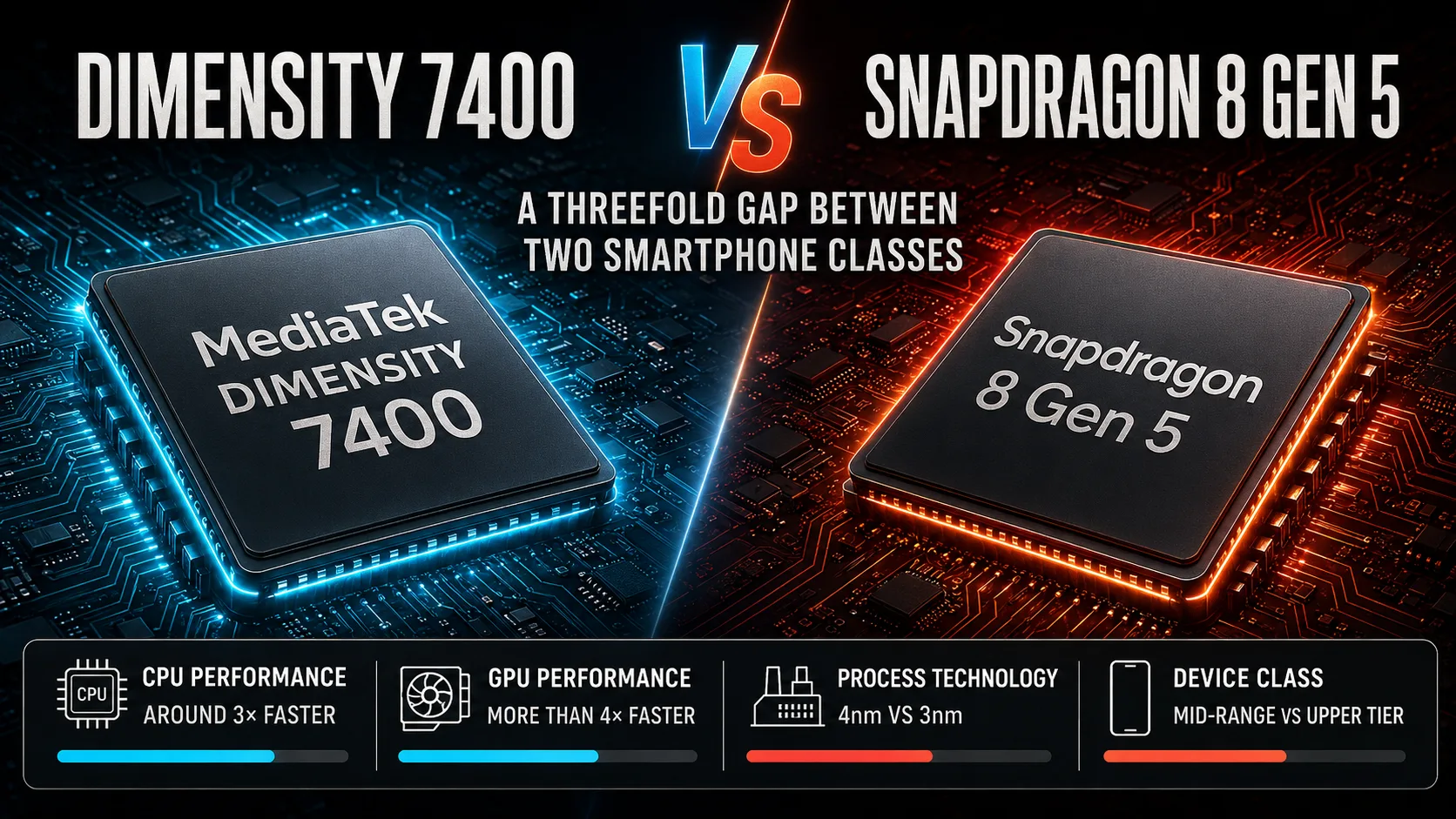
MediaTek Dimensity 7400 vs Snapdragon 8 Gen 5: A Gap Three Times Wider That Can't Be Hidden by Optimization
MediaTek Dimensity 7400 is aimed at mass-market mid-range smartphones, while Qualcomm Snapdragon 8 Gen 5 targets significantly more expensive sub-flagship models. They are not alternatives within the same price segment. This comparison shows what benefits come from upgrading to a higher mobile platform and what features require additional payments.
Key Differences
| Parameter | MediaTek Dimensity 7400 | Qualcomm Snapdragon 8 Gen 5 |
|---|---|---|
| Device Class | Mid-range | Sub-flagship and affordable flagship smartphones |
| Process Technology | 4 nm | 3 nm |
| CPU Configuration | 4 × Cortex-A78, 4 × Cortex-A55 | 2 × Oryon Prime, 6 × Oryon Performance |
| Max Frequency | 2.6 GHz | 3.8 GHz |
| Graphics | Mali-G615 MC2 | Adreno with modular architecture |
| Memory and Storage | Up to LPDDR5 and UFS 3.1 | LPDDR5X and UFS 4.1 |
| Cameras and Video | Up to 200 MP, 4K at 30 fps | Triple 20-bit ISP, up to 4K at 120 fps |
| Wireless Connectivity | Wi-Fi 6E, Bluetooth 5.4 | Wi-Fi 7, Bluetooth 6.0, UWB |
| Max 5G Speed | 3.27 Gbps | 10 Gbps |
| AI Block | MediaTek NPU 655 | Hexagon NPU and matrix accelerators in CPU |
The table shows the technical ceiling of the platforms, not necessarily the hardware included in every smartphone. Manufacturers can install slower storage, omit Wi-Fi 7, or limit camera modes. However, Snapdragon's capabilities are initially much broader.
Cortex-A78 vs Oryon
The Dimensity 7400 features four Cortex-A78 and four Cortex-A55 cores. This CPU handles Android, browsing, social media, and photo processing adequately, but its performance cores belong to the older generation of Arm architecture. In terms of configuration, the chip almost mirrors the Dimensity 7300: the max frequency of Cortex-A78 has only increased from 2.5 GHz to 2.6 GHz, while the architecture remains the same.
Snapdragon 8 Gen 5 employs eight proprietary Qualcomm Oryon cores. The two Prime cores run at frequencies of up to 3.8 GHz, while the six performance cores reach up to 3.32 GHz. There is no separate energy-efficient Cortex-A5xx cluster here.
Eight fast cores ensure high peak multithreaded performance, but maintaining it depends on the cooling and power limitations of the smartphone. The difference between the platforms will be particularly noticeable in video processing, archive unpacking, app installations, and prolonged multitasking.
Smartphone Benchmark Results
The table provides estimated results from specific devices. Firmware, temperature, RAM size, and performance mode influence the final scores, thus accuracy to one unit is conditional. All AnTuTu results pertain to version 11.
| Smartphone | Processor | AnTuTu 11 | Geekbench 6, Single Core | Geekbench 6, All Cores |
|---|---|---|---|---|
| realme Narzo 80 Pro 5G | Dimensity 7400 | 985,745 | 1,037 | 2,923 |
| realme P4 5G | Dimensity 7400 Ultra | 958,940 | 997 | 2,955 |
| OnePlus 15R | Snapdragon 8 Gen 5 | 3,082,388 | 2,847 | 9,422 |
| vivo S50 Pro mini | Snapdragon 8 Gen 5 | 2,902,731 | 3,029 | 9,401 |
| realme Neo 8 | Snapdragon 8 Gen 5 | 3,222,272 | 2,792 | 9,400 |
realme uses the designation Dimensity 7400 Ultra; however, the posted CPU and GPU configurations match those of the standard Dimensity 7400. MediaTek does not identify Ultra as a standalone mobile platform.
In this selection, Snapdragon is approximately 2.8 times faster in single-core Geekbench 6 and about 3.2 times faster in multithreaded performance. The average AnTuTu score is also higher by about 3.2 times. This is not merely a difference between adjacent classes: Snapdragon handles heavy applications, games, and prolonged multitasking significantly better.
In Games, the Gap is Even Wider
Mali-G615 MC2 is suitable for online games and less demanding projects. In heavy games, it is necessary to lower graphics quality and resolution, and stable frame rates even in such a mode depend on the smartphone's cooling.
The results collected from various open sources illustrate the approximate magnitude of the gap rather than the result of direct laboratory device comparison.
| Smartphone | Processor | 3DMark Steel Nomad Light | Average Frame Rate |
|---|---|---|---|
| realme Narzo 80 Pro 5G | Dimensity 7400 | 403 | around 3 FPS |
| Infinix GT 30 | Dimensity 7400 | 430 | around 3 FPS |
| OnePlus 15R | Snapdragon 8 Gen 5 | 1,832 | 13.58 FPS |
Snapdragon outperforms the best Dimensity result by approximately 4.3 times. The Adreno graphics allow for higher settings, utilizing complex effects, and maintaining acceptable performance longer in new games.
High peak speed does not negate heating. In a separate 3DMark Wild Life Extreme Stress Test, the OnePlus 15R retained 62.3% of its initial performance. This result cannot be directly compared with the Steel Nomad Light scores in the table, but it shows a noticeable drop in Snapdragon's frequencies under prolonged graphical load.
Cameras and Artificial Intelligence
The Dimensity 7400 supports cameras up to 200 MP, Google Ultra HDR, and 4K recording at 30 fps. The NPU 655 accelerates noise reduction, scene recognition, and other computational photography features. For the mid-range, these capabilities are adequate, but the sensor's resolution alone does not determine the quality of the photos.
Snapdragon is equipped with a triple 20-bit ISP and broader capabilities for HDR video, multi-frame processing, and high frame rate shooting. The Hexagon NPU is designed for heavier local models, while the Oryon cores support matrix acceleration.
The actual feature set depends on the manufacturer. A powerful ISP or NPU does not guarantee a quality camera and advanced AI tools if the company has not implemented them in the firmware.
Battery Life and Heating
Choosing Dimensity 7400 solely for its assumed battery life is not advisable. Snapdragon completes short tasks faster, but its power consumption and heating increase significantly under prolonged gaming load.
Overall battery life is determined by the battery, display, modem, firmware, and the power limitations of specific smartphones. The 3 nm and 4 nm process technologies alone do not allow for declaring a winner in battery life.
What to Choose
Smartphones powered by Dimensity 7400 and Snapdragon 8 Gen 5 rarely intersect in price. The former targets the mid-range market, while the latter is aimed at significantly more expensive models. Thus, the comparison reveals what benefits come from upgrading to a higher platform and whether it is worth the additional cost.
For browsing, messaging, navigation, video, and less demanding games, the capabilities of Dimensity 7400 are sufficient. When choosing such a smartphone, the display, camera, battery, case protection, and update longevity are more important.
Snapdragon 8 Gen 5 is needed for heavy games, emulators, video processing, local AI, and prolonged loads. The additional cost is not just for a slightly faster interface; it's for a different level of CPU, graphics, camera capabilities, and connectivity.
Dimensity 7400 does not replace Snapdragon 8 Gen 5 for less money. It is a platform for another class of smartphones and less demanding scenarios.
Advantages
- Higher Technology: 3 nm (4 nm vs 3 nm)
- Higher Frequency: 3800 MHz (2600 MHz vs 3800 MHz)
- Newer Launch Date: November 2025 (February 2025 vs November 2025)
Basic
GPU Specifications
Connectivity
Memory Specifications
Miscellaneous
Benchmarks
Comparison of Devices
Related SoC Comparisons



Share in social media
Or Link To Us
<a href="https://cputronic.com/index.php/soc/compare/mediatek-dimensity-7400-vs-qualcomm-snapdragon-8-gen-5" target="_blank">MediaTek Dimensity 7400 vs Qualcomm Snapdragon 8 Gen 5</a>